Danish Wedding Glossary: Terms from A to Z
Reviewed by Ludmila Bernowski, CEO & Co-Founder of Denmark Wedding Services. Last reviewed: November 2026. Practical, experience-based information, not legal advice — for legal questions, consult a qualified lawyer. Our Google Business Profile and reviews
Short answer: This glossary explains the Danish words couples meet when they marry in Denmark: in letters from the Danish Agency of Family Law (Familieretshuset), on booking receipts and on the certificate. The two most important are easy to mix up. The *prøvelsesattest* is the approval issued before the wedding and is valid for 4 months; the *vielsesattest* is the marriage certificate you receive after the ceremony. Every entry links to the full guide.
On this page
Who this guide is for: Couples from abroad who are preparing a civil wedding in Denmark and keep seeing Danish words they cannot place, and anyone who wants a quick, sourced definition before reading the detailed guide on that topic.
Key points
- Each definition is one to three sentences; the link after it leads to the guide that covers the topic in full.
- The legal terms come from the Danish Marriage Act (*ægteskabsloven*), consolidated as LBK no. 663 of 1 July 2026. Section numbers are given where they help.
- *Prøvelsesattest* (before the wedding) and *vielsesattest* (after the wedding) are two different documents.
- At least two witnesses (*vidner*) must attend every Danish wedding; the old role of the *forlover* was abolished in 1969.
- Without a keyboard for æ, ø and å, write ae, oe and aa.
- You do not need to learn Danish to marry in Denmark: our team reads the letters and answers your questions in English, German, Russian, Spanish and French.
What do the words for the authorities and the application mean?
- 11 b-erklæring (section 11 b declaration): a declaration both partners sign to confirm they know the Danish family-reunification rules. It is needed when only one partner is a Danish or Nordic citizen or holds certain Danish residence permits, and not when the partner living in Denmark is an EU/EEA citizen with a right of residence (Marriage Act § 11 b). More in family reunification after a Danish wedding.
- Borgerservice: the citizen service of a municipality. The City of Copenhagen, for example, lists its marriage and wedding pages under Borgerservice.
- CPR-nummer: the Danish personal identification number. Couples from abroad usually have none and do not need one to apply; Life in Denmark says a fee paid by bank transfer is matched to the application by CPR number or by name and passport or ID number. In Copenhagen, partners with a Danish or Nordic CPR number need no ID at the ceremony, and everyone else follows the booking receipt (Copenhagen City Hall).
- EES (Entry/Exit System): the EU's digital border register, in Danish *ind- og udrejsesystemet*. Since 10 April 2026 passports are no longer stamped, so Familieretshuset asks non-EU partners on a short stay for printouts of the EU tool "Check how long you can stay". How to make them: EES printout for the application.
- Familieretshuset: the Danish Agency of Family Law. It checks the marriage conditions when at least one partner is neither a Danish or Nordic citizen nor holds a permanent right of residence in Denmark (Marriage Act § 13(3)); other couples apply to their municipality. Everything about the agency: Familieretshuset explained.
- Familiesammenføring: family reunification, the right of a foreign spouse to live in a country with their partner. It is a separate application under the rules of the country where you want to live and never follows automatically from the wedding (family reunification after a Danish wedding).
- Lovligt ophold: lawful stay. A partner without Danish citizenship must be lawfully in Denmark, for example visa-free, on a visa or with a residence permit, to marry there (Marriage Act § 11 a). Life in Denmark states that procedural residence (*processuelt ophold*) during a pending immigration case is not lawful residence in this sense. See visa requirements and residence permits.
- MitID: the Danish digital ID. Couples who do not have it can still apply to Familieretshuset online by creating a profile with their e-mail address (applying without MitID).
- Nyidanmark.dk: the website of the Danish Immigration Service and the Danish Agency for International Recruitment and Integration (SIRI), with the rules and forms for visas, residence permits and family reunification.
- Proformaægteskab: a sham marriage entered mainly to obtain a right of residence in Denmark, the EU/EEA or Switzerland. The Marriage Act forbids it (§ 8 a), which is why the authority may ask about your relationship (proof of relationship).
- Prøvelse af ægteskabsbetingelserne: the check of the marriage conditions, carried out by the municipality or by Familieretshuset before any wedding can take place (Marriage Act §§ 12 and 13).
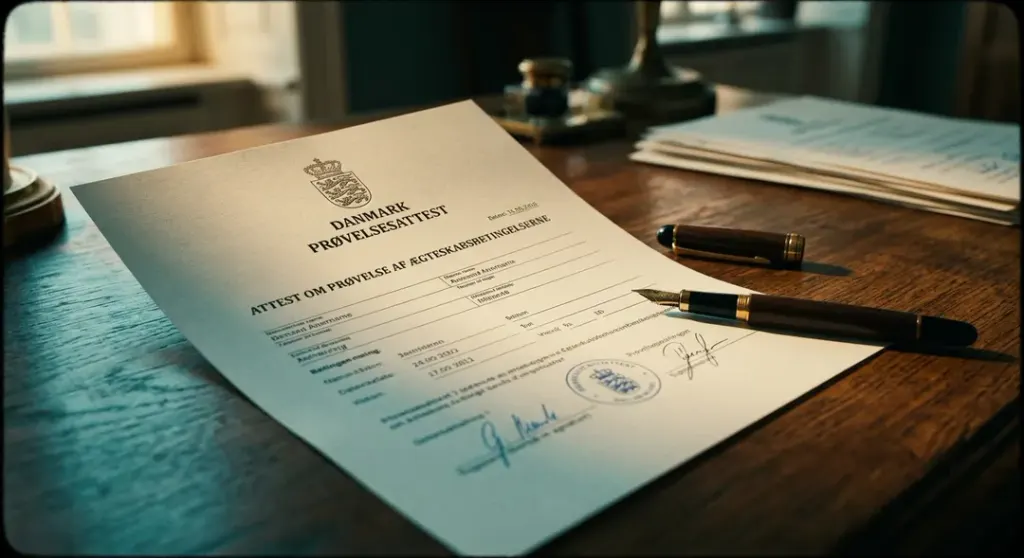
- Prøvelsesattest: the Certificate of Marital Status, the approval that you may marry each other in Denmark. It is valid for 4 months; the validity is shortened if the lawful stay of a partner ends earlier (Marriage Act § 19). The town hall needs it before the wedding. Details: Familieretshuset explained; if you hold one without a date yet: approved, but no wedding date.
- Udlændingestyrelsen: the Danish Immigration Service, which processes applications for family reunification of a spouse in Denmark under the Danish rules.
- Ægteskabsbetingelser: the conditions for marriage. Among them: both partners are at least 18 (§ 2), they are not closely related (§ 6), neither is still married (§ 9), and each has Danish citizenship or a lawful stay (§ 11 a). Overview: marrying in Denmark as an international couple.
- Ægteskabserklæring: the notice of marriage that couples who apply to their municipality (Danish or Nordic citizens and permanent residents) submit online. Both partners complete it before the municipality receives it (step-by-step guide).
- Ægteskabsloven: the Danish Marriage Act, *lov om ægteskabs indgåelse og opløsning*. The current consolidated text is LBK no. 663 of 1 July 2026.
What do the words for the ceremony mean?
- Borgerlig vielse: a civil wedding, performed by the mayor or a person the mayor authorises (Marriage Act § 18). It is open to everyone; according to Lex, the Danish encyclopaedia, civil weddings were introduced in 1851 and became a free choice with the marriage laws of 1922. What happens on the day: the Danish civil ceremony.
- Brudepar: the bridal couple.
- Bryllup: the wedding as a celebration. Lex traces the word to Old Norse *brúðhlaup*, the procession that escorted the couple to and from the church.
- Forlover: historically a person who had to confirm that the couple were not too closely related. Lex states that the requirement was abolished in 1969, so the role no longer exists in law. In everyday Danish the word is often used loosely for the best man.
- Kirkelig vielse: a church wedding. Within the Church of Denmark (*folkekirken*) it is possible when one partner is a member, and within a recognised faith community when one partner belongs to it (Marriage Act § 16). Borger.dk says you contact the priest of the church and bring the approval. More in church and religious weddings in Denmark.
- Kommune: the municipality. Denmark has 98 municipalities (KL, Local Government Denmark); each performs civil weddings at the places it designates and sets its own dates. To switch to another town after approval: changing the kommune.
- Rådhus: the town hall or city hall. Borger.dk says the wedding usually takes place there, but the mayor can allow another place, such as a forest or a park (town halls in Denmark, special wedding places).
- Tolk: an interpreter. The Marriage Act allows rules on paying for an interpreter at the ceremony (§ 20(4)); when you need one and who arranges it: interpreter at a Danish wedding.
- Vidne / vidner: witness / witnesses. Every wedding takes place in the presence of at least two witnesses (Marriage Act § 20), and borger.dk says the municipality must provide them if you do not bring your own. Copenhagen always provides two official witnesses (witnesses at a Danish wedding).
- Vielse: the wedding ceremony as a legal act, in which both partners declare that they want to marry each other and are then pronounced married (Marriage Act § 20(2)).
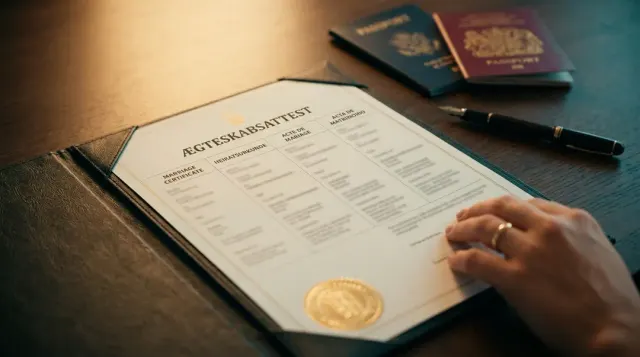
- Vielsesattest: the marriage certificate. Borger.dk says you receive it straight after the wedding; Copenhagen hands couples two multilingual certificates in Danish, English, German, French and Spanish. Also called *ægteskabsattest*. Everything about it: the Danish marriage certificate.
- Vielsesmyndighed: the marriage authority, the person or office that conducts the wedding. For a civil wedding this is the mayor of the municipality or a person the mayor authorises (Marriage Act § 18).
What do the words for documents and legalisation mean?
- Apostille / legalisering: an apostille is the certificate under the Hague Apostille Convention that confirms a public document is authentic; countries outside the Convention use legalisation instead. There are two separate cases: the apostille some partners need on their own home-country documents before applying (apostille and legalisation by country), and the apostille on the finished Danish certificate for use abroad (apostille on the Danish marriage certificate).
- Autoriseret translatør: an authorised translator. Documents in Danish, English or German need no translation; other foreign documents are translated by an authorised translator, including the apostille (translating documents).
- Civilstandsattest: a certificate of civil or marital status, a different document from the Danish prøvelsesattest. It is not required for every application, but Familieretshuset can ask for proof of marital status in individual cases, and the City of Copenhagen may ask residents who recently lived abroad for one (civil status certificate).
- Dødsattest: a death certificate, which widowed partners use to show that the previous marriage has ended (widowed and marrying again).
- Fuldmagt: a power of attorney. Familieretshuset publishes an official English template; with it, a representative such as DWS can handle the application for you (declaration of truth and power of attorney).
- Navneændring: a change of name. Your name does not change through the ceremony; couples who are not registered as living in Denmark arrange a married name in their home country afterwards (name change after the wedding).
- Skilsmisse / separation: divorce / legal separation. A partner who was married before shows the final divorce decree, because nobody may marry while a previous marriage still exists (Marriage Act § 9) (divorced and marrying again).
- Tro og love: Danish forms use the phrase *på tro og love*, "on my honour", for declarations given under penalty of law. Familieretshuset's English template for this is called "Truth declaration" and refers to section 163 of the Danish Criminal Code (declaration of truth).
The full list of documents is in documents for a Danish wedding.
Which Danish terms are often confused?
| Often confused | The difference |
|---|---|
| Prøvelsesattest vs vielsesattest | The prøvelsesattest is the approval before the wedding; the vielsesattest is the marriage certificate after it. |
| Vidne vs forlover | Vidner are the legal witnesses today. The forlover was an older role that Denmark abolished in 1969 (Lex). |
| Borgerlig vs kirkelig vielse | A civil wedding is open to everyone (§ 18); a church wedding depends on membership of the church or faith community (§ 16). |
| Apostille on your own documents vs on the Danish certificate | The first is needed on some home-country documents before you apply; the second on the Danish certificate when you use it outside the EU. |
| Familieretshuset vs kommune | Familieretshuset checks the conditions for most international couples; the kommune performs the wedding and gives you the date. |
How do I read and type æ, ø and å?
- æ is written ae, ø is written oe and å is written aa: *prøvelsesattest* becomes *proevelsesattest*, *ægteskab* becomes *aegteskab*, *Rådhus* becomes *Raadhus*.
- Some place names keep the old spelling with "aa", for example Aabenraa.
- German names for border towns: Tønder = Tondern, Aabenraa = Apenrade, Sønderborg = Sonderburg.
- Other examples: Helsingør = Helsingoer, Ærø = Aeroe (wedding on Ærø).
Looking for customs rather than terms? See Danish wedding traditions.
How DWS helps
- Comfort Package, €799.00: the official 2,100 DKK fee (2026) is included in our package. We check your documents, submit the application to Familieretshuset, book your ceremony date and make sure two witnesses are there, in Copenhagen, Tønder, Aabenraa or any other Danish municipality.
- No Danish needed: if a letter from Familieretshuset or the town hall arrives in Danish, we read it and explain what it means in English, German, Russian, Spanish or French.
- Apostille Service, €100 (optional): for the apostille on the finished Danish certificate when you need it outside the EU.
- German ⇄ Russian translations, €50 per document: done by our co-founder, a sworn translator for Russian and German. Other languages need an authorised translator.
Approval and ceremony are two separate clocks. Familieretshuset aims for about 5 working days once an application is complete; that is a target, not a guarantee. Where it has asked for more information, it is currently working on applications received in October 2026.
The video on this page shows how our process works. For the whole route at a glance, see our process, the FAQ and the free wedding checklist.
Frequently asked questions about Danish wedding terms
What is the difference between prøvelsesattest and vielsesattest?
The prøvelsesattest is the approval issued before the wedding that you may marry each other in Denmark; it is valid for 4 months. The vielsesattest is the marriage certificate you receive straight after the ceremony.
What does borgerlig vielse mean?
A civil wedding, performed by the mayor or a person the mayor authorises, usually at the town hall. Under the Danish Marriage Act it is open to everyone.
Is the forlover the same as a witness?
No. The forlover was an older role that Denmark abolished in 1969, according to Lex. Today at least two witnesses (vidner) must attend every wedding.
What does lovligt ophold mean for our wedding?
Lawful stay: a partner without Danish citizenship must be lawfully in Denmark to marry there, for example visa-free, on a visa or with a residence permit. A procedural stay during a pending immigration case does not count.
Do we need MitID to apply?
No. Couples without MitID can apply to Familieretshuset online by creating a profile with their e-mail address.
How do I type æ, ø and å?
Write ae for æ, oe for ø and aa for å, for example proevelsesattest for prøvelsesattest.
Sources
- Retsinformation – Danish Marriage Act (ægteskabsloven), LBK no. 663 of 1 July 2026, §§ 2, 6, 8 a, 9, 11 a, 11 b, 12–13, 15–20 (in Danish) – read 23 November 2026
- borger.dk – Når I vil giftes (in Danish) – read 23 November 2026
- Life in Denmark – If you wish to get married in Denmark – read 23 November 2026
- Familieretshuset – Processing time for certificates of marital status – read 23 November 2026
- Familieretshuset – Apply for a Certificate of Marital Status – read 23 November 2026
- Familieretshuset – Documentation of legal stay in Schengen for non-EU citizens – read 23 November 2026
- Familieretshuset – Truth declaration (official template, PDF) – read 23 November 2026
- Familieretshuset – Power of Attorney (official template, PDF) – read 23 November 2026
- City of Copenhagen – City Hall wedding – read 23 November 2026
- City of Copenhagen – Getting married in the City of Copenhagen – read 23 November 2026
- Lex – borgerlig vielse (in Danish) – read 23 November 2026
- Lex – forlover (in Danish) – read 23 November 2026
- Lex – bryllup (in Danish) – read 23 November 2026
- KL – Local Government Denmark – read 23 November 2026
- HCCH – Apostille Section – read 23 November 2026
- New to Denmark – Family reunification – read 23 November 2026
- New to Denmark – Spouse or cohabiting partner – read 23 November 2026
Written by Ludmila Bernowski, co-founder of Denmark Wedding Services; reviewed by Shenol Reetz, co-founder. Denmark Wedding Services is not a law firm; this glossary is general information, not legal advice. Last checked: 23 November 2026.
Watch Our Video
Follow us on YouTube, Instagram & TikTok for more wedding tips
Ready to Start Your Danish Wedding?
Fill out our free checklist in about 2 minutes — we'll send you a personalized document list and guide you through every step.
Start Free Checklist →