Divorced and Marrying Again in Denmark: Divorce Papers, Finality Proof and Foreign Divorces
Reviewed by Ludmila Bernowski, CEO & Co-Founder of Denmark Wedding Services. Last reviewed: November 2026. Practical, experience-based information, not legal advice — for legal questions, consult a qualified lawyer. Our Google Business Profile and reviews
Short answer: Yes, you can marry again in Denmark after a divorce. The earlier marriage must be legally dissolved, and you prove it with the divorce decree and its finality endorsement, plus an apostille and a translation where needed. The Danish marriage conditions set no waiting period after a divorce. If you live in Germany and were divorced outside the EU, check first whether Germany has to recognise the divorce under § 107 FamFG.
On this page
- What does Denmark ask for if one of you is divorced?
- What is the finality stamp, and why does it matter so much?
- Which proof counts in which country?
- Do divorce documents need an apostille or a translation?
- Which divorces does Denmark not recognise?
- You were divorced in Denmark: what do you need?
- Is there a waiting period after a divorce?
- You are separated but not yet divorced: can you marry?
- Must the property of the first marriage be divided first?
- What if your name still comes from the earlier marriage?
- Living in Germany with a divorce from outside the EU: what we point out
- How does Denmark Wedding Services help?
- Frequently asked questions
Who this guide is for: Couples where one or both partners were married before: people divorced in Germany, Austria, Switzerland, the UK or the US, partners whose divorce was granted in Russia, Ukraine or Türkiye, and anyone who lives in Germany but was divorced outside the EU.
Key points
- Both partners must be unmarried. A separation, even a legal separation, does not end a marriage; while you are only separated you cannot marry again.
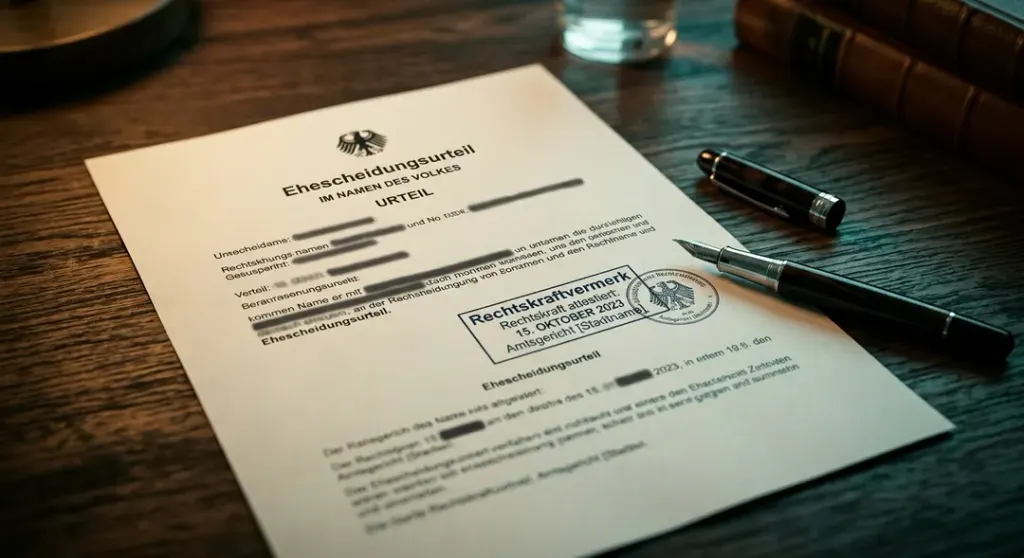
- The proof is the divorce document with an endorsement showing that it is final, for example the Rechtskraftvermerk on a German divorce decision or the Final Order from England and Wales.
- An affidavit is not accepted as proof, and neither is a civil status certificate that says "divorced" on its own.
- Private divorces made without any authority or court are not recognised in Denmark.
- If you were divorced in Denmark and the divorce is registered in the Danish CPR register, you need no divorce document.
- After a divorce you do not have to divide the property of the earlier marriage before you marry again.
- Germany generally recognises divorces from outside the EU only after a procedure under § 107 FamFG; until then it still treats the earlier marriage as existing.
These are the questions we hear most from divorced partners: is our divorce decree enough, does it need a stamp, and is there a waiting period? This guide answers them from the official Danish rules as of November 2026. For the full document list for every couple, see our guide to documents for a Danish wedding.
What does Denmark ask for if one of you is divorced?
The Danish Agency of Family Law (Familieretshuset) checks that both partners are unmarried. If one of you was married before, that marriage must have been legally dissolved, and you show it with a judicial or administrative divorce decree, a death certificate or an annulment. You submit the documents in their original language and, if they are not in Danish, English or German, with a translation.
For a divorce granted outside the Nordic countries, the official Danish guidance on marriage cases (Vejledning om behandling af ægteskabssager, point 2.5.2.3.1) names three parts:
- a copy of the divorce document,
- the finality endorsement (in Danish: retskraftpåtegning),
- a translation of the document with all its endorsements, where a translation is needed.
What is the finality stamp, and why does it matter so much?
The finality endorsement confirms that a decision is final: it can no longer be appealed, or the time to appeal has passed. Without it, Familieretshuset cannot see whether the earlier marriage has really ended. A divorce decree without this endorsement is one of the most common gaps we find when we check documents; more typical problems are in our guide to Danish marriage application mistakes.
In Germany, the court office (Geschäftsstelle) of the German divorce court (Familiengericht) issues the certificate of finality (Rechtskraftzeugnis, § 46 FamFG). In divorce cases the parties receive it automatically, without asking; it is placed on a copy of the decision without the reasons. If yours is missing, ask the court that granted the divorce. German courts have decided divorces by "Beschluss" since 2009, so older divorces are often still called "Scheidungsurteil". Either way, what counts is the note that the decision is final.
Which proof counts in which country?
The names differ, but the principle is the same everywhere: Denmark needs the divorce decision and proof that it is final.
- Germany: the Scheidungsbeschluss with the Rechtskraftvermerk of the Familiengericht. It is in German, so it needs no translation, and it needs no apostille.
- Austria and Switzerland: the court's divorce decision with the court's confirmation that it is final. Documents in German need no translation.
- England and Wales: the Final Order or, if the court issued your divorce application before 6 April 2022, the Decree Absolute. According to GOV.UK, only with it are you divorced and free to marry again; keep it safe, because you need to show it if you remarry. Scotland and Northern Ireland have their own courts and documents; there, the final divorce document from that court counts. For British couples, see also Denmark or the UK after Brexit.
- United States: a certified copy of the court's final divorce decree (often called a final judgment or decree of dissolution of marriage). If it does not show that it is final, ask the court clerk for a confirmation. An affidavit does not replace the decree.
- Russia, Ukraine and Belarus: after a court divorce, the court decision with the note that it has entered into force («решение вступило в законную силу»); after a divorce registered at the civil registry (ZAGS), the divorce certificate («свидетельство о расторжении брака»). If you have both, submit both. Familieretshuset decides what it needs in each case; we check what you have before you apply.
- Türkiye: the divorce judgment with its finality note (kesinleşme şerhi), with a translation if it is in Turkish. More in our guide to marrying a Turkish partner in Denmark.
In some countries a civil status certificate forms part of the finality proof. Even then, the divorce decision itself still has to be submitted.
Do divorce documents need an apostille or a translation?
That depends on the country that issued the document, not on your citizenship. Documents from Germany, Austria, Switzerland, Great Britain and most other European countries typically need neither an apostille nor legalisation, and the same goes for documents from the US, Canada, Australia, New Zealand and Türkiye. Familieretshuset names the European exceptions, among them Russia, Ukraine, Belarus, Georgia, Kazakhstan and Bosnia and Herzegovina: their documents need an apostille. Documents from countries outside these groups need an apostille if the country is a party to the Hague Apostille Convention, and legalisation in the issuing country if it is not.
If a document is not in Danish, English or German, an authorised translator must translate it into Danish, English or German, including the apostille and every stamp. The translation should be ready before you apply. Which rule applies to which country is in our overview of apostille and legalisation by country.
Which divorces does Denmark not recognise?
A foreign divorce must be one that Denmark can recognise under its own rules. The official guidance (point 2.5.2.3.2) says:
- Private divorces made without any authority or court are not recognised.
- Divorces that conflict with basic Danish legal principles (ordre public) are not recognised. One example is a divorce the other spouse did not know about: the divorce papers must have been served on them, or they must have learned of the case in another way.
- Divorces with no link to the country that granted them: a divorce from a state that has joined the 1970 Hague Convention on the Recognition of Divorces (among them the UK, Switzerland, Italy, the Netherlands, Poland and Australia) is in principle recognised if one of the links the convention names applied, such as one spouse living there. In other cases, the authority that granted the divorce must have had jurisdiction similar to the Danish rules: as a rule, one spouse lived in that country, or both were its citizens. A divorce obtained on holiday in a country where neither spouse lived and of which neither was a citizen is therefore not recognised.
Not every piece of paper counts as proof either. An affidavit, a one-sided statement often made before a notary, is not accepted as proof that someone is single, divorced or widowed. A civil status certificate that says "divorced" is not enough on its own; the divorce decision with its endorsements still has to be submitted. If part of the proof is missing, tell us before you apply, and we will work out with you what Familieretshuset needs in your case.
You were divorced in Denmark: what do you need?
If the Danish CPR register shows that your marriage ended in a Danish divorce, you do not need to submit a divorce document. If the court judgment is not yet registered in CPR, you submit a copy on which the court has noted that no appeal was lodged. For divorces granted in Finland, Iceland, Norway or Sweden, a copy of the judgment with a statement that it is final is enough, and for an Icelandic or Norwegian divorce granted by an authority, a copy of that decision.
Is there a waiting period after a divorce?
The Danish marriage conditions contain no waiting period after a divorce. Once the divorce is final and you can prove it, Familieretshuset can process your application. Some home countries have their own rules, such as waiting periods, and these can matter if the marriage is later to be recognised or registered there. If in doubt, ask your home country's embassy or consulate.
You are separated but not yet divorced: can you marry?
No. A separation, even one granted by a court, does not end a marriage. As long as one of you is only separated, Danish law does not allow a new marriage. Only the final divorce clears the way, so apply to Familieretshuset only once the finality endorsement is in your hands.
Must the property of the first marriage be divided first?
No, not after a divorce. The Danish guidance (point 2.6.3) states that after a divorce or annulment, the joint property does not have to be divided before you marry again. It is different for widowed partners when the late spouse's estate is dealt with in Denmark: as a rule, the estate has to be dealt with first, with a few exceptions named in the guidance.
What if your name still comes from the earlier marriage?
Many divorced people still carry the surname of their earlier marriage, or took back a former name after the divorce. Familieretshuset needs proof of your name and date of birth, usually your passport. If the name in your passport differs from the one in the divorce decision, add the document that shows the change, such as the earlier marriage certificate or a name-change certificate. That way the authority can see that both documents concern the same person.
Living in Germany with a divorce from outside the EU: what we point out
For Familieretshuset, what counts is whether Denmark recognises your divorce. Germany checks this later under its own rules, and this is a trap we point out to every couple who lives in Germany.
Under § 107 FamFG, a foreign divorce generally takes effect in Germany only once the state justice administration (Landesjustizverwaltung) has found that the conditions for recognition are met. The exceptions:
- Divorces from other EU member states are recognised without a procedure. This does not apply to Denmark, which does not take part in that EU rule, so a Danish divorce can also fall under § 107 FamFG.
- Home-state decisions: if a court or authority of the state of which both spouses were citizens at the time made the decision, no finding is needed.
In every other case, for example a divorce in the US, Türkiye or Ukraine where the spouses were not both citizens of that country, Germany treats the earlier marriage as still existing until recognition. Denmark can still approve your wedding, because it recognises the divorce under its own rules. Problems can appear later, for example when you register the Danish marriage in Germany or use it with a German authority. Once the divorce is recognised, the recognition takes effect from the date the divorce became final abroad.
So check before the wedding whether your divorce falls under § 107 FamFG, and apply in good time if it does; in several German states the president of a higher regional court (Oberlandesgericht) decides on these applications. How the Danish marriage works in Germany is explained in our guide to recognition of a Danish marriage in Germany.
The marriage is valid under Danish law; recognition and legal effects abroad depend on the destination country.
Denmark Wedding Services is not a law firm. We provide practical and administrative support for marrying in Denmark; for questions about the recognition of your divorce, your surname or property matters, ask the relevant authority or a qualified lawyer.
Widowed rather than divorced? See widowed and marrying again in Denmark. If a marriage concluded in Denmark ends, see divorce after marrying in Denmark.
How does Denmark Wedding Services help?
We check every document before we submit your application: whether the finality endorsement is there, whether the apostille and translation are complete, and whether the translation covers every stamp. So you know in advance whether anything is missing. Our founder, a state-authorised sworn translator for Russian and German, translates Russian divorce certificates and court decisions into German for €50 per document.
The Comfort Package costs €799.00 and includes the Danish authority fee (2,100 DKK in 2026), a personal checklist, the review of all documents, the application to Familieretshuset and all communication with the authority, the booking of your ceremony date and two witnesses, in every Danish municipality. If Familieretshuset asks for more documents, we answer the request with you; what happens then is explained in our guide to a Familieretshuset request for information.
Your first step is the free document checklist. If your divorce was granted outside the EU or has no finality endorsement, write to us before you apply.
Frequently asked questions
What extra document do I need if I am divorced?
The divorce decision with proof that it is final, for example a German divorce decision with its Rechtskraftvermerk or the Final Order from England and Wales. If the issuing country requires an apostille, or the document is not in Danish, English or German, an apostille and a translation are added.
I was divorced in Denmark. Do I need the divorce document?
No, if the Danish divorce is registered in the CPR register. If the court judgment is not yet registered there, you submit a copy on which the court has noted that no appeal was lodged.
Is there a waiting period after a divorce in Denmark?
The Danish marriage conditions contain no waiting period after a divorce. Some home countries have their own rules, which can matter if the marriage is later to be recognised or registered there.
I am separated but not yet divorced. Can I marry?
No. A separation, even one granted by a court, does not end a marriage. Only the final divorce clears the way.
Will an affidavit or a civil status certificate saying "divorced" do?
No. Denmark does not accept an affidavit as proof, and a civil status certificate is not enough on its own. The divorce decision with its endorsements has to be submitted.
I live in Germany and was divorced outside the EU. Is there a risk?
Yes, and we point it out: under § 107 FamFG such a divorce generally takes effect in Germany only after a finding by the state justice administration, unless both spouses were citizens of the country that granted it. Until then Germany treats the earlier marriage as still existing. Check this before the wedding.
Must we divide the property of my first marriage first?
No, not after a divorce. Under the Danish guidance, the joint property does not have to be divided before a divorced person marries again.
Sources
- Familieretshuset — Marriage conditions (read 2026-11-23)
- Familieretshuset — Apply for a Certificate of Marital Status (read 2026-11-23)
- Familieretshuset — Documentation requirements: apostille, legalisation, translation (read 2026-11-23)
- Retsinformation — Vejledning om behandling af ægteskabssager, VEJ nr. 10410 af 19/12/2022, points 2.5 to 2.6.3 (Danish) (read 2026-11-23)
- GOV.UK — Finalise your divorce: final order or decree absolute (read 2026-11-23)
- Gesetze im Internet — § 46 FamFG, certificate of finality (German) (read 2026-11-23)
- Gesetze im Internet — § 107 FamFG, recognition of foreign divorce decisions (German) (read 2026-11-23)
- Bavarian justice administration — recognition of foreign divorce decisions (German) (read 2026-11-23)
Written by Ludmila Bernowski, CEO and co-founder of Denmark Wedding Services and state-sworn translator for Russian and German. All facts checked against the official sources above on 23 November 2026.
Ready to Start Your Danish Wedding?
Fill out our free checklist in about 2 minutes — we'll send you a personalized document list and guide you through every step.
Start Free Checklist →