Changing Your Name After a Danish Wedding: Married Name, Double Name, Deadlines
Reviewed by Ludmila Bernowski, CEO & Co-Founder of Denmark Wedding Services. Last reviewed: November 2026. Practical, experience-based information, not legal advice — for legal questions, consult a qualified lawyer. Our Google Business Profile and reviews
Short answer: Your name does not change through the ceremony in Denmark. If you are not registered as living in Denmark, the municipalities of Tønder, Aabenraa and Kolding state that you cannot apply for a name change there either. You declare a married name after you return, in your country of residence: in Germany at the registry office (Standesamt), since 1 May 2025 also as a double name. Switzerland sets a 6-month deadline after a wedding abroad.
On this page
- Can we change our name at the ceremony in Denmark?
- Which names are on the Danish marriage certificate?
- Which name law applies to us in Germany?
- Does our name change automatically in Germany?
- Which double names are possible since 1 May 2025?
- Where and how do we declare the married name after a wedding in Denmark?
- What does the declaration cost, and is there a deadline?
- How does it work in Austria?
- How does it work in Switzerland?
- What if one of us is not an EU citizen?
- Which documents and offices do we update afterwards?
- How does Denmark Wedding Services help?
- Frequently asked questions about changing your name
Who this guide is for: Couples who do not live in Denmark, who plan a civil wedding there or have already married, and who want a shared surname or a double name. It explains the rules in Germany, Austria and Switzerland and which documents you update afterwards.
Key points
- Denmark does not change the name of couples who do not live in Denmark; you apply for the change after the wedding where you are registered.
- The Danish marriage certificate shows both names exactly as they appear in your passports, and keeps them if it is reissued later.
- In Germany, since 1 May 2025, the name follows the law of the country of habitual residence. Without a declaration, each spouse keeps their name.
- New in Germany: a double name made of both surnames as the married name, with or without a hyphen, with at most two parts.
- In Austria a double name is also limited to two parts and is always written with a hyphen.
- In Switzerland the declaration of a common family name is due no later than 6 months after a wedding abroad.
- You get a new passport or ID card only once the name declaration at home has taken effect.
Can we change our name at the ceremony in Denmark?
Only if you live in Denmark. Tønder Municipality writes that under Danish name law a name change in connection with a wedding in Denmark is not possible for a person who is not permanently registered in Denmark; it must be applied for after the wedding where that person is registered. Aabenraa and Kolding say the same.
Couples who live in Denmark apply for a name change at the wedding through the self-service on borger.dk, no later than 15 days before the ceremony. That route is not open to couples who travel to Denmark to marry.
Which names are on the Danish marriage certificate?
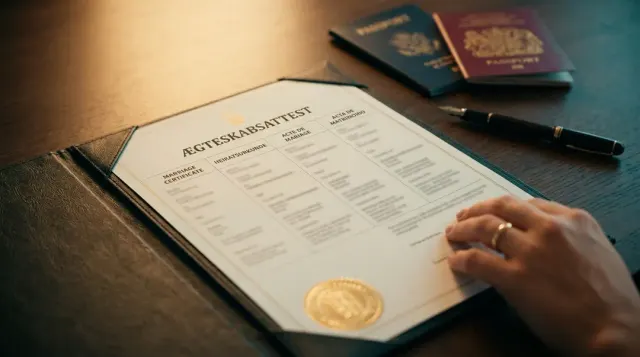
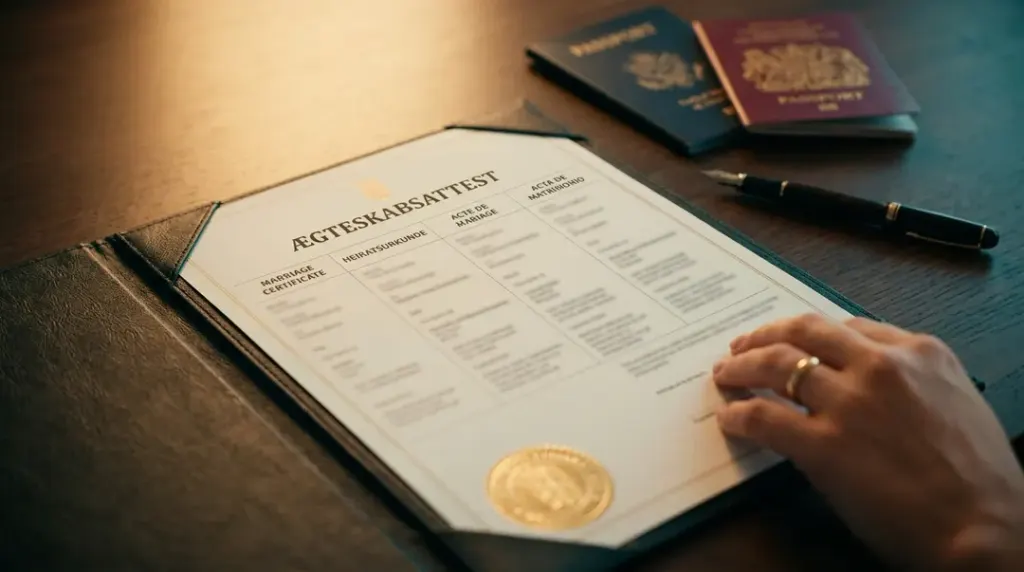
According to Tønder Municipality, the marriage certificate always shows both names as they appear in your passports. If a new certificate is issued later, the names from the wedding day stay, even if one of you has changed name since. The certificate is available in an international version in Danish, English, German, French and Spanish.
In practice, the Danish certificate is the proof you show at home. Your home authority then records and certifies the new name. More on the certificate in the Danish marriage certificate explained.
Which name law applies to us in Germany?
Since 1 May 2025 a person's name follows the law of the country where they have their habitual residence, no longer their nationality. Couples who live in Germany therefore fall under German name law. A name you already have does not change because of this.
If you are German and live abroad, the name you use in marriage follows the law of your country of residence. You can, however, choose German name law by a declaration to a German registry office; the German mission abroad can certify that declaration. For marriages concluded before 1 May 2025, the Federal Foreign Office says the previous rules continue to apply.
Does our name change automatically in Germany?
No. If you choose no married name (Ehename), each spouse keeps the name they had at the wedding (Section 1355(1) of the German Civil Code, BGB). There is no obligation to change your name.
As a married name you can choose:
- the birth name or the current surname of one spouse,
- a double name made of one name from each spouse.
The spouse whose name does not become the married name may add their birth name or previous name before or after it as an accompanying name (Begleitname, Section 1355a BGB). This is not possible if the married name is already a double name.
Which double names are possible since 1 May 2025?
The new option is a true double name as the shared married name: both spouses then carry, for example, "Berg Lund" or "Berg-Lund". The double name may have at most two parts and can be written with or without a hyphen. If a surname itself has several parts, only one part may be used for the double name.
The City of Berlin points out that a married-name declaration made after the wedding cannot be revoked while the marriage lasts. Choose the spelling carefully.
Where and how do we declare the married name after a wedding in Denmark?
At a German registry office. If your marriage is not entered in a German register, the registry office of your place of residence is responsible; if no registry office is responsible, it is Standesamt I in Berlin (Section 41 of the Civil Status Act, PStG). You can make the declaration together with the optional registration of the marriage in Germany (Nachbeurkundung) or separately. How that registration works is explained in the Danish marriage in Germany.
If the married name is chosen after the wedding, the declaration must be publicly certified (Section 1355(4) BGB). The registrar can do this (Section 41(1) PStG). Berlin takes the declaration in person at the registry office and usually asks for:
- the married-name declaration form,
- the passport or ID card of both spouses,
- the marriage certificate, with an official translation if it is a foreign certificate without an international version,
- for a marriage abroad, the birth certificates.
Ask your registry office in advance whether it accepts the multilingual Danish certificate, which includes German, without a translation. Requirements can differ between offices.
What does the declaration cost, and is there a deadline?
Each German state sets its own fees. Berlin as an example (read 23 November 2026):
| Service (Berlin example) | Fee |
|---|---|
| Married-name declaration at a wedding in Berlin | none |
| Later married-name declaration | €25.00 |
| Certificate of the name used (Bescheinigung über die Namensführung) | €12.00 |
German law sets no fixed deadline. The declaration should be made at the wedding but is also possible later, as long as the marriage exists; after a divorce, Berlin says, a married name can no longer be chosen. Plan the declaration early anyway if you will soon need a passport in your new name.
How does it work in Austria?
According to oesterreich.gv.at, spouses who make no choice keep their previous surnames. As a common family name you can choose either spouse's surname or form a double name from both. The spouse whose name does not become the common name may use a double name made of the common name and their own. A double name has at most two parts and is always written with a hyphen.
Name declarations are made to the registry office (Standesamt). The page sets no separate deadline for marriages abroad, so ask your registry office. If you travel abroad soon after the wedding, check with the passport authority in good time when you can get a new passport.
How does it work in Switzerland?
The Federal Office of Justice is clear: your name does not change automatically through marriage. If you want a common family name after a wedding abroad, you must submit the name declaration no later than 6 months after the marriage, with your marriage documents, to the competent Swiss representation abroad or the cantonal supervisory authority.
If you keep separate names, you decide within the same 6 months which of your surnames your children will carry. Swiss law does not provide a double name made of both surnames for children. Couples can use an alliance name (Allianzname); it is not official and is not entered in the civil status register, but the issuing authority can add it to identity documents.
Swiss citizens report the marriage itself to the Swiss representation; the documents must not be older than six months. You renew your passport, identity card and driving licence only if your name has changed.
What if one of us is not an EU citizen?
Then there are two names in two systems. For couples who live in Germany, German name law decides; instead, spouses can declare to the registry office that they choose the law of a state of which one of them is a national or where one of them has their habitual residence (Article 10(2) of the Introductory Act to the Civil Code, EGBGB). Whether your partner's home country puts the new name in its own passport is for that country to decide under its own rules.
So ask your partner's consulate before you make the declaration, so that the passport, residence permit and German records do not show different names for good. If an authority outside the EU wants the Danish certificate with an apostille, the details are in the Danish marriage certificate and the apostille.
Which documents and offices do we update afterwards?
Only once the new name has been declared and has taken effect, update your documents:
- ID card and passport: apply for new ones in your new name.
- Travel bookings: the name on the ticket must match the passport. The UK passport office, for example, advises not to book travel until the new passport has arrived, because it has a new number.
- Visas and residence permits: ask the issuing authority whether a document in your old name stays valid.
- Employer, bank, health insurer, insurance policies, contracts: show the certificate of the name used or the marriage certificate.
What else comes after the wedding, from your civil status to the apostille, is summarised in married in Denmark: what next?.
How does Denmark Wedding Services help?
With the Comfort Package for €799.00 we check your documents, submit the application to the Danish Agency of Family Law (Familieretshuset), reserve the ceremony date in a Danish municipality of your choice and provide two witnesses. The official 2,100 DKK fee (2026) is included in our package. We enter your names exactly as they appear in your passports, because that is how they will appear on the marriage certificate. What matters about the passport is explained in passport and ID requirements for marrying in Denmark.
You then declare the married name yourselves at your registry office. If your German registry office needs a Russian document in German, our founder, a state-authorised sworn translator for Russian and German, translates and certifies it for €50 per document (German ⇄ Russian only). The trip from Germany is described in getting married in Denmark from Germany; your personal document list comes with the free checklist.
Denmark Wedding Services is not a law firm. We provide practical and administrative support for marrying in Denmark; for individual questions about name law, please ask your registry office, your country's mission abroad or a qualified legal professional.
Written by Ludmila Bernowski, CEO & Co-Founder of Denmark Wedding Services, state-authorised sworn translator for Russian and German; reviewed by Shenol Reetz, co-founder. Last reviewed: 23 November 2026.
Frequently asked questions about changing your name
Can we take a shared surname at our wedding in Denmark?
Only if you live in Denmark. For people who are not permanently registered in Denmark, a name change in connection with the wedding is not possible; you apply for it after the wedding where you are registered.
Does our name change automatically in Germany?
No. Without a declaration, each spouse keeps the name they had at the wedding. You choose a married name by a declaration to the registry office; after the wedding it must be publicly certified, which the registry office itself can do.
Can we use a double name as our married name since 2025?
Yes. Since 1 May 2025 a double name made of both surnames is possible; it has at most two parts and can be written with or without a hyphen. According to Berlin, couples who married before that date and already have a married name can change it into a double name once.
Is there a deadline for the name declaration?
In Switzerland, yes: no later than 6 months after a wedding abroad. In Germany the declaration is also possible later, as long as the marriage exists. For Austria, ask your registry office.
What does a later name declaration cost in Germany?
It depends on the federal state. In Berlin a later married-name declaration costs €25.00 and a certificate of the name used costs €12.00.
Sources
- Tønder Municipality: getting married in Tønder (in German) (read 23 November 2026)
- Aabenraa Municipality: Marriage Registry Office (read 23 November 2026)
- Kolding Municipality: International marriages (read 23 November 2026)
- borger.dk: Når I vil giftes (in Danish) (read 23 November 2026)
- City of Copenhagen: get a new marriage certificate, international version (read 23 November 2026)
- German Federal Foreign Office: new name law since 1 May 2025 (in German) (read 23 November 2026)
- Gesetze im Internet: EGBGB, Article 10 (name) (in German) (read 23 November 2026)
- Gesetze im Internet: Section 1355 BGB, married name (in German) (read 23 November 2026)
- Gesetze im Internet: Section 1355a BGB, accompanying name (in German) (read 23 November 2026)
- Gesetze im Internet: Section 41 PStG, name declarations of spouses (in German) (read 23 November 2026)
- Berlin service portal: name declaration, choosing a married name (in German) (read 23 November 2026)
- oesterreich.gv.at: name law at marriage (in German) (read 23 November 2026)
- Swiss Federal Office of Justice: FAQ on names and citizenship, published 19 March 2026 (in German) (read 23 November 2026)
- Embassy of Switzerland in Denmark: after a marriage abroad (in German) (read 23 November 2026)
- GOV.UK: Changing your passport information (read 23 November 2026)
Ready to Start Your Danish Wedding?
Fill out our free checklist in about 2 minutes — we'll send you a personalized document list and guide you through every step.
Start Free Checklist →