Do Documents Need a Translation to Marry in Denmark?
Reviewed by Ludmila Bernowski, CEO & Co-Founder of Denmark Wedding Services. Last reviewed: November 2026. Practical, experience-based information, not legal advice — for legal questions, consult a qualified lawyer. Our Google Business Profile and reviews
Short answer: Documents in Danish, English or German need no translation to marry in Denmark. Every other foreign document must be translated into Danish, English or German by an authorised translator, including the apostille, and for legalised documents all stamps. You submit the original and the translation together, and the translation must be finished before you apply. For German ⇄ Russian we translate ourselves, at €50 per document.
On this page
- Do documents need to be translated to marry in Denmark?
- Which documents does this concern?
- Does the passport need a translation?
- Does the apostille need to be translated?
- What comes first: the apostille or the translation?
- Who may translate the documents?
- Do we upload the original and the translation?
- Will our Danish marriage certificate need translating later?
- Can DWS translate our documents?
- How DWS helps
- Frequently asked questions about translating documents
Who this guide is for: Couples who want to marry in Denmark and hold documents in Russian, Ukrainian, Polish, Turkish, Arabic, Thai or another language, for example a divorce decree, the death certificate of a former spouse or the birth certificate of a shared child. And couples from Germany or the UK who want to know whether their own documents need translating.
Key points
- The Danish Agency of Family Law (Familieretshuset) accepts documents in Danish, English and German without a translation.
- All other foreign documents are translated by an authorised translator into Danish, English or German.
- The apostille is translated too; for legalised documents, all stamps and markings.
- Order: first the apostille or legalisation in the issuing country, then the translation, then the application.
- You upload the original and the translation, not the translation alone.
- For the passport, Familieretshuset wants colour photos of every page, but no translation.
- The Danish marriage certificate from Copenhagen, Tønder or Aabenraa is multilingual, including English and German.
Do documents need to be translated to marry in Denmark?
Only if they are not in Danish, English or German. Familieretshuset states that foreign documents must be translated into Danish, English or German by an authorised translator. A UK death certificate, a US divorce decree or a German Erweiterte Meldebescheinigung therefore needs no translation.
Which documents you submit at all depends on your situation. The list is in our documents guide.
Which documents does this concern?
Familieretshuset says explicitly for three documents that they are submitted in the original language and in a version translated into Danish, English or German:
- a residence certificate or similar proof, if you live together outside Denmark;
- the birth certificates of shared children;
- proof that a previous marriage ended: a divorce decree, a death certificate or an annulment.
If Familieretshuset asks for further documents while processing, for example a certificate of marital status, the same language rule applies.
Does the passport need a translation?
No. For the passport, Familieretshuset asks for colour photos of every page in very high quality, including the front and back covers and blank pages. It does not ask for a translation of the passport.
Does the apostille need to be translated?
Yes, if it is not in Danish, English or German. Familieretshuset says the translation requirement also applies to the apostille. If a document is legalised instead of apostilled, all stamps and markings must be translated as well.
An untranslated apostille is one of the gaps we look for in every document check. Whether your document needs an apostille or legalisation at all depends on the country that issued it: see apostille or legalisation by country.
What comes first: the apostille or the translation?
The apostille or legalisation first, then the translation. Because the apostille has to be translated too, it must already be on the document when the translator starts. The apostille or legalisation is always obtained in the country that issued the document.
The translation must be finished before you apply; Familieretshuset asks for this explicitly. If it is missing, Familieretshuset asks for more information. Where it has asked for more information, it is currently working on applications received in October 2026 (Familieretshuset, read 23 November 2026). A complete application, by contrast, can be decided in about 5 working days; that is the agency's target, not a guarantee.
Who may translate the documents?
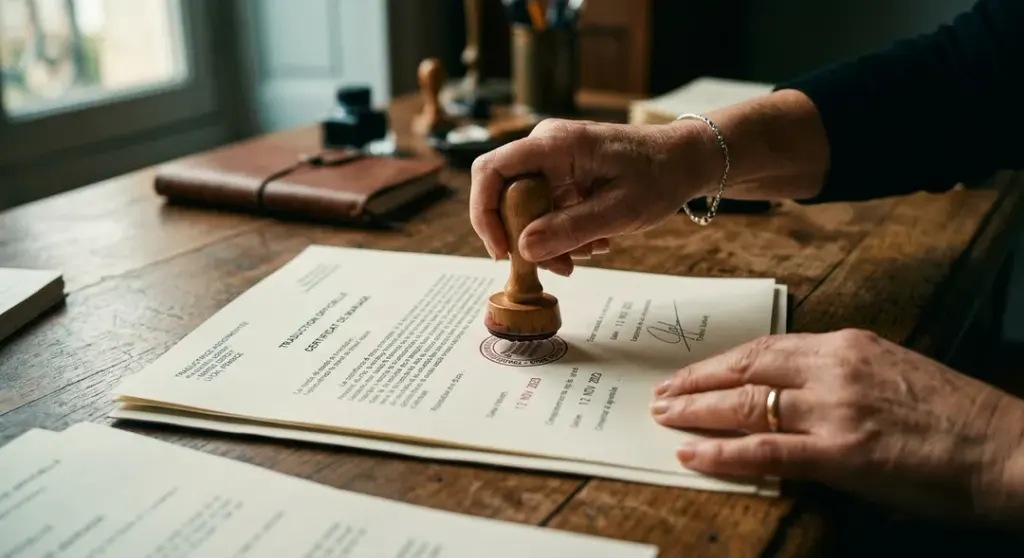
An authorised translator. On the page we read, Familieretshuset does not define "authorised" any further. You are on the safe side with a translator who is sworn, authorised or appointed by a court or public authority in their country and who certifies the translation with a stamp and signature.
In Germany, the German federal states' joint database, justiz-dolmetscher.de, lists sworn interpreters and authorised (ermächtigte) translators. A translation you made yourself, or one from a translation app, is not an authorised translation.
Do we upload the original and the translation?
Yes, always both. Upload the original with its apostille and the complete translation, every page photographed so it is easy to read. Translation costs are not included in the Comfort Package.
Will our Danish marriage certificate need translating later?
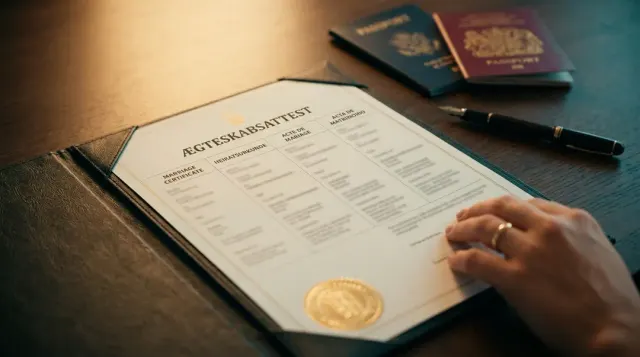
Often not. Copenhagen, Tønder and Aabenraa hand over two multilingual marriage certificates after the ceremony, in Danish, English, German, French and Spanish. For Germany, Austria, Switzerland, the UK or the USA this version is usually enough without a translation; whether an authority asks for more is up to that authority.
Within the EU, the marriage certificate needs no apostille under Regulation (EU) 2016/1191. For other EU languages there is the EU multilingual standard form; more on that in our guide to the Danish marriage certificate.
Outside the EU, the certificate usually needs an apostille; our optional Apostille Service does this for €100. That is a different apostille from the one on your own documents. Whether the destination country also wants a translation into its own language, and what kind, is decided by the authority there. For Russia, read our guide to recognition of the Danish marriage in Russia.
Can DWS translate our documents?
Yes, for German ⇄ Russian: our co-founder Ludmila (Mila) Bernowski is a sworn translator for Russian and German in Germany. A certified translation costs €50 per document. We do not translate other languages; for those you hire an authorised translator, and we tell you which pages, stamps and markings must be included. You can read more about Mila in our story.
How DWS helps
- Document check before you apply: we tell you which of your documents need a translation, and we check that the apostille, the stamps and every page are translated.
- Comfort Package, €799.00: the official 2,100 DKK fee (2026) is included in our package. We check your documents, submit the application to Familieretshuset, book your ceremony date and make sure two witnesses are there, in every Danish municipality.
- Certified translation German ⇄ Russian: €50 per document.
- Apostille Service, €100: on your finished Danish marriage certificate, after the wedding.
Our free wedding checklist lists the documents for your nationalities. A question about one specific document? Write to us via the contact page.
Frequently asked questions about translating documents
Do German or English documents need a translation?
No. Familieretshuset accepts documents in Danish, English and German without a translation.
Who may translate the documents?
An authorised translator, into Danish, English or German. You are on the safe side with a translator who is sworn, authorised or appointed by a court or public authority in their country and who certifies the translation with a stamp and signature.
Does the apostille need to be translated?
Yes, if it is not in Danish, English or German. If a document is legalised instead of apostilled, all stamps and markings must be translated as well.
What comes first: the apostille or the translation?
The apostille or legalisation first, then the translation. Because the apostille has to be translated too, it must already be on the document when the translator starts.
Do we upload the original and the translation?
Yes, always both. Upload the original with its apostille and the complete translation, every page photographed so it is easy to read.
Can DWS translate our documents?
Yes, for German ⇄ Russian: a certified translation costs €50 per document. We do not translate other languages; for those you hire an authorised translator.
Sources
- Familieretshuset – Documentation requirements – read 23 November 2026
- Familieretshuset – Apply for a certificate of marital status – read 23 November 2026
- Familieretshuset – Processing time for certificates of marital status – read 23 November 2026
- City of Copenhagen – City Hall wedding – read 23 November 2026
- German federal states – Interpreter and translator database (in German) – read 23 November 2026
- Regulation (EU) 2016/1191 on public documents (EUR-Lex) – read 23 November 2026
Written by Ludmila Bernowski, co-founder of Denmark Wedding Services and a sworn translator for Russian and German in Germany; reviewed by Shenol Reetz, co-founder. Denmark Wedding Services is not a law firm; this guide is general information, not legal advice. Last checked: 23 November 2026.
Ready to Start Your Danish Wedding?
Fill out our free checklist in about 2 minutes — we'll send you a personalized document list and guide you through every step.
Start Free Checklist →