Interpreter at a Danish Wedding: Language Rules for the Ceremony
Reviewed by Ludmila Bernowski, CEO & Co-Founder of Denmark Wedding Services. Last reviewed: November 2026. Practical, experience-based information, not legal advice — for legal questions, consult a qualified lawyer. Our Google Business Profile and reviews
Short answer: Civil weddings in Denmark are held in Danish, English or German, and both partners must understand what is said during the ceremony. If one of you does not understand any of these languages, you bring your own interpreter: Copenhagen, Aabenraa and Kolding say so on their official pages. No town hall we checked offers a ceremony in Russian, Ukrainian or another language. Since 1 July 2025, children under 18 may generally not interpret with Danish authorities.
On this page
- In which languages are Danish town-hall weddings held?
- Do both of us have to understand the ceremony?
- When do we need an interpreter, and who arranges it?
- Who can be our interpreter?
- Can our child interpret at the wedding?
- Who pays for the interpreter?
- Do the witnesses need to understand the language?
- In which language is the marriage certificate?
- How DWS helps
- Frequently asked questions about interpreters
Who this guide is for: Couples where one partner speaks only Russian, Ukrainian, Arabic, Turkish or another language and understands little Danish, English or German, and who want to know whether they can still marry in Denmark, who may interpret and who pays.
Key points
- Ceremony languages: Danish, English or German. Copenhagen lets you choose when you book; Aabenraa, Kolding and Haderslev name the same three.
- Both of you must understand the ceremony. Copenhagen says this is required by law; Aabenraa says that if it cannot communicate with both of you, it cannot marry you.
- For any other language, you arrange the interpreter yourselves (Copenhagen, Aabenraa, Kolding).
- Children under 18 may not interpret in oral communication with public authorities, except for an unproblematic matter or an acute case (Marriage Act § 58 e, in force since 1 July 2025).
- If the town hall itself calls an interpreter, the couple pays when neither partner lives in Denmark (guidance VEJ, point 1.5).
- In Kolding and Tønder, your own witnesses must also understand the ceremony language.
In which languages are Danish town-hall weddings held?
In Danish, English or German. The City of Copenhagen says the ceremony "can be conducted in English, German or Danish" and that you choose the language when you book. Aabenraa, Kolding and Haderslev name the same three languages. In Tønder (Tondern) the staff speak German and English. Our comparison of Tønder or Aabenraa covers the two border towns in more detail.
None of the official municipal pages we read offers a ceremony in Russian, Ukrainian, Polish, Arabic or any other language.
Do both of us have to understand the ceremony?
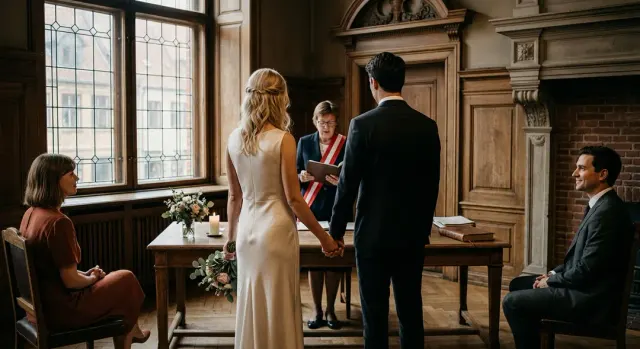
Yes. At the ceremony both partners, present at the same time, answer the registrar's question and declare that they will marry each other (Marriage Act § 20). Copenhagen puts it plainly: "By law, it is required that you both understand what is being said during the ceremony." Aabenraa says both of you must be able to communicate in English, German or Danish, and "If we cannot communicate with both of you, we cannot wed you."
It is enough that each of you understands one of the three languages. A ceremony in English works for a couple where one partner speaks English and the other German, as long as both follow what is said.
When do we need an interpreter, and who arranges it?
You need an interpreter when one of you does not understand Danish, English or German well enough to follow the ceremony. The town halls expect you to bring one:
| Town hall | Ceremony languages | What the official page says about interpreters |
|---|---|---|
| Copenhagen | English, German, Danish (chosen when booking) | For another language, "you must arrange for an interpreter yourselves" |
| Aabenraa (Apenrade) | English, German, Danish | Otherwise "you must bring along a translator" |
| Kolding | Danish, English, German | "If you do not understand these languages, you must bring an interpreter" |
| Tønder (Tondern) | Staff speak German and English | Not mentioned; ask before the wedding |
| Haderslev | Danish, German, English | Not mentioned; ask before the wedding |
Source: municipal websites, read on 23 November 2026.
The official guidance also allows the registrar to call in an interpreter "who is a trained translator or similar" when one of the partners does not understand Danish (VEJ, point 1.5). Do not rely on this: the municipalities above ask you to bring your own.
Who can be our interpreter?
The municipal pages only say "bring an interpreter" or "a translator". They publish no rule that the person must be certified, and none says that a bilingual friend is accepted. Because the town hall decides whether it can communicate with both of you, tell it in advance who will interpret, in which language, and ask whether that person is accepted. We can ask for you when we book your date.
The interpreter should be an adult who speaks the ceremony language and your partner's language well.
Can our child interpret at the wedding?
Do not plan for it. Since 1 July 2025, Danish law says children under 18 must not be used as interpreters in oral communication with public authorities (Marriage Act § 58 e, added by Act no. 469 of 14 May 2025). The law allows two exceptions: an unproblematic matter or an acute case. Whether a wedding ceremony could count as an exception is the municipality's decision, and no town hall we checked says so. Choose an adult interpreter.
This rule is about interpreting only. Under the official guidance a person under 18 may still be a witness, as long as they understand that a wedding is taking place; see our guide to witnesses at a Danish wedding.
Who pays for the interpreter?
If you bring your own interpreter, any fee is agreed between you and that person; the town halls publish no price. If the municipality calls in an interpreter during the ceremony, the same rules apply as for interpreting during the examination of your marriage conditions: the couple pays when neither partner lives in Denmark, unless one of you is a Nordic citizen and a Nordic language is used (VEJ, point 1.5; Marriage Act § 20(4)).
Do the witnesses need to understand the language?
In some towns, yes. Kolding says "The witnesses must be able to understand the language of the ceremony", and Tønder asks that your own witnesses understand some German or English. Our Comfort Package includes two witnesses in every Danish municipality, so this question only matters if you bring your own.
In which language is the marriage certificate?
You receive two multilingual marriage certificates in Danish, English, German, French and Spanish in Copenhagen, Tønder and Aabenraa. If your home authority needs a translation, ask it which translation it accepts. Documents you send with the application follow other rules, explained in our guide to translating documents for a Danish wedding. The ceremony itself, step by step, is in what happens at a Danish civil ceremony.
How DWS helps
- Comfort Package, €799.00: the official 2,100 DKK fee (2026) is included in our package. We check your documents, submit your application to the Danish Agency of Family Law (Familieretshuset), book your date and make sure two witnesses are there, in Copenhagen, Tønder, Aabenraa or any other Danish municipality.
- Language at the booking: we choose the ceremony language with the town hall and, if one of you needs an interpreter, can tell the town hall who will interpret and ask whether that person is accepted.
- Before the day: our team explains the process in English, German, Russian, Spanish or French, so the partner who speaks less English knows what to expect. We do not interpret at the ceremony itself; please bring your own interpreter if you need one.
Questions about your own case? Contact us, or read the answers in our FAQ. The short video on this page shows how a City Hall wedding in Copenhagen works.
Frequently asked questions about interpreters
In which languages are Danish town-hall weddings held?
Danish, English or German. Copenhagen lets you choose when you book; Aabenraa, Kolding and Haderslev name the same three.
Must both of us understand the ceremony?
Both of you must understand the ceremony. Copenhagen says this is required by law; Aabenraa says that if it cannot communicate with both of you, it cannot marry you.
Who provides the interpreter?
For any other language, you arrange the interpreter yourselves (Copenhagen, Aabenraa, Kolding).
Can our child interpret at the wedding?
Children under 18 may not interpret in oral communication with public authorities, except for an unproblematic matter or an acute case (Marriage Act § 58 e, in force since 1 July 2025).
Who pays if the town hall calls an interpreter?
If the town hall itself calls an interpreter, the couple pays when neither partner lives in Denmark (guidance VEJ, point 1.5).
Sources
- Danish Marriage Act (ægteskabsloven), LBK no. 663 of 1 July 2026, § 20 and § 58 e (in Danish) – read 23 November 2026
- Guidance on marriage cases, VEJ no. 10410 of 19 December 2022, point 1.5 (in Danish) – read 23 November 2026
- City of Copenhagen – City Hall wedding – read 23 November 2026
- Aabenraa Kommune – Marriage Registry Office – read 23 November 2026
- Kolding Kommune – International marriages – read 23 November 2026
- Tønder Kommune – Marriage – read 23 November 2026
- Haderslev Kommune – Marriage – read 23 November 2026
Written by Ludmila Bernowski, co-founder of Denmark Wedding Services; reviewed by Shenol Reetz, co-founder. Denmark Wedding Services is not a law firm; this guide is general information, not legal advice. Last checked: 23 November 2026.
Watch Our Video
Follow us on YouTube, Instagram & TikTok for more wedding tips
Ready to Start Your Danish Wedding?
Fill out our free checklist in about 2 minutes — we'll send you a personalized document list and guide you through every step.
Start Free Checklist →