The Danish Marriage Certificate: Languages, Copies and Use Abroad
Reviewed by Ludmila Bernowski, CEO & Co-Founder of Denmark Wedding Services. Last reviewed: November 2026. Practical, experience-based information, not legal advice — for legal questions, consult a qualified lawyer. Our Google Business Profile and reviews
Short answer: After a civil wedding in Copenhagen, Tønder or Aabenraa you are handed two marriage certificates at the end of the ceremony, each combining Danish, English, German, French and Spanish. The town hall where you married issues them and also issues replacements: Copenhagen and Aabenraa do so free of charge. Inside the EU the certificate needs no apostille; for use outside the EU it usually needs an apostille or legalisation.
On this page
- What is the Danish marriage certificate?
- Is it an "international marriage certificate"?
- Which languages is the Danish marriage certificate in?
- How many copies do we get, and when?
- Which names are on the certificate?
- How do we get a new or extra copy?
- Does a reissued certificate prove we are still married?
- Digital or wet signature: which one do we need?
- Do we need a translation or an apostille in the EU?
- When does the certificate need an apostille?
- How DWS helps
- Frequently asked questions about the Danish marriage certificate
Who this guide is for: Couples who are about to marry in Denmark, or already have, and want to know what document they take home, whether it is an "international marriage certificate", and how to get another copy later.
Key points
- Copenhagen, Tønder and Aabenraa each hand couples two multilingual certificates (Danish, English, German, French, Spanish) straight after the ceremony.
- The certificate is issued by the registry office of the municipality where you married, and that office also reissues it.
- Tønder states that the certificate shows both names exactly as they appear in your passports.
- Copenhagen and Aabenraa reissue certificates free of charge; Copenhagen says it sends them within three to four weeks, Tønder says about four weeks.
- A reissued certificate does not prove that you are still married today (City of Copenhagen).
- Inside the EU, marriage documents need no apostille (Regulation (EU) 2016/1191). Outside the EU, plan for an apostille or legalisation.
What is the Danish marriage certificate?
It is the official record of your marriage, called *vielsesattest* or *ægteskabsattest* in Danish. For a civil wedding it is issued by the registry office of the municipality (kommune) where the wedding took place, according to the Danish Ministry of Foreign Affairs. For a wedding in the Church of Denmark the parish office issues it instead.
Your marriage is valid under Danish law from the moment of the ceremony. Recognition and legal effects abroad depend on the destination country; the certificate is the document you use to show the marriage there.
Is it an "international marriage certificate"?
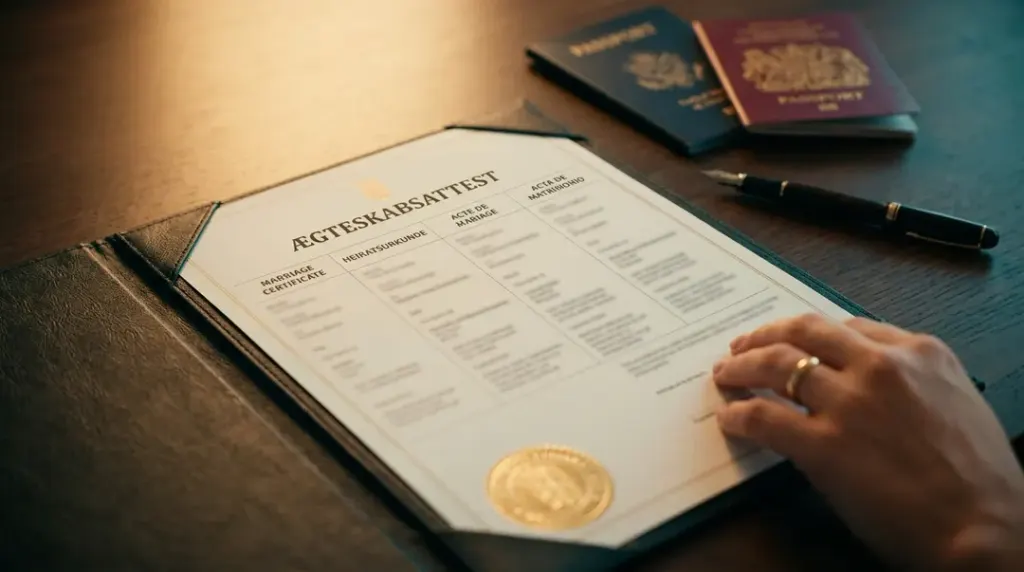
There is no separate document type called an international marriage certificate. What couples mean by it is the multilingual version that Danish town halls hand out: one certificate with the headings and entries in five languages. Tønder and Aabenraa call it an "international" certificate. Because English, German, French and Spanish are already on it, many offices abroad can read it without a translation.
Which languages is the Danish marriage certificate in?
Danish, English, German, French and Spanish, combined on one document. Copenhagen, Tønder and Aabenraa all state these five languages on their own pages. Copenhagen also issues a Danish-only version on request when you order a new copy.
If you need the certificate in another EU language, for example Italian or Polish, ask the municipality before the wedding whether it can add the EU multilingual standard form (more on that below). Otherwise the receiving office may ask for a translation.
How many copies do we get, and when?
Two. Copenhagen hands you "two multi-lingual marriage certificates" once you have signed the marriage documents, and the ceremony then ends. Tønder and Aabenraa also give each couple two international certificates at the ceremony. You therefore leave the town hall with both copies in your hands; nothing has to be posted to you.
| Town hall | Copies at the ceremony | Languages | New copy later |
|---|---|---|---|
| Copenhagen | 2 | DA, EN, DE, FR, ES | Free; by Digital Post or letter; sent within 3–4 weeks |
| Tønder | 2 | DA, EN, DE, FR, ES | On request with proof of identity; about 4 weeks |
| Aabenraa | 2 | DA, EN, DE, FR, ES | Free; by e-mail or post |
Status: municipal websites, read on 23 November 2026. For other municipalities, check their own page or ask the registry office before the wedding. More about each town: Copenhagen, Tønder and Aabenraa.
Which names are on the certificate?
Tønder states that the certificate always shows both names exactly as they appear in the passports. A certificate reissued later keeps the names from the wedding day, even if one of you has changed name since. If you plan to take a new surname, do that through your home country's authorities after the wedding; the Danish certificate is the document you show them.
How do we get a new or extra copy?
Ask the municipality where you married:
- Copenhagen: write to the Wedding Office (Vielseskontoret) by Digital Post or by letter. Give the date of the marriage, your names at the time of the marriage, your CPR numbers or dates of birth, whether you want Digital Post or ordinary mail (with the address), and the language: Danish or the international version. The new certificate is free and is sent within three to four weeks. If you order it for someone else, you need their written authorisation.
- Tønder: you can request a reissued certificate at any time. Include proof that you are one of the people named on it, or a power of attorney with proof. Tønder states about four weeks.
- Aabenraa: e-mail vielser@aabenraa.dk or write by post with your names, dates of birth, the date and place of the wedding and the address the certificate should go to. A new certificate is free of charge.
Not every municipality issues replacements free of charge, so check the fee on the municipality's own page; any fee there is the municipality's own charge.
Does a reissued certificate prove we are still married?
No. The City of Copenhagen says plainly that a reissue of the marriage certificate does not confirm your present marital status. It shows that the marriage took place. If an office abroad wants proof of your current marital status, ask it which document it accepts.
Digital or wet signature: which one do we need?
It depends on the office that will receive it. Denmark's Ministry of Foreign Affairs says a civil marriage certificate can be received electronically via Digital Post or issued with a physical ("wet") signature. Borger.dk adds that not all authorities accept digital certificates yet and that many countries still require a physical signature and a stamp.
For the apostille the difference matters: only documents with a digital signature can be uploaded for an e-apostille, and receiving a document electronically is not the same as it having a digital signature. Scans, copies and printouts of paper originals are not accepted. Keep the two paper originals from the ceremony safe.
Do we need a translation or an apostille in the EU?
In most cases neither. Under Regulation (EU) 2016/1191, documents on marriage, including capacity to marry and marital status, can be presented in another EU country without an apostille. You also need no official translation if the document is in an official language of that country, or in a language it accepts. The rules cover only the authenticity of the document, not the recognition of its legal effects, and an office may exceptionally ask for a certified translation if it cannot fully understand the content. Some offices still ask for an apostille, so check first.
For other EU languages there is the EU multilingual standard form (Danish: *sprogbilag*), a translation aid attached to the certificate. Borger.dk explains that it must be ordered before the certificate is issued, because both are issued together, and cannot be added afterwards. Its description is written for church certificates, so for a civil wedding ask the municipality in good time whether it can issue one.
For couples from Germany, our guide on recognition of a Danish marriage in Germany covers the German side.
When does the certificate need an apostille?
Usually when you use it outside the EU. Countries in the Hague Apostille Convention accept an apostille; countries outside it require legalisation instead. This is a different apostille from the one some partners need on their own home-country documents before the application (see apostille and legalisation by country). Everything about the apostille on the Danish certificate, including timing and costs, is on our page apostille for a Danish marriage certificate.
How DWS helps
- Comfort Package, €799.00: the official 2,100 DKK fee (2026) is included in our package. We check your documents, submit the application to the Danish Agency of Family Law (Familieretshuset), book your ceremony date and make sure two witnesses are there, in Copenhagen, Tønder, Aabenraa or any other Danish municipality. You leave the ceremony with the certificates in hand.
- Apostille Service, €100 (optional): if you need the finished Danish certificate for a country outside the EU, we arrange the apostille on it.
- Before the wedding: tell us where you will use the certificate. If that country needs a language that is not on the multilingual certificate, you then know in time to ask the municipality about the standard form before the certificate is issued.
Approval and ceremony are two separate clocks. Familieretshuset aims for about 5 working days once an application is complete; that is a target, not a guarantee. Where it has asked for more information, it is currently working on applications received in October 2026.
The video on this page explains how couples use a Danish marriage certificate abroad. For the documents you need before the wedding, see documents for a Danish wedding.
Frequently asked questions about the Danish marriage certificate
What languages is the Danish marriage certificate in?
Copenhagen, Tønder and Aabenraa issue a multilingual certificate that combines Danish, English, German, French and Spanish on one document.
How many marriage certificates do we get in Denmark?
Copenhagen, Tønder and Aabenraa each hand the couple two multilingual certificates at the end of the ceremony.
How do we get a new copy of our Danish marriage certificate?
Ask the municipality where you married. Copenhagen reissues it free of charge on request by Digital Post or letter and sends it within three to four weeks; Aabenraa reissues it free of charge by e-mail or post; Tønder states about four weeks.
Does a reissued certificate prove we are still married?
No. The City of Copenhagen states that a reissued marriage certificate does not confirm your present marital status; it only shows that the marriage took place.
Does the Danish marriage certificate need an apostille?
Not for use in another EU country (Regulation (EU) 2016/1191). Outside the EU it usually needs an apostille, or legalisation in countries outside the Hague Convention. DWS offers an optional Apostille Service for €100.
Sources
- City of Copenhagen – City Hall wedding – read 23 November 2026
- City of Copenhagen – Get a new marriage certificate – read 23 November 2026
- Tønder Kommune – Heiraten (in German) – read 23 November 2026
- Aabenraa Kommune – Marriage Registry Office – read 23 November 2026
- Ministry of Foreign Affairs of Denmark – Marriage certificates – read 23 November 2026
- borger.dk – Attester (in Danish) – read 23 November 2026
- Your Europe – Getting your public documents accepted in the EU – read 23 November 2026
- European e-Justice Portal – Public documents: Denmark – read 23 November 2026
- Familieretshuset – Processing time for certificates of marital status – read 23 November 2026
Written by Ludmila Bernowski, co-founder of Denmark Wedding Services; reviewed by Shenol Reetz, co-founder. Denmark Wedding Services is not a law firm; this guide is general information, not legal advice. Last checked: 23 November 2026.
Watch Our Video
Follow us on YouTube, Instagram & TikTok for more wedding tips
Ready to Start Your Danish Wedding?
Fill out our free checklist in about 2 minutes — we'll send you a personalized document list and guide you through every step.
Start Free Checklist →