Documents You Need for a Danish Wedding
Reviewed by Ludmila Bernowski, CEO & Co-Founder of Denmark Wedding Services. Last reviewed: October 2026. Practical, experience-based information, not legal advice — for legal questions, consult a qualified lawyer. Our Google Business Profile and reviews
Short answer: To marry in Denmark, each partner needs a valid passport (EU/EEA citizens: national ID card) and a residence and civil-status document no older than 3 months (a DWS requirement). If previously married, add the final divorce decree or the former spouse's death certificate. Non-EU partners also prove lawful stay. Birth certificates and a certificate of no impediment are not required.
On this page
- Which documents do you need to marry in Denmark?
- Which documents does Denmark not require?
- What if one of you is divorced or widowed?
- Which documents need an apostille or legalisation?
- Do your documents need to be translated?
- How do non-EU partners prove lawful stay in Denmark?
- What changes with the EU Entry/Exit System (EES)?
- What can Familieretshuset decide?
- How does Familieretshuset check for sham marriages?
- Which document details cause follow-up questions most often?
- What should you bring on the ceremony day?
- How does DWS help with your documents?
- FAQs About Documents to Marry in Denmark
Who this guide is for: International and binational couples putting together the documents for their marriage application in Denmark, whether you are both EU/EEA citizens or one of you comes from outside the EU/EEA.
Key points
- Every partner: a valid passport or EU/EEA national ID card, plus a residence and civil-status document not older than 3 months.
- Previously married: a final divorce decree or death certificate for every earlier marriage. Children together: each child's birth certificate.
- Partner from outside the EU/EEA and Switzerland: proof of lawful stay (visa, residence permit or EES printout). If you have no children together, DWS also asks for proof of your relationship; Familieretshuset does not require it upfront but may ask for it.
- Whether a document needs an apostille or legalisation depends on the country that issued it, not on your citizenship. Passports never need one.
- Documents in Danish, English or German are accepted without translation.
- Not required: your own birth certificates, a certificate of no impediment (CNI) or appointments at an embassy.
- Familieretshuset processes complete applications in about 5 working days as a general rule. This is a target, not a guarantee.
Before any wedding with a foreign partner, the Danish Agency of Family Law (Familieretshuset) checks that you both meet the conditions to marry. You apply online, yourselves or through a representative, and upload a small but complete set of documents. Which ones depends on three questions: where do you live, which citizenship do you each hold, and have you been married before or do you have children together? This guide answers all three. Last reviewed: September 2026.
For the whole journey from application to ceremony, read our guide to marrying in Denmark as an international couple.
Which documents do you need to marry in Denmark?
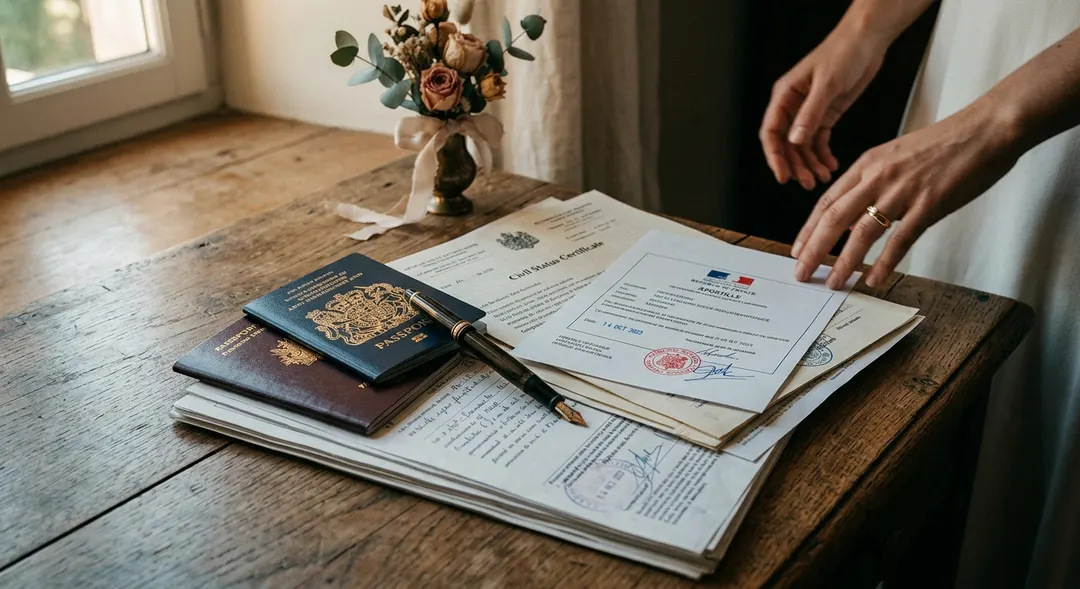
The table shows which documents are needed in which situation. It is based on Familieretshuset's requirements and on the personal document checklist we use to review every application before it is submitted.
| Document | Who needs it? | What to watch |
|---|---|---|
| Passport or EU/EEA national ID card | both partners | passport: colour photos of all pages, including covers and blank pages; ID card: front and back |
| Residence and civil-status document | both partners | official certificate from the country where you live, not older than 3 months |
| Final divorce decree | anyone who is divorced | one for every earlier marriage |
| Death certificate of the former spouse | anyone who is widowed | – |
| Birth certificate of each child you have together | couples with children together | replaces the proof of relationship |
| Proof of lawful stay | partner from outside the EU/EEA and Switzerland | visa, residence permit or EES proof with tickets |
| Apostille or legalisation | anyone submitting documents issued in certain non-EU countries | on the documents, never on the passport; depends on the issuing country |
| Proof of relationship (asked for by DWS) | partner from outside the EU/EEA without children together | photos together, travel tickets, chat excerpts; not required upfront by Familieretshuset, which may request unedited photos |
Both partners from the EU/EEA or Switzerland
For two EU/EEA citizens the list is short: passport or national ID card, a current residence certificate and a civil-status document from the country where you live, plus a divorce decree or death certificate if one of you was married before. Photograph the passport completely, page by page and in colour: Familieretshuset explicitly asks for pictures of all pages, including the covers and blank pages. For an ID card, the front and back are enough. Residents of Germany use the Erweiterte Meldebescheinigung (extended registration certificate), which already shows the marital status, so no separate civil-status certificate is needed. More on this in our guide to marrying in Denmark from Germany.
One partner from outside the EU/EEA
If one of you is a citizen of a country outside the EU/EEA and Switzerland, two things are added: proof that you are staying in the Schengen area lawfully (see the section on lawful stay below) and an apostille or legalisation on documents from certain issuing countries (never on the passport). If you have no children together, we also ask for proof of your relationship, such as photos together from different times, travel tickets or chat excerpts. Familieretshuset does not require couple photos with the application, but it may ask about your relationship and request unedited photos of you together if the relationship seems insufficiently documented. If you have children together, their birth certificates replace the proof of relationship. We cover this situation in detail in our guide for binational couples.
Power of attorney and forms when DWS applies for you
You can apply to Familieretshuset yourselves online, even from abroad. If we file the application for you, three forms are added: the service contract, the power of attorney for Familieretshuset and the declaration of truth. We pre-fill them from your answers and email them to you. You print them, both sign by hand (the power of attorney needs original signatures) and upload photos or scans.
Which documents does Denmark not require?
Many couples expect a long list of certificates and are surprised by how much falls away. Familieretshuset checks the conditions for marriage itself, so it typically does not ask for:
- birth certificates of the two of you (only for children you have together)
- a Certificate of No Impediment (CNI) or a certificate of capacity to marry from your home country
- appointments at an embassy or consular stamps
- church records or baptism certificates
- translations of documents issued in Danish, English or German
- a residence in Denmark: there is no residency requirement
This is why couples who face long procedures at home often choose Denmark. What you do need is covered in full above; the rest of this guide explains the details that decide whether your file is complete.
What if one of you is divorced or widowed?
Anyone who was married before must show that the earlier marriage has ended.
- Divorced: submit the final divorce decree, for every earlier marriage. Whether it needs an apostille or legalisation depends on the country that issued it (see the next section).
- Widowed: submit the death certificate of the former spouse, with the same apostille and translation rules as a divorce decree.
- Children together: submit each child's birth certificate.
The 3-month rule applies only to residence and civil-status documents. Divorce decrees, death certificates and children's birth certificates can be older.
Which documents need an apostille or legalisation?
What decides is the country that issued the document, not your citizenship: a document issued in Germany never needs an apostille, even if your partner is Russian or Indian. Familieretshuset distinguishes four groups (as of September 2026):
| Documents issued in … | What Familieretshuset usually requires |
|---|---|
| EU/EEA countries and Switzerland | no apostille, no legalisation |
| USA, Canada, Australia, New Zealand, Turkey, the UK and the other European countries (except those in the next row) | usually neither apostille nor legalisation |
| Albania, Armenia, Azerbaijan, Belarus, Bosnia and Herzegovina, Georgia, Kazakhstan, Kyrgyzstan, Kosovo, Russia, Tajikistan, Ukraine, Uzbekistan, and members of the Hague Apostille Convention outside Europe | apostille |
| Countries that have not joined the Hague Apostille Convention | legalisation |
Passports never need an apostille. The apostille is issued in the country that issued the document, and if the document is not in Danish, English or German, the translation must cover the apostille too. Before we submit your application, we check whether your documents need one.
Quick reference for the countries we see most often:
- Germany: German documents never need an apostille, and no certificate of capacity to marry (Ehefähigkeitszeugnis) is required.
- Russia and Ukraine: civil-status documents and divorce papers need an apostille from the issuing country, plus an authorised translation that also covers the apostille. For Ukrainians with temporary protection in a Schengen country, that country's residence permit is the proof of lawful stay.
- USA, Canada, Australia and New Zealand: documents typically need neither an apostille nor legalisation; English-language documents need no translation.
- United Kingdom: documents typically need no apostille and, being in English, no translation. A Certificate of No Impediment is not part of the Danish list. British partner? Read getting married in Denmark as a UK citizen.
- Turkey: documents typically need no apostille, but Turkish-language documents need an authorised translation.
- India, China, Brazil, Mexico, Argentina, Japan and other Hague members outside Europe: apostille. The Convention has applied to China since 7 November 2023 and to Viet Nam since 11 September 2026.
- Iran, Iraq, the United Arab Emirates, Egypt and other non-members: legalisation, which usually takes longer, so plan extra time.
Every couple gets a personal list from us: the overview shows the patterns, your situation decides the details. The apostille many couples associate with Denmark usually concerns something else, the Danish marriage certificate after the wedding. For that step, see our apostille guide for Danish marriage certificates.
Do your documents need to be translated?
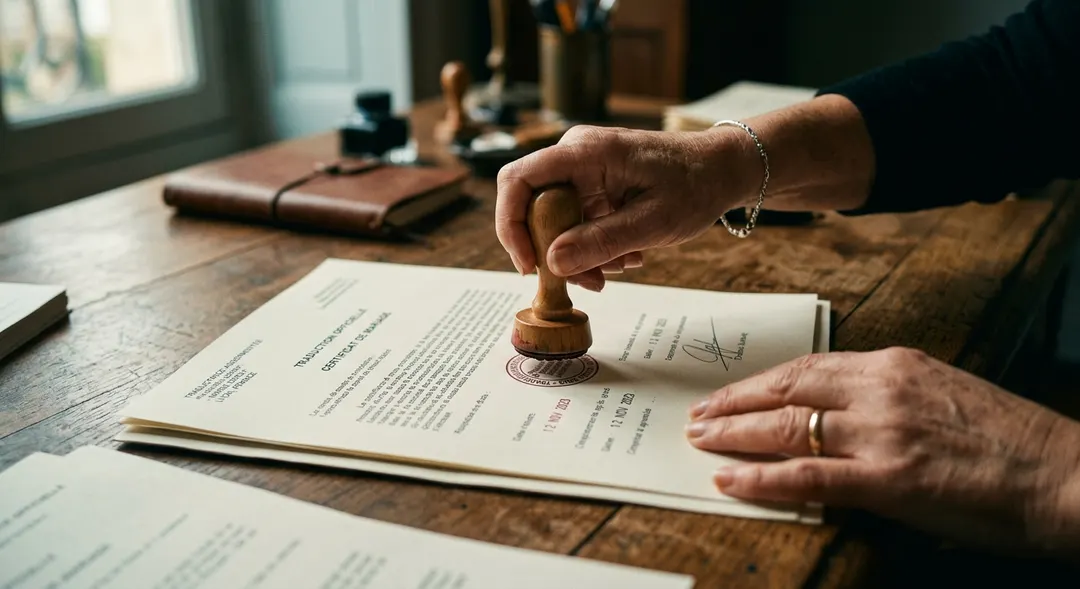
Familieretshuset accepts documents in Danish, English or German without translation. Documents in any other language must be translated into one of these three languages by an authorised translator, including any apostille; for legalised documents, all stamps and markings must be translated as well. For Russian-language documents, DWS offers certified translation between Russian and German for €50 per document. For other languages you need your own authorised translator.
- No translation for documents in Danish, English or German
- Authorised translation for all other languages, including the apostille
- Optional via DWS: certified German ⇄ Russian translation, €50 per document
- Other languages: your own authorised translator
How do non-EU partners prove lawful stay in Denmark?
Besides the documents, both partners must be allowed to stay in Denmark lawfully on the wedding day. For EU/EEA and Swiss citizens, the passport or ID card covers this. For partners from outside the EU/EEA, Familieretshuset accepts the following since 10 April 2026:
- Schengen visa (type C): the visa sticker in the passport, plus a printout of the data and result pages from the EU's EES calculator, plus plane tickets or boarding passes. The visa must be valid on the wedding day and can be issued by any Schengen country.
- Residence permit of a Schengen country: a copy of the permit is enough, with no visa and no EES check.
- Visa-free entry (for example from the USA, the UK, Canada, Australia, Japan or Brazil): a printout of the data and result pages from the EES calculator, plus plane tickets or boarding passes as proof of your entry date.
- Family reunification: a pending family-reunification case is separate from the marriage application; for the wedding, only your current lawful stay counts.
Important: if your visa or visa-free period has expired and you may only stay because your family-reunification application is being processed (procedural residence), this is not lawful residence under the Danish Marriage Act, and you normally cannot marry in Denmark. According to Life in Denmark, exceptions are possible only in special circumstances, for example joint children, serious illness or a long-term connection to Denmark.
Short stays are limited to 90 days in any 180-day period across the whole Schengen area. If none of these routes works, the application cannot go ahead, which is why we check this before you book travel. All scenarios are in our Denmark wedding visa requirements guide.
What changes with the EU Entry/Exit System (EES)?
Since 10 April 2026 the EU Entry/Exit System (EES) is fully in operation. It registers non-EU short-stay travellers digitally at the Schengen border, with a facial image and fingerprints, and replaces the stamps in the passport. For a wedding in Denmark that has three consequences:
- Proof of entry: because passports are no longer stamped, visa-free travellers prove their entry date with a boarding pass or e-ticket. Keep them.
- Count your days: the limit of 90 days in any 180 is calculated automatically for the whole Schengen area. Before you book, run the official EU calculator Check how long you can stay, press Send and save both the data page and the result page: the result must show enough days up to and including your ceremony date. You upload this printout with your documents.
- Passport rules: to enter the Schengen area, a non-EU passport must be valid for at least 3 months beyond the planned departure, have been issued within the last 10 years and have at least 2 blank pages.
EES does not apply to EU citizens or to holders of a residence permit or long-stay visa. ETIAS, the planned travel authorisation for visa-free travellers, is not in operation yet (as of September 2026).
What can Familieretshuset decide?
Familieretshuset ends its review with an approval, a request for more information or, rarely, a refusal. The approval is the Prøvelsesattest (certificate of marital status): it is valid for 4 months and is shortened if a passport, visa or residence permit expires earlier, so keep your documents valid well beyond the wedding date. Complete applications are, as a general rule, decided in about 5 working days (a target, not a guarantee), while every missing document costs time. The ceremony date is booked separately at the town hall afterwards, for example in Copenhagen, Aabenraa or Tønder. Processing times, the validity rules and the reasons for a refusal are explained in our guide to Familieretshuset, the Danish Agency of Family Law.
How does Familieretshuset check for sham marriages?
A marriage in Denmark must not be entered into to obtain a right of residence, so Familieretshuset may ask how long you have known each other, whether you have children together and whether you live together. If the relationship seems insufficiently documented, it may request unedited photos of you together, ask follow-up questions or invite you to an interview. A well-prepared proof of relationship, with photos from different times, travel tickets and chat excerpts, helps to avoid this, and we help you put it together in advance.
Which document details cause follow-up questions most often?
Beyond the basic list, four details most often lead to follow-up questions from Familieretshuset: residence and civil-status documents older than 3 months, a missing residence permit when a non-EU partner already lives in the EU, passports that were not photographed completely, and forms without original signatures. Every request for more information slows the case down, so we check each document for date, completeness and legibility before submission.
- Up to date: residence and civil-status documents not older than 3 months
- Residence permit: include a copy if the non-EU partner lives in a Schengen country
- Complete passport: colour photos of all pages, including covers and blank pages
- Signatures: power of attorney, declaration of truth and service contract signed by hand by both partners
Want to know exactly which documents you need? Our free personal document checklist asks about your situation and emails you the matching list as a PDF.
What should you bring on the ceremony day?
When you travel to Denmark, your application is already approved. For the ceremony day itself you need very little:
- Both passports or ID cards: the same ones listed in your application. Don't renew them between approval and ceremony.
- A copy of your Prøvelsesattest: we send it to you digitally; a printed backup does no harm.
- Two witnesses: Danish law requires two witnesses. With the Comfort Package we provide them; if you bring your own witnesses instead, they need photo ID.
- Wedding rings, if you want to exchange them. This is optional.
- Weatherproof clothes or an umbrella for photos outdoors: Danish weather changes quickly, even in summer.
The ceremony itself takes about 10 to 15 minutes. Afterwards you receive the Danish marriage certificate, issued in five languages (Danish, English, German, French and Spanish).
How does DWS help with your documents?
We guide couples in English, German and Russian. This is how it works:
- Step 1: you receive the free personal checklist.
- Step 2: you answer the application questions online.
- Step 3: we send you the three pre-filled forms; you sign them by hand and upload them.
- Step 4: you upload your documents. Photos or scans are enough, and you can scan with your phone camera.
- Step 5: we check everything and submit the application to Familieretshuset.
- Step 6: after approval, we book the ceremony date at the town hall.
The Comfort Package costs €799.00 and includes the review of your documents, the application to Familieretshuset including the Danish authority fee, communication with Familieretshuset, booking the ceremony date in Copenhagen, Aabenraa or Tønder, two witnesses and the 24/7 AI assistant. You pay only at the end of the document upload. Only if your case needs them, you can add a certified German ⇄ Russian translation (€50 per document) or, after the wedding, the apostille on the marriage certificate (€100). A breakdown of all costs is in our guide to the cost of getting married in Denmark.
How the documents fit into the whole timeline is shown in our step-by-step guide for getting married in Denmark, and our process in detail is on the how it works page. Couples who book the Comfort Package also get our wedding planning app, with a wedding-day checklist of what to bring.
FAQs About Documents to Marry in Denmark
Do you need a birth certificate to marry in Denmark?
No. Familieretshuset does not ask for the birth certificates of the two of you. You only submit birth certificates for children you have together, one for each child, and they also replace the proof of relationship that DWS otherwise asks for when one partner is from outside the EU/EEA.
Can we marry in Denmark with an ID card instead of a passport?
Yes, EU/EEA citizens can use their national ID card; Familieretshuset then needs photos of the front and back. Citizens of other countries need their passport, photographed completely. The UK has no national ID card, so British partners use their passport. Bring exactly the document listed in the application to the ceremony and don't renew it between approval and wedding.
Which documents does a non-EU citizen need to marry in Denmark?
A partner from outside the EU/EEA and Switzerland needs a passport, a residence and civil-status document, a divorce decree or death certificate if previously married, proof of lawful stay (visa, residence permit, or the EES calculator printout with plane tickets). If you have no children together, DWS also asks for proof of your relationship; Familieretshuset does not require it upfront but may request unedited photos of you together. Depending on the issuing country, an apostille or legalisation and an authorised translation are added.
How old can the documents be?
Familieretshuset publishes no fixed maximum age but wants current documents, and DWS asks for residence and civil-status documents not older than 3 months when you submit. If yours is older, request a fresh one before you upload. Divorce decrees, death certificates and children's birth certificates have no such limit. Your passport should stay valid well beyond the wedding date, because the approval is shortened if it expires earlier.
Do documents from the USA or the UK need an apostille?
For Familieretshuset, documents from the USA and the UK typically need neither an apostille nor legalisation, and because they are in English they need no translation. If another authority asks for an apostille, it is issued in the country that issued the document. We check before submission whether your documents need one.
Does DWS translate documents?
Only between German and Russian: DWS offers certified German ⇄ Russian translation for €50 per document. Documents in Danish, English or German need no translation. For all other languages you need your own authorised translator into Danish, English or German, and the translation must include the apostille.
Sources
- Familieretshuset — documentation requirements, translation and apostille
- Familieretshuset — applying for a certificate of marital status and the documents to attach
- Familieretshuset — documentation of legal stay for non-EU citizens from 10 April 2026
- Familieretshuset — processing time for certificates of marital status
- Familieretshuset — banning sham marriages
- Familieretshuset — lawful stay to marry in Denmark (Danish)
- Getting married in Denmark: lawful residence, passport rules and validity of the certificate of marital status — lifeindenmark.borger.dk
- EU Regulation 2016/1191 on public documents (EUR-Lex)
- HCCH — Hague Apostille Convention status table
- EU Entry/Exit System (EES) — official information
Ready to Start Your Danish Wedding?
Fill out our free checklist in about 2 minutes — we'll send you a personalized document list and guide you through every step.
Start Free Checklist →