Marriage Process in Denmark with DWS: 6 Service Steps
Short answer: with Denmark Wedding Services you marry in Denmark in 6 service steps — from a free checklist (about 2 minutes) to your town-hall date — for €799.00 all-in, Danish authority fee included. For the approval, Familieretshuset’s target is about 5 working days from the day it has your complete application — a target, not a guarantee. The 6 service steps cover the four legal steps — your documents, the application to the Danish Agency of Family Law (Familieretshuset), its approval and the ceremony at a Danish town hall; our step-by-step guide describes the same legal path in 7 steps, from checking that you can marry to receiving your marriage certificate. The wedding date is booked only after the approval and depends on the dates the town hall has released — Aabenraa releases dates 60 days ahead (the next free dates are currently about two months away), Copenhagen states waits of up to four months. There is no residency requirement, but you must be able to enter and stay in Denmark lawfully for the ceremony.
Your 6 service steps with Denmark Wedding Services
Everything before the ceremony day happens online, in your own time. You start with a free checklist (about 2 minutes), receive your personalised document list by email, answer the application questions and upload your documents whenever it suits you — every answer and every file is saved automatically, so you can stop and continue later. You pay the €799.00 Comfort Package only at the end, once your documents are in.
| Step | Who does it | Typical time |
|---|---|---|
| 1. Free checklist | You (details on both partners) | About 2 minutes |
| 2. Application questions | You; we then email you the three pre-filled forms | In your own time — answers are saved as you go |
| 3. Upload and sign | You — both partners sign the forms by hand | In your own time — each file is saved at once |
| 4. Payment (€799.00) | You, once your documents are in | At the end of the upload |
| 5. Review, submission and approval | We check and submit; Familieretshuset decides | Approval target: about 5 working days for complete applications — not a guarantee |
| 6. Ceremony date and wedding day | We book; the town hall releases the dates | Depends on the town hall (Copenhagen: up to four months; Aabenraa: dates released 60 days ahead); the ceremony takes about 10–15 minutes |
Ready to begin? Start the free checklist — it takes about 2 minutes and commits you to nothing.
- Step 1 — Free checklist (about 2 minutes, no documents needed): answer a few questions about both partners. Within minutes you receive an email with your personalised list of documents.
- Step 2 — Application questions: open your personal link from the email and answer the questions for the Familieretshuset application. Everything is saved as you go — pause and continue whenever you like. Once you have answered them, we email you our three documents (service contract, power of attorney, declaration of truth) already filled in.
- Step 3 — Upload your documents: add your files one by one, in any order; each file is saved the moment it is added. Print the three pre-filled documents, both partners sign by hand, then scan or photograph them and upload them with the rest.
- Step 4 — Payment at the end: once your documents are in, you pay the Comfort Package (€799.00). The Danish authority fee is already included.
- Step 5 — Review and submission: we check every document against the current Familieretshuset requirements and submit your application. For the approval (Prøvelsesattest), Familieretshuset’s target is about 5 working days from the day it has your complete application.
- Step 6 — Ceremony date and wedding day: after approval we book your ceremony date at Copenhagen, Aabenraa or Tønder town hall. On the day you bring your passports; two legal witnesses are included in the Comfort Package, and the optional apostille follows after the ceremony.
What are the four legal steps to marry in Denmark?
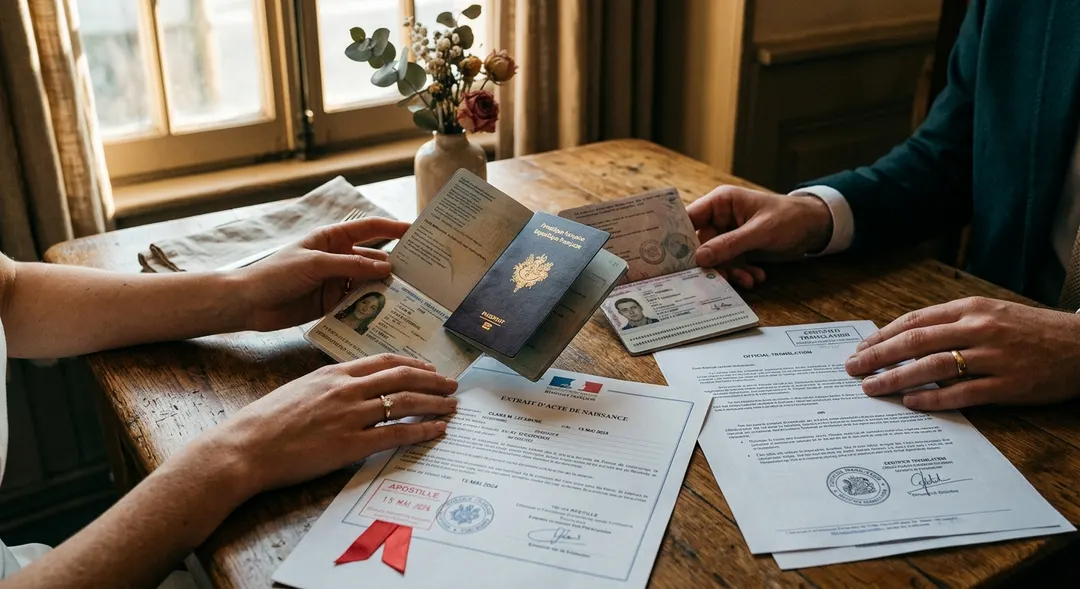
Danish law requires four steps. You prepare your documents (passports, the divorce decree if either of you was married before, and proof of lawful stay for a partner from outside the EU), the application goes to Familieretshuset, Familieretshuset checks it and issues the approval (Prøvelsesattest), and you marry at a Danish town hall in front of two witnesses. If you need the marriage certificate outside the EU, an apostille follows after the ceremony.
- Step 1 — Documents: valid passports, the final divorce decree if previously married, proof of lawful stay for a partner from outside the EU, and a registration certificate if you have had the same address for at least 6 months
- Step 2 — Application to Familieretshuset: submitted online (the Danish authority fee is included in our €799.00 Comfort Package — no separate fee for you)
- Step 3 — Approval (Prøvelsesattest): usually about 5 working days for complete applications; longer if Familieretshuset needs more information
- Step 4 — Ceremony at the town hall: about 10–15 minutes, two witnesses required (both included in the Comfort Package)
- Afterwards — apostille and registration at home: for the optional apostille, the Danish Ministry of Foreign Affairs states about 5–7 working days for documents sent by post; then you register the marriage in your home country if required
Which couples can use this process?
Denmark marries couples of almost any nationality: EU and non-EU citizens, opposite-sex and same-sex couples, first marriages and remarriages — you do not need to live in Denmark. You cannot marry if either of you is still married to someone else or under 18, and both of you must be able to enter and stay in Denmark lawfully on the wedding day.
- EU + EU couples — documents issued in EU countries, such as a divorce decree, usually need no apostille (Regulation (EU) 2016/1191)
- EU + non-EU couples — the same approval process; the non-EU partner’s documents may need an apostille, depending on the issuing country
- Non-EU + non-EU couples — possible with visa-free entry or a Schengen visa; an apostille only where the issuing country requires it
- Same-sex couples — legal since 2012, the same process as for opposite-sex couples
- Previously married — with a divorce decree that shows it is final (Rechtskraftvermerk in Germany, Final Order — formerly Decree Absolute — in England and Wales)
How long does each step take?
Collecting the documents takes 1–2 weeks in simple cases, longer if documents from outside the EU need an apostille. Familieretshuset usually processes an application in about 5 working days from the day it has the complete application — a general target, not a guarantee. The ceremony date is booked after the approval and depends on the dates the town hall has released: Aabenraa releases dates 60 days ahead, and Copenhagen states waiting times of up to four months. An apostille on the Danish marriage certificate adds about 5–7 working days.
How approval works is explained in Familieretshuset processing time, and our step-by-step guide to getting married in Denmark walks through every stage. Days, times and current waiting times for each town hall: getting married in Copenhagen, getting married in Aabenraa near the German border, and getting married in Tønder.
- Documents: 1–2 weeks (longer if an apostille or legalisation is needed)
- Submission: as soon as all documents are complete and checked
- Approval (Prøvelsesattest): usually about 5 working days for complete applications; valid for 4 months
- Wedding date: booked after the approval, depending on the dates the town hall has released
- Apostille on the Danish certificate: about 5–7 working days (Danish Ministry of Foreign Affairs)
What can go wrong and how to avoid it?
Most delays come from a handful of problems: unreadable or incomplete scans, a divorce decree without confirmation that it is final, an apostille from the wrong country, a passport or residence permit that expires too soon and missing translations. Each of these leads to a request for more information, which delays the approval. Checking every document before submission avoids most of them.
- Apostille from the wrong country — an apostille is issued in the country that issued the document, not in Denmark
- Missing finality confirmation on a divorce decree (Rechtskraftvermerk, Final Order / Decree Absolute, sentenza definitiva)
- Passport, visa or residence permit expiring soon — the approval is shortened to the earliest expiry date
- Missing translation — documents not in Danish, English or German need a translation by an authorised translator, including the apostille itself
- Incomplete application — every question on the application must be answered exactly
How Denmark Wedding Services guides you through each step
With the Comfort Package (€799.00) we check your documents against the Familieretshuset requirements, submit the application, book the ceremony at the town hall you choose and provide two witnesses. Optional extras are the Apostille Service (€100) and certified translations between German and Russian (€50 per document). Denmark Wedding Services was founded by Ludmila (Mila) Bernowski and Shenol Reetz.
Get started with our free wedding checklist or contact us for a personal timeline. For the full overview, read our guide to marriage in Denmark for foreigners and international couples.
- Document check against the current Familieretshuset requirements
- Application prepared and submitted for you
- Ceremony booking in Copenhagen, Aabenraa or Tønder
- Two witnesses included in the Comfort Package
- Optional Apostille Service (€100) after the ceremony — no return trip needed
- Optional certified translation German ⇄ Russian (€50 per document)
Sources and review
Reviewed by Ludmila Bernowski, CEO & Co-Founder of Denmark Wedding Services. Last reviewed: September 2026. This page is practical information, not legal advice; processing times and town-hall dates are set by the authorities and can change.
- Familieretshuset — International marriages
- Familieretshuset — Processing time for certificates of marital status
- Life in Denmark — If you wish to get married in Denmark
- Danish Ministry of Foreign Affairs — Legalisation and apostille
- City of Copenhagen — City Hall wedding
- Aabenraa Kommune — Marriage Registry Office
- Tønder Kommune — Heiraten (German)
Frequently Asked Questions About the Denmark Marriage Process
How much does the full Denmark wedding process cost?
The DWS Comfort Package is €799.00 and covers the legal and administrative process — including the Danish authority fee, so there is no separate government fee to pay. Your only other costs are travel, accommodation and food, plus any optional extras you choose, for example our Apostille Service (€100).
Do we both need to be present in Denmark during the application?
No. The Familieretshuset application is handled online, and both of you can prepare and upload your documents from home. You only need to be in Denmark on the wedding day, with the passports used for the application. Many couples arrive the day before the ceremony.
What happens if our documents need a translation?
Familieretshuset accepts documents in Danish, English or German without translation. Documents in any other language need a translation by an authorised translator into one of these three languages; the apostille itself must be translated too. For German ⇄ Russian, our certified translation costs €50 per document; for other languages you arrange the translation yourself. Plan it before you apply, so the application is complete when it is submitted.
Can everything happen remotely until the wedding day?
Yes. Both partners stay at home while the documents are collected, the application is submitted and Familieretshuset checks it. The only time you need to be in Denmark is the wedding day itself — which is why couples living in different countries often choose Denmark.
What is the difference between the Familieretshuset approval and the ceremony?
The approval (Prøvelsesattest) is the legal permission to marry: the Danish Agency of Family Law issues it after checking your documents and confirming that you meet the Danish conditions for marriage. The ceremony is the wedding itself, held at a Danish town hall by a registrar in front of two witnesses. The approval is valid for 4 months (shorter if a passport, visa or residence permit expires earlier), and the wedding must take place within that time.