Marriage in Denmark for Foreigners: Rules by Nationality 2026
Reviewed by Ludmila Bernowski, CEO & Co-Founder of Denmark Wedding Services. Last reviewed: October 2026. Practical, experience-based information, not legal advice — for legal questions, consult a qualified lawyer. Our Google Business Profile and reviews
Short answer: International couples of any nationality can marry in Denmark with lighter paperwork than in most European countries. There is no residency requirement, but each partner must enter and stay lawfully, and complete applications are generally processed in about 5 working days (a target, not a guarantee). What differs by nationality is entry and whether documents need an apostille or translation.
On this page
- Who counts as an "international couple" for a Denmark marriage?
- Why do so many international couples choose Denmark?
- What is the same for every nationality?
- What differs by nationality: entry, apostille and translation?
- How do same-sex international couples marry in Denmark?
- How is the Denmark marriage recognized in each partner's home country?
- What does it cost to marry in Denmark as an international couple?
- How Denmark Wedding Services supports international couples
- Frequently Asked Questions About Marrying as an International Couple in Denmark
- Your next step as an international couple
Who this guide is for: International couples of any nationality combination planning a legally binding Danish marriage who want to know which rules depend on their passports and documents.
Key points
- Open to any nationality combination, including EU + non-EU and both-non-EU pairs.
- No residency requirement, but lawful entry and stay are required for the ceremony.
- Complete applications: about 5 working days as a general target, not a guarantee.
- Whether a document needs an apostille depends on the country that issued it, not on your passport.
- Documents in Danish, English or German need no translation.
- The Comfort Package costs €799.00 for every nationality combination, including the Danish authority fee and two witnesses.
International couples — partners of different nationalities, mixed EU + non-EU pairs, expats abroad, long-distance binational relationships — can legally marry in Denmark with lighter paperwork than in most European countries. Familieretshuset (the Danish Agency of Family Law) generally processes complete applications in about 5 working days regardless of nationality (a general target, not a guarantee; cases needing more information take longer). There is no residency requirement to marry and, in most cases, no embassy appointment. This guide explains who counts as an "international couple", what differs by nationality — entry, apostille and translation — and how the marriage is recognised in each partner's home country.
Denmark's rules make it one of the more accessible countries in Europe for international couples. In Germany, a foreign partner usually needs a certificate of no impediment (Ehefähigkeitszeugnis) or an exemption granted by the President of the Higher Regional Court (§ 1309 BGB). France requires one partner (or a parent) to live in the commune — at least one month of continuous residence for a secondary residence — and the banns are posted for 10 days before the wedding. Denmark asks for a passport, proof of lawful entry and stay, proof of residence and civil status (DWS asks for these to be no older than 3 months), and a final divorce decree if previously married. The same rules apply to a German-Spanish couple, a Brazilian-American couple, a British-Indian couple or a Japanese-Russian couple.
Who counts as an "international couple" for a Denmark marriage?
For the purposes of this guide, an "international couple" is any couple where at least one partner is not a Danish citizen and not currently a Danish resident. The category covers:
- Two non-Danish EU citizens living in different EU countries (e.g., German + Spanish, French + Italian)
- EU + non-EU pairs where one partner enters with a Schengen visa, a residence permit or a visa-free passport
- Two non-EU citizens entering Denmark together with Schengen visas or visa-free passports
- Expat couples — citizens of one country currently living in a third country (e.g., an Australian living in Dubai marrying a Canadian living in Singapore)
- Long-distance couples — partners from different countries who have lived apart and want to marry before relocating; where you can live together afterwards and how family reunification works is covered in our guide to marrying a non-EU partner in Denmark
- Same-sex international couples — same rules, same process, since Denmark opened marriage to same-sex couples in 2012
What all these scenarios have in common: neither partner needs to live in Denmark, and the marriage is conducted under Danish law and issued as a Danish marriage certificate. With an apostille, the certificate is authenticated for use in the member states of the Hague Apostille Convention (authentication is not automatic recognition; whether the marriage is recognised depends on the destination country).
A Danish citizen marrying an international partner follows the same route: the couple applies to Familieretshuset unless both partners are Danish or Nordic citizens or hold an indefinite residence permit or indefinite right of residence in Denmark. Only in that case does the application go to the local municipality (kommune).
Why do so many international couples choose Denmark?
The short answer: speed, simplicity and legal certainty. Specifically:
- About 5-working-day Familieretshuset approval — one of the faster timelines in Europe (a general target, not a guarantee)
- No residency requirement to marry — neither partner needs to live in Denmark before, during or after the wedding, but you must be able to enter and stay lawfully for the ceremony
- A short document list — passport, residence and civil-status documents (plus a divorce decree if previously married), compared with longer lists per partner in Germany and France and the Nulla Osta + apostille + translation chain in Italy
- Usually no embassy appointments — Familieretshuset works with the couple's submitted scans (only documents from countries outside the Hague Convention need legalisation via an embassy)
- 5-language marriage certificate — issued in Danish, English, German, French and Spanish
- Hague Apostille authentication — with an apostille, the certificate is authenticated for use in the Convention's member states (recognition abroad depends on the destination country)
- Ceremonies in Danish, English or German — depending on the town hall; we check the language with you before booking, and most couples need no interpreter
- Same rules regardless of sexuality — same-sex marriages have full legal parity since 2012
The contrast is clear. A German-Spanish couple marrying in Germany faces a longer document list per partner, the Ehefähigkeitszeugnis requirement and often a wait of several weeks. The same couple in Denmark presents passports, residence and civil-status documents, and the three documents DWS sends pre-filled for signature (Service Contract, Power of Attorney, Declaration of Truth); a complete application is generally processed in about 5 working days. The legal validity is the same, with far less bureaucracy.
For the German-side comparison, our Denmark vs Germany wedding guide shows the side-by-side document tables.
What is the same for every nationality?
The procedure itself does not change with your passport. You gather your documents and sign the three pre-filled forms, the application goes to Familieretshuset, and a complete application is generally approved in about 5 working days; the approval (Prøvelsesattest) is valid for 4 months, or shorter if a passport, visa or residence permit expires earlier — with a passport from outside the EU/EEA it can end sooner, because the passport must still be valid 3 months after you leave Denmark (see Step 4 of our step-by-step guide). Every step in order is explained in our step-by-step guide to getting married in Denmark, and what the agency does and how it reviews applications is covered in our guide to Familieretshuset, the Danish Agency of Family Law.
After approval you book the ceremony at one of three town halls: getting married in Copenhagen, getting married in Aabenraa near the German border, or getting married in Tønder. The date depends on the town hall's free dates; if you are still choosing a month, see the best time of year to get married in Denmark.
What differs by nationality: entry, apostille and translation?
Three things depend on your passport and on where your documents were issued (as of September 2026).
Entry: visa-free, Schengen visa or residence permit
- EU/EEA and Swiss citizens — passport or national ID card; no visa
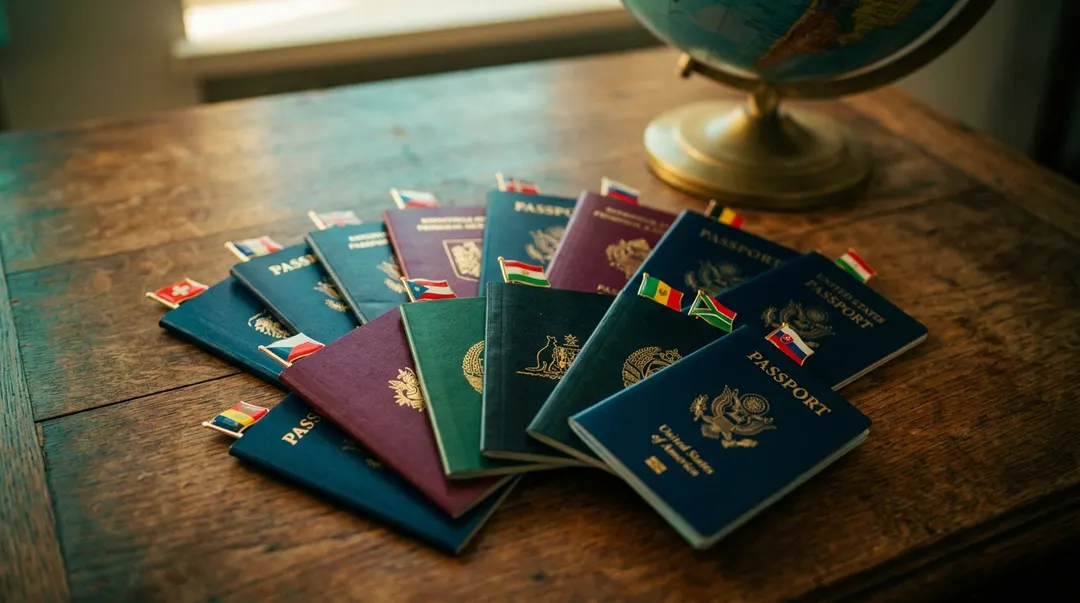
- Visa-free passport holders (e.g. US, UK, Canada, Australia, New Zealand, Japan, South Korea, Singapore, Brazil, Argentina, Mexico, and Ukrainian biometric passports) — passport plus proof of the entry date (boarding pass or e-ticket, since passports of short-stay travellers are no longer stamped under the EU Entry/Exit System)
- Schengen visa required — e.g. Russian, Belarusian, Indian and Chinese passport holders need a Schengen visa that covers the wedding date; see our guide to visa requirements for a wedding in Denmark
- Residence permit holders — a non-EU partner who lives in an EU country uses that residence permit (e.g. a German Aufenthaltstitel or a French titre de séjour) as proof of lawful stay
Apostille or legalisation: it depends on the issuing country
Passports never need an apostille. For civil-status documents such as a divorce decree or a certificate of marital status, what counts is the country that issued the document — not your nationality:
- No apostille — documents from EU/EEA countries and Switzerland; documents from the US, UK, Canada, Australia, New Zealand, Turkey and most other European countries are typically accepted without one
- Apostille needed — e.g. documents from Russia, Ukraine, Belarus, Georgia, Kazakhstan and the other Hague member states such as India, China (a member since 7 November 2023), Japan, Brazil, Mexico or Saudi Arabia (a member since 7 December 2022)
- Legalisation via the embassy — documents from countries outside the Hague Convention, e.g. Iran, Iraq, the UAE, Egypt or Qatar
An apostille is issued in the country that issued the document; for legalisation, the issuing country's authorities and the embassy complete the chain. Before we submit, we check whether each document needs one and that it is complete. Start this step early: where an apostille or legalisation is needed, it is usually the longest part of the preparation.
Translation
Documents in Danish, English or German are accepted without translation. Documents in other languages need an authorised translation into one of these three languages, including the apostille or legalisation stamps. For Russian documents we offer a certified Russian → German translation (€50 per document); documents in other languages need an authorised translator of your choice.
Previously married in a non-EU country? The same rules apply to your divorce decree: an apostille or legalisation if the issuing country requires one, and a translation if it is not in Danish, English or German. Country-specific document details are in our complete documents guide for marrying in Denmark; British partners can read our guide to getting married in Denmark as a UK citizen.
How do same-sex international couples marry in Denmark?
The same way as any other international couple. Denmark was the first country in the world to legally recognise same-sex partnerships (1989) and opened marriage to same-sex couples with full equal rights in 2012. For Familieretshuset, the application, document requirements, processing time and ceremony are identical regardless of the partners' gender. There is no separate process and no special form.
Where same-sex international couples face difficulties is at home, not in Denmark. Some home countries don't recognise same-sex marriages even when validly performed abroad:
- Full home-country recognition — EU member states that perform same-sex marriage (including Estonia and Greece since 2024), UK, US, Canada, Australia, New Zealand, Brazil, Argentina, Chile, Colombia, Mexico, South Africa, Taiwan, Switzerland, Iceland, Norway, Israel (Israel recognises foreign same-sex marriages even though same-sex marriage isn't performed locally)
- Partial recognition / civil partnership equivalence — e.g. Croatia, Czechia, Italy. Since the CJEU ruling of 25 November 2025 (C-713/23), EU states must recognise a same-sex marriage of two EU citizens concluded in another member state where they exercised their right to move and reside; whether a short wedding trip is enough has not been decided — ask your registry office
- No home-country recognition — Russia, Turkey, Saudi Arabia, UAE, Egypt, much of MENA and Africa
In the "no recognition" category, the Danish marriage still matters: it can serve as the legal basis for a spouse-residency application in a country that recognises it — such as an EU country, the US, Canada or Australia — if one partner has the right to live there. The marriage is fully valid in Denmark and in many other countries; what changes is whether the home country chooses to honour it. Our same-sex marriage in Denmark guide covers recognition country by country.
How is the Denmark marriage recognized in each partner's home country?
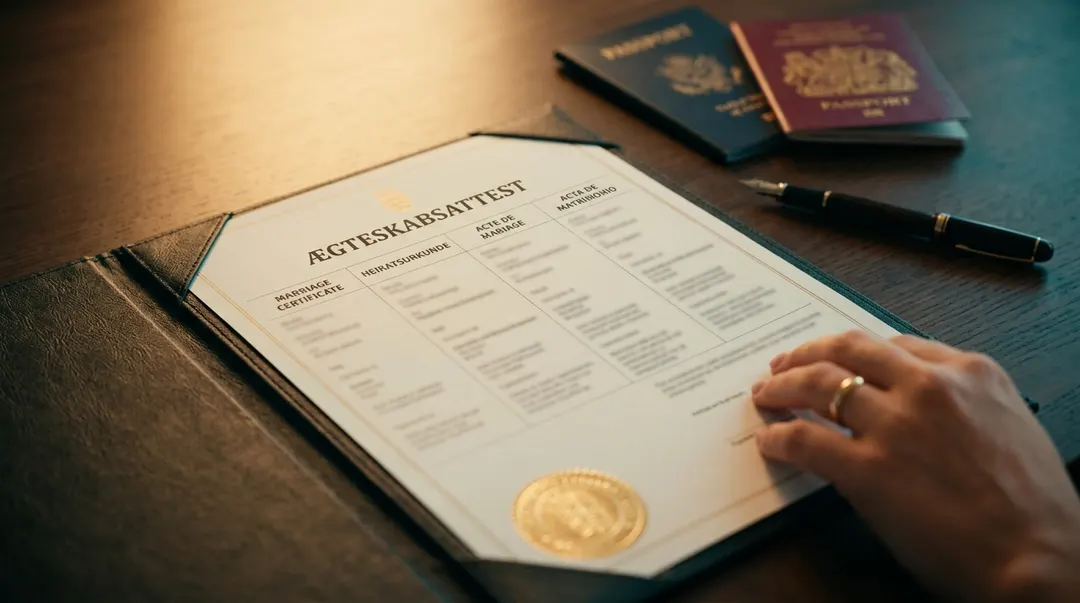
Denmark's marriage certificate is easy to use abroad for two reasons: it is issued in 5 languages (Danish, English, German, French, Spanish) on the same document, and Denmark is a party to the Hague Apostille Convention. Recognition by home country:
- EU member states — recognition; under EU Regulation 2016/1191 no apostille is needed for civil-status documents (some authorities still ask — check with the receiving authority)
- UK — generally recognised; ask the UK authority you deal with (for example for a visa or a name change) which copy of the certificate it needs
- US — recognition is a matter of state law and generally accepted at federal level (passport name change, immigration, taxes); an apostille is recommended for state-level use
- Canada, Australia, New Zealand — full recognition; an apostille is recommended for provincial/state registration
- Latin America (Spanish-speaking) — generally recognised; the certificate includes Spanish, but ask the registry or consulate whether a separate translation is required; an apostille is usually needed
- Brazil, Mexico, Argentina — recognised; ask your home-country civil registry or consulate how a marriage concluded abroad is registered (an apostille on the Danish certificate is usually needed)
- Russia, China, Turkey, India — recognition of opposite-sex marriages; an apostille from Denmark and a certified translation into the home language are usually required
- Iran, Iraq, UAE, Egypt — recognition possible but requires legalisation instead of an apostille; Saudi Arabia, a Convention member since December 2022, takes an apostille
For use outside the EU, our optional Apostille Service (€100) arranges the Danish Ministry of Foreign Affairs apostille on your Danish marriage certificate. The ministry states a processing time of 5–7 working days for documents received by post or courier (longer in busy periods). The apostilled certificate can then be used in member states of the Hague Apostille Convention (non-member countries need legalisation instead), for example for spouse-visa applications, residence permits, joint tax filing and name changes. For details, see our Danish marriage apostille guide.
What does it cost to marry in Denmark as an international couple?
| Item | Price (as of September 2026) | Note |
|---|---|---|
| Comfort Package | €799.00 | includes the application, the Danish authority fee, ceremony booking and two witnesses |
| Apostille Service (optional) | €100 | apostille on the Danish marriage certificate, for use outside the EU |
| Certified translation Russian ⇄ German (optional) | €50 per document | only German ⇄ Russian; other languages via an authorised translator |
| Personal consultation (optional) | €19.99 | for individual questions in advance |
| Apostille, legalisation or translation of your own documents | depends on the issuing country / translator | not included |
| Travel, accommodation, rings, photographer, dinner | individual | not included |
The package price is the same for every nationality combination — an EU + EU couple pays the same as a couple with documents from a non-Hague country. Travel, hotels and extras for the whole trip are itemised in our Denmark wedding cost breakdown.
How Denmark Wedding Services supports international couples
Denmark Wedding Services is based in Langenfeld (Germany) and works in English, German and Russian. It was founded by Ludmila Bernowski, who married binationally in Denmark in 2018, together with Shenol Reetz — read more in our story. International couples are the core of our work, and the Comfort Package covers:
- Pre-submission document review — we check structure, issuing authority, consistency and quality so that issues are caught before Familieretshuset sees them
- Apostille check — before we submit, we check whether each of your documents needs an apostille or legalisation
- Three pre-filled forms — Service Contract, Power of Attorney and Declaration of Truth, which you sign by hand
- Familieretshuset communication — if Familieretshuset requests supplementary documents, we reply on your behalf
- Ceremony booking — in Copenhagen, Aabenraa or Tønder, included in the package
- Two legal witnesses — included and provided by us; you can also bring your own
- 24/7 AI wedding assistant — answers your questions by chat or voice
Familieretshuset also checks that a marriage is genuine and may ask any couple how long they have known each other, where they met, whether they have children together and whether they live or have lived together. Answer these questions honestly. With a non-EU partner, we recommend keeping shared photos, travel tickets or messages ready as proof of the relationship.
Optional extras are the certified Russian ⇄ German translation (€50 per document) and the Apostille Service for the finished marriage certificate (€100). The Comfort Package costs €799.00 for all international couples, including the Danish authority fee. Not sure you need an agency at all? Our guide to wedding planners and agencies in Denmark weighs applying yourselves against hiring help.
Frequently Asked Questions About Marrying as an International Couple in Denmark
Do international couples need to be Danish residents to marry in Denmark?
No. Denmark has no residency requirement for international couples. Neither partner needs to live in Denmark before, during or after the wedding; you only need to enter and stay lawfully for the ceremony. You arrive for the ceremony, marry, and leave the same day or stay for a short honeymoon. France, by comparison, requires one partner (or a parent) to live in the commune, with at least one month of continuous residence for a secondary residence, and posts the banns for 10 days before the wedding.
Can international couples marry in Denmark if they live in different countries?
Yes. Long-distance binational couples, where each partner lives in a different country, are a common scenario. Both partners simply need to enter Denmark lawfully on or before the ceremony day. Documents are submitted digitally before travel, so neither partner needs to travel for the application. Many couples arrive the day before the ceremony and leave the day after, so the total time in Denmark can be under 48 hours.
Which language is the ceremony conducted in for international couples?
Depending on the town hall, ceremonies are held in Danish, English or German; we check the language with you before booking. As long as both partners understand the language of the ceremony, no interpreter is needed. The marriage certificate is issued in five languages (Danish, English, German, French, Spanish), so the language of the ceremony only matters for the spoken vows. English is the usual choice; German is common when one partner is German-speaking.
Does our home country need to approve the marriage before we travel to Denmark?
No. The Danish marriage application goes only to Familieretshuset, without involvement from either partner's home country. Recognition happens at home after the wedding, when you register the marriage locally or use it for a name change, tax filing or residence permit. Within the EU, no apostille is needed for civil-status documents under EU Regulation 2016/1191, though some authorities still ask; other countries require an apostille and/or a translation.
Can international couples bring their own witnesses, or does Denmark provide them?
Both options work. If you travel with family or friends, two adults with photo ID can be your witnesses. If you come alone, two legal witnesses are included in the DWS Comfort Package and provided by us; Tønder and Aabenraa can also provide municipal witnesses on some slots — Tønder on Tuesday and Thursday mornings, Aabenraa from Monday to Thursday between 10:00 and 12:00. With the Comfort Package, couples who marry without guests therefore do not need to organise witnesses themselves.
Your next step as an international couple
Marrying in Denmark as an international couple isn't a loophole — it is a regular civil procedure under Danish law with clear conditions: both partners of age, free to marry, lawfully in Denmark and present at the ceremony. About five working days for approval of a complete application, a short document list, ceremonies in Danish, English or German depending on the town hall, and a certificate that can be apostilled for use in the member states of the Hague Apostille Convention.
The most useful first step is the free Denmark wedding checklist. In about 2 minutes you'll know which documents you need and whether any of them needs an apostille or a translation. From there, approval generally takes about 5 working days once your documents are complete, and your ceremony date in Copenhagen, Aabenraa or Tønder depends on the town hall's free dates.
Sources
- Danish Agency of Family Law — international marriages
- Getting married in Denmark — lifeindenmark.borger.dk
- Danish Immigration Service — New to Denmark
- Legalisation of documents — Danish Ministry of Foreign Affairs
- EU Regulation 2016/1191 on public documents (EUR-Lex)
- Regulation (EU) 2018/1806, Annex II — visa-exempt countries (EUR-Lex)
- Marriage in France: where to marry and publication of banns — service-public.gouv.fr
- German Civil Code § 1309 — certificate of no impediment for foreign nationals (gesetze-im-internet.de)
- Court of Justice of the EU — judgment C-713/23 of 25 November 2025 (EUR-Lex)
- Tønder Kommune — marriage for couples from abroad (witnesses, ceremony times)
- Aabenraa Kommune — civil weddings (municipal witnesses Monday–Thursday 10–12; in Danish)
Watch Our Video
Follow us on YouTube, Instagram & TikTok for more wedding tips
Ready to Start Your Danish Wedding?
Fill out our free checklist in about 2 minutes — we'll send you a personalized document list and guide you through every step.
Start Free Checklist →