Widowed and Marrying Again in Denmark: Death Certificate, Estate Rule and Widow’s Pension
Reviewed by Ludmila Bernowski, CEO & Co-Founder of Denmark Wedding Services. Last reviewed: November 2026. Practical, experience-based information, not legal advice — for legal questions, consult a qualified lawyer. Our Google Business Profile and reviews
Short answer: Yes, as a widow or widower you can marry again in Denmark. You prove your late spouse’s death with the death certificate, plus an apostille and a translation where needed. The Danish marriage conditions set no waiting period. Only if the estate is dealt with in Denmark must it be divided or under administration first; if it is dealt with abroad, you may marry before it is finished.
On this page
- Which document proves that you are widowed?
- What if a court established the death?
- Is a certificate saying "widowed" or an affidavit enough?
- Did your spouse die in Denmark or another Nordic country?
- Do death certificates need an apostille or a translation?
- Do you also need the certificate of your earlier marriage?
- Is there a waiting period after the death of a spouse?
- Must the estate be settled before the new marriage?
- The estate is dealt with in Denmark: which documents?
- You kept an undivided estate (uskiftet bo): what now?
- What happens to a German widow’s or widower’s pension?
- Can your children be your witnesses?
- How does Denmark Wedding Services help?
- Frequently asked questions
Who this guide is for: Widows and widowers who want a civil wedding in Denmark with a new partner, and their partners, especially when the death certificate comes from Germany, Austria, Switzerland or a country outside the EU, when the late spouse lived in Denmark, or when a German widow’s or widower’s pension is paid.
Key points
- Both partners must be unmarried. After the death of a spouse, you show this with the death certificate.
- A death certificate issued by an administrative authority needs no finality endorsement. If a court established the death, you submit the court decision with its finality endorsement.
- An affidavit is not accepted as proof, and neither is a civil status certificate that says "widowed" on its own.
- If the death is registered in the Danish CPR register, you need no death certificate.
- The Danish marriage conditions contain no waiting period after the death of a spouse.
- The Danish estate rule (§ 10 of the Danish Marriage Act) applies only when the estate is dealt with in Denmark. If you kept an undivided estate (uskiftet bo), it must be divided before the new marriage.
- Under German law, the widow’s or widower’s pension ends on remarriage; on a first remarriage there is a lump-sum settlement on application. Ask your pension provider before the wedding.
These are the questions we hear most from widowed partners: which certificate do we need, must the estate be finished first, and what happens to the pension? This guide answers them from the official rules as of November 2026. For the full document list for every couple, see our guide to documents for a Danish wedding.
Which document proves that you are widowed?
The Danish Agency of Family Law (Familieretshuset) checks that both partners are unmarried. If one of you was married before, that marriage must have ended, and Familieretshuset names the death certificate as one of the accepted proofs. You upload it as a photo or scan with the application; the authority can ask for the original in an individual case.
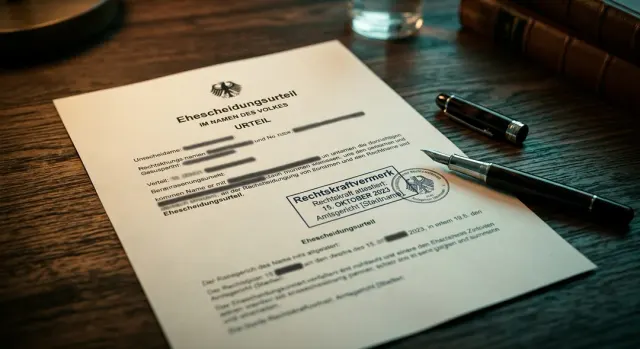
For a death outside the Nordic countries, the official Danish guidance on marriage cases (Vejledning om behandling af ægteskabssager, point 2.5.2.3.1) names the same parts as for a divorce: a copy of the document, the finality endorsement and a translation with all endorsements where a translation is needed. For widowed partners there is one important relief: in many countries death certificates are issued by administrative authorities, in Germany for example by the civil registry office (Standesamt). Such a death certificate needs no finality endorsement.
What if a court established the death?
If a spouse went missing and a court declared them dead, there is often no ordinary death certificate. The court decision is then the proof, and like any court decision it needs the endorsement showing that it is final. In this case, talk to us before you apply so that we can work out with you which documents you have.
Is a certificate saying "widowed" or an affidavit enough?
No. Under the Danish guidance, a civil status certificate that says "widowed" is not enough on its own; the death certificate still has to be submitted. An affidavit, a one-sided statement often made before a notary, is not accepted as proof that someone is single, divorced or widowed either, because no authority has checked what it says.
Did your spouse die in Denmark or another Nordic country?
If the death is registered in the Danish CPR register, you do not need to submit any proof. Otherwise, for a death in Denmark the death certificate or a certificate from the probate court (skifteretten) is enough. For a death in Finland, Iceland, Norway or Sweden, you submit a copy of the death certificate or a similar document.
Do death certificates need an apostille or a translation?
That depends on the country that issued the document, not on your citizenship. Documents from Germany, Austria, Switzerland, Great Britain and most other European countries typically need neither an apostille nor legalisation, and the same goes for documents from the US, Canada, Australia, New Zealand and Türkiye. Familieretshuset names European exceptions, among them Russia, Ukraine, Belarus, Georgia, Kazakhstan and Bosnia and Herzegovina: their documents need an apostille. For other countries: an apostille if the country is a party to the Hague Apostille Convention, otherwise legalisation in the issuing country.
If a document is not in Danish, English or German, an authorised translator must translate it into Danish, English or German, including the apostille and every stamp. A German death certificate therefore needs neither an apostille nor a translation. Which rule applies to which country is in our overview of apostille and legalisation by country, and how translations work is in our guide to translating your documents.
Do you also need the certificate of your earlier marriage?
Have it ready. In some countries the death certificate does not name the surviving spouse, and many widowed people still carry the surname from their earlier marriage. Under the Danish guidance (point 1.4), a name that differs from your other documents must be proved another way, for example with a marriage certificate. Whether the authority asks for the earlier marriage certificate in your case is for Familieretshuset to decide; before you apply, we check with you that the names in your passport and on the death certificate fit together.
Is there a waiting period after the death of a spouse?
The Danish marriage conditions contain no waiting period after the death of a spouse. Once you have the documents you need, Familieretshuset can process your application. Some home countries have their own rules, which can matter if the marriage is later to be registered there. If in doubt, ask the relevant authority in your home country.
Must the estate be settled before the new marriage?
Familieretshuset points this out: if you are widowed in Denmark, you cannot remarry while the estate of your late spouse is not settled. The basis is § 10 of the Danish Marriage Act (ægteskabsloven). Under it, the surviving spouse may only marry once administration of the estate by an estate administrator (bobestyrer) or a public estate procedure has begun, or a private division of the estate has been completed.
The Act names four exceptions. The rule does not apply if
- there was no community of property in the earlier marriage,
- the spouses were legally separated (in Danish: separeret) at the time of death,
- all heirs of the deceased consent to the new marriage and the surviving spouse has not taken over an undivided estate (uskiftet bo),
- no estate administration is to take place in Denmark.
For most of our couples, the last point is the decisive one. If the estate is not dealt with in Denmark, for example because your spouse lived in Germany and the estate is settled there, the Danish guidance (point 2.6.2) says you may marry even though the estate has not been finished. Familieretshuset decides whether there is a Danish estate in your case.
The estate is dealt with in Denmark: which documents?
Then you show that the estate does not stand in the way of your marriage, usually with a certificate from the probate court (skifteretsattest), for example that the private division is complete or that an estate administrator has taken over the estate. Administration by an estate administrator does not have to be finished. If you do not have the certificate, the guidance says the authority can ask the probate court directly.
If there was no community of property in the earlier marriage, you show this with a registered marriage settlement providing for full separate property (fuldstændigt særeje); a settlement that applies only in case of divorce is not enough. If you were legally separated at the time of death, the separation decision is enough, unless the separation is already registered in CPR.
You kept an undivided estate (uskiftet bo): what now?
Under Danish inheritance law, the surviving spouse can keep the joint property undivided, which is called uskiftet bo. If you want to marry again, you must first have this undivided estate divided by applying to the probate court. Here the heirs cannot simply consent instead, and the authority cannot grant an exemption. Only if all other heirs have waived their inheritance in your favour are you the only heir; then nothing has to be divided.
In other cases, an exemption from the estate rule (skiftefritagelse) is granted only for very special reasons; the guidance gives the example of a surviving spouse who is dying. It does not change the fact that the inheritance must still be divided later.
What happens to a German widow’s or widower’s pension?
Here we state the rule in the law; we cannot and do not give advice on your pension.
- Paid only without remarriage: Under § 46 SGB VI, widows and widowers receive the pension from the German statutory pension insurance as long as they have not remarried. The Deutsche Rentenversicherung points out that the entitlement ends with a new marriage or registered partnership.
- Lump sum on the first remarriage: Under § 107 SGB VI, the pension is settled on the first remarriage with a lump sum of 24 monthly amounts. For the small widow’s or widower’s pension, this is reduced by the months for which it has already been paid.
- Only on application: The lump sum is not paid automatically. According to the Deutsche Rentenversicherung, an informal application with the new marriage certificate to the responsible pension provider is enough.
- Revival: If the new marriage is dissolved or declared void, § 46(3) SGB VI allows an entitlement to arise again, known as the pension after the previous spouse.
These provisions speak of remarriage and make no exception for a wedding abroad. Before the wedding, ask the Deutsche Rentenversicherung or the provider that pays your pension what this means for you. Occupational pensions, private schemes and pensions from other countries have their own rules, which we do not cover here.
Can your children be your witnesses?
The ceremony needs two witnesses. In the Comfort Package we provide them in every Danish municipality. If you would rather have family members as witnesses, such as your adult children, tell us before we book, because town halls handle your own witnesses differently. Under § 58 e of the Danish Marriage Act, children under 18 generally may not act as interpreters with public authorities. More in our guide to witnesses at a Danish wedding.
Many widowed couples want a quiet, small ceremony. How a wedding for two or with a few guests works is described in our Denmark elopement guide. Whether to change your name afterwards is explained in our guide to changing your name after the wedding.
The marriage is valid under Danish law; recognition and legal effects abroad depend on the destination country.
Denmark Wedding Services is not a law firm and does not give pension advice. We provide practical and administrative support for marrying in Denmark; for questions about the estate, inheritance or your pension, ask the probate court, your pension provider or a qualified lawyer.
How does Denmark Wedding Services help?
We check every document before we submit your application: the death certificate, the apostille and translation where they are needed, and whether the names in your passport, the death certificate and the earlier marriage certificate fit together. If your late spouse lived in Denmark or you kept an undivided estate, we raise it at the very start. For a marriage with a divorced partner, see our guide to marrying again in Denmark after a divorce. Our founder, a state-authorised sworn translator for Russian and German, translates Russian certificates into German for €50 per document.
The Comfort Package costs €799.00 and includes the Danish authority fee (2,100 DKK in 2026), a personal checklist, the review of all documents, the application to Familieretshuset and all communication with the authority, the booking of your ceremony date and two witnesses, in every Danish municipality. If Familieretshuset asks for more documents, we answer the request with you; what happens then is explained in our guide to a Familieretshuset request for information.
Your first step is the free document checklist. If a court established the death or the estate is dealt with in Denmark, write to us before you apply.
Frequently asked questions
Which document proves that I am widowed?
The death certificate of your late spouse. If the issuing country requires an apostille, or the document is not in Danish, English or German, an apostille and a translation are added.
Does the death certificate need a finality endorsement?
No, if an administrative authority issued it. Only if a court established the death do you submit the court decision with its finality endorsement.
Is there a waiting period after the death of a spouse?
The Danish marriage conditions contain no waiting period after the death of a spouse.
Must the estate be settled before I marry again?
Only if it is dealt with in Denmark; then § 10 of the Danish Marriage Act applies, with its exceptions. If the estate is not dealt with in Denmark, you may marry even though it has not been finished.
I kept an undivided estate (uskiftet bo) in Denmark. What now?
You must have it divided by the probate court before the new marriage; an exemption is not possible. Only if all other heirs have waived their inheritance in your favour does nothing have to be divided.
Will my German widow’s pension stop if I marry in Denmark?
Under § 46 SGB VI the widow’s or widower’s pension is paid only as long as you have not remarried; on a first remarriage, § 107 SGB VI provides a lump-sum settlement on application. Ask the Deutsche Rentenversicherung before the wedding; we do not give pension advice.
Is a certificate saying "widowed" enough?
No. A civil status certificate is not enough on its own, and an affidavit is not accepted as proof. The death certificate has to be submitted.
Sources
- Familieretshuset — Marriage conditions (read 2026-11-23)
- Familieretshuset — Documentation requirements: apostille, legalisation, translation (read 2026-11-23)
- Danish Marriage Act (ægteskabsloven), LBK no. 663 of 1 July 2026, § 10 and § 58 e (in Danish) (read 2026-11-23)
- Retsinformation — Vejledning om behandling af ægteskabssager, VEJ nr. 10410 af 19/12/2022, points 1.4, 2.5.2 and 2.6 (Danish) (read 2026-11-23)
- Gesetze im Internet — § 46 SGB VI, widow’s and widower’s pension (German) (read 2026-11-23)
- Gesetze im Internet — § 107 SGB VI, lump-sum settlement on remarriage (German) (read 2026-11-23)
- Deutsche Rentenversicherung — lump-sum settlement for widows and widowers who remarry (German) (read 2026-11-23)
Written by Ludmila Bernowski, CEO and co-founder of Denmark Wedding Services and state-sworn translator for Russian and German. All facts checked against the official sources above on 23 November 2026.
Ready to Start Your Danish Wedding?
Fill out our free checklist in about 2 minutes — we'll send you a personalized document list and guide you through every step.
Start Free Checklist →