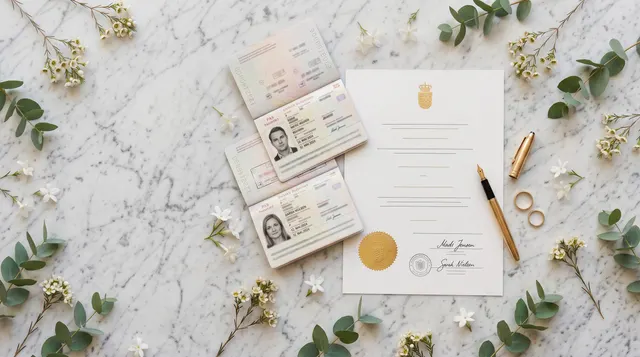
Visa Requirements for Marrying in Denmark 2026
Reviewed by Ludmila Bernowski, CEO & Co-Founder of Denmark Wedding Services. Last reviewed: October 2026. Practical, experience-based information, not legal advice — for legal questions, consult a qualified lawyer. Our Google Business Profile and reviews
Short answer: Denmark has no marriage visa. To marry there you only need the lawful right to enter and stay in Denmark on the ceremony day: visa-free entry, a Schengen short-stay visa (type C) or a residence permit from Denmark or another Schengen country. There is no residency requirement, but you must be physically and lawfully present on the day.
On this page
- Do you need a special visa to marry in Denmark?
- Scenario 1: both partners are EU/EEA citizens
- Scenario 2: what does a non-EU partner of an EU citizen need?
- Scenario 3: can two non-EU citizens marry in Denmark?
- Which countries have visa-free access to Denmark?
- Should you mention the wedding on your visa application?
- Visa scenarios by nationality
- What if your visa expires before the ceremony?
- Does marrying in Denmark give you a visa or residence permit?
- Which embassy handles a Schengen visa for Denmark?
- What Denmark Wedding Services handles
- Since 2026: the EU Entry/Exit System (EES) and proof of entry
- FAQs About the Visa for a Wedding in Denmark
Who this guide is for: Couples checking whether their nationality and entry status let them marry in Denmark.
Key points
- No special wedding visa — you need lawful entry and stay for the ceremony.
- Common paths: visa-free entry, a Schengen type C visa, or a residence permit from Denmark or another Schengen country.
- A Schengen visa issued by any Schengen country covers Denmark; it must be valid on the ceremony date.
- No residency requirement, but lawful presence on the day is mandatory.
Denmark does not issue a "marriage visa" and does not require either partner to apply for one: whichever lawful entry status applies to your nationality is enough, as long as it is still valid on the ceremony date. As proof of lawful stay, Familieretshuset accepts a visa (tourist visas included), a Danish residence permit or EU registration certificate, a residence permit from another Schengen country, a passport, or documentation of the date you entered Denmark.
Do you need a special visa to marry in Denmark?

Denmark has no special marriage visa. To get married in Denmark, you simply need to be legally present in the country on the day of your ceremony. This means:
- If you can legally enter Denmark — visa-free, with a Schengen visa, or with a residence permit from Denmark or another Schengen country — you can get married there.
- There is no residency requirement — you don't need to live in Denmark.
- There is no minimum stay — you can arrive, marry, and leave on the same day.
Which of these applies to you depends on your nationality: EU/EEA citizens need no visa; citizens of visa-free countries such as the US, the UK, Canada or Brazil enter with their passport; citizens of visa-required countries such as Russia, China, India, Iran or Turkey need a Schengen visa unless they already hold a residence permit from a Schengen country.
Scenario 1: both partners are EU/EEA citizens
🇪🇺 If both partners are EU/EEA citizens, you can freely travel to Denmark and get married with just your passport or national ID card. No visa needed.
Scenario 2: what does a non-EU partner of an EU citizen need?
🇪🇺 + 🌍 This is a very common scenario for binational couples — see our guide to marrying a non-EU partner in Denmark for the wider context including documents and recognition. The non-EU partner needs one of these:
- A valid Schengen visa (type C) — applied for at the consulate of your main Schengen destination; a visa issued by any Schengen country is valid for Denmark
- OR a residence permit from a Schengen country (e.g., a German Aufenthaltstitel)
- OR visa-free entry, if their nationality is on the EU's visa-free list
Only a residence permit from a Schengen country counts. A residence permit from an EU country outside the Schengen area, such as Ireland, does not by itself allow visa-free travel to Denmark.
Important: The visa or entry must be valid on the ceremony date. Plan accordingly. Our full Danish wedding documents checklist explains how visa documentation interacts with the Familieretshuset application.
Scenario 3: can two non-EU citizens marry in Denmark?
🌍 + 🌍 Both partners need legal entry into the Schengen zone. Options:
- Schengen visa (type C) for each partner
- Existing residence permits from any Schengen country
- Visa-free entry (if your nationality is on the EU's visa-free list)
Important: A Schengen visa from ANY Schengen country works — you don't specifically need a Danish visa.
Which countries have visa-free access to Denmark?

Citizens of these countries can enter Denmark without a visa for up to 90 days within any 180-day period (a selection, not the full list):
- 🇺🇸 USA, 🇨🇦 Canada, 🇦🇺 Australia, 🇳🇿 New Zealand
- 🇬🇧 United Kingdom (post-Brexit)
- 🇯🇵 Japan, 🇰🇷 South Korea, 🇸🇬 Singapore
- 🇧🇷 Brazil, 🇲🇽 Mexico, 🇦🇷 Argentina
The complete lists of visa-free and visa-required nationalities are in Annexes I and II of EU Regulation 2018/1806, linked from the European Commission's EU visa policy page.
Should you mention the wedding on your visa application?
Yes. State the real purpose of your trip in the visa application — for example tourism and a civil wedding in Denmark — and bring documents that match it, such as your hotel booking and return ticket. Under the EU Visa Code the consulate checks the purpose of the stay, and information that is incomplete or inconsistent can lead to a refusal.
Visa scenarios by nationality
The scenarios above cover the categories. Here's how they play out for some common nationalities:
| Nationality (examples) | Visa needed for Denmark? | Proof of lawful stay for the application |
|---|---|---|
| EU/EEA citizens | No | Passport or national ID card |
| USA, UK, Canada, Australia, Japan, Brazil, Mexico, Argentina | No — visa-free for up to 90 days in any 180-day period | Passport plus proof of your entry date (for example the boarding pass) |
| Ukraine (biometric passport) | No — visa-free for up to 90 days in any 180-day period | Passport plus proof of your entry date, or an EU temporary-protection document |
| Russia, China, India, Iran, Turkey | Yes — a Schengen visa (type C); apply to Denmark if it is your main destination | The visa, or a residence permit from a Schengen country if you have one |
| Any nationality with a Schengen residence permit | No | The residence permit |
Russia
Russian citizens need a Schengen visa (type C) issued by a Schengen embassy or consulate. Since November 2025, Russian citizens are generally no longer issued multiple-entry Schengen visas and must apply for a new visa for each trip, so plan the wedding as a trip of its own and apply early. A valid Schengen visa from a country other than Denmark also works — you can marry in Denmark on a German, French or Italian Schengen visa, as long as it is still valid on the ceremony date.
Ukraine
Ukrainian citizens with a biometric passport can travel to the Schengen area visa-free for 90 days within any 180-day period (since 2017). Couples currently displaced under EU temporary protection status can present that document as proof of legal entry.
India
Indian citizens need a Schengen visa. Apply to the Schengen country that is your main destination — Denmark, if you only travel for the wedding. Where to hand in the application in India is shown on the Danish Ministry of Foreign Affairs' list of application places (see "Which embassy handles a Schengen visa for Denmark?" below).
China
Chinese citizens need a Schengen visa. Where to hand in the application in China is shown on the same Ministry of Foreign Affairs list; processing times vary, so apply early.
Turkey
Turkish citizens need a Schengen visa unless they hold a residence permit from a Schengen country (for example a German Aufenthaltstitel). Many Turkish citizens already have a Schengen visa for unrelated travel.
Iran
Iranian citizens need a Schengen visa. Iran is not a Hague Convention member, so Iranian documents (for example a divorce decree) need legalisation via the embassy instead of an apostille, and the same applies to the Danish certificate afterwards (see our apostille guide).
Visa-free nationalities
Citizens of visa-free countries — among them the USA, the UK, Canada, Australia, Japan, Brazil, Mexico and Argentina (see the list above) — need no visa application. Bring your passport, a return ticket and proof of accommodation, because Schengen border officers may ask for them, and keep your boarding pass as proof of your entry date.
What if your visa expires before the ceremony?
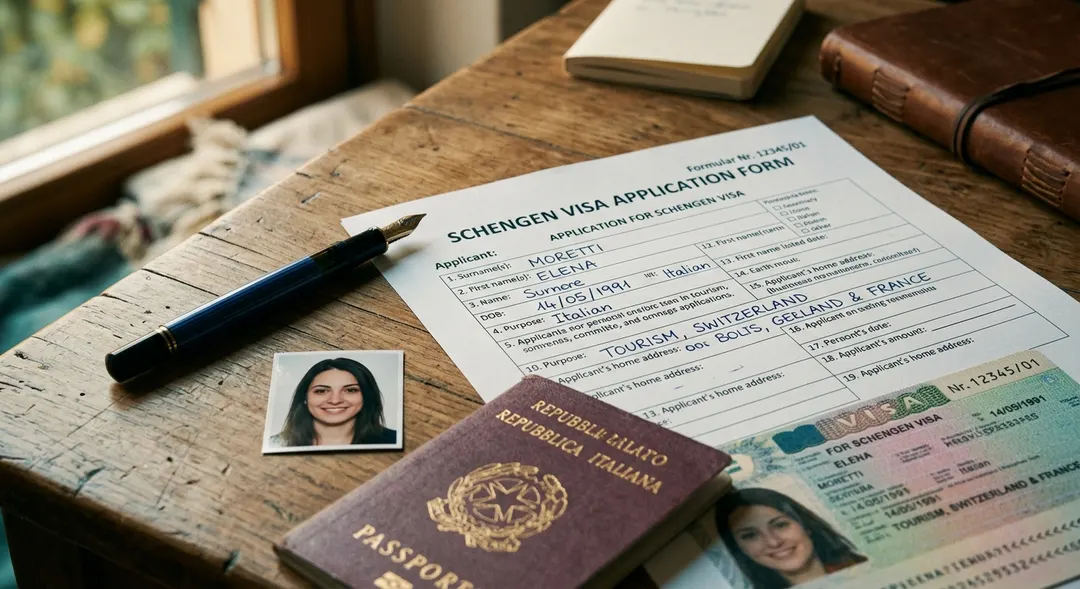
This is a common visa pitfall. A typical trap: a non-EU partner gets a Schengen visa valid for 30 days, and the couple only applies after arriving. The approval alone has a target of about 5 working days (not a guarantee), and the next free date at the town hall can be weeks or months away — Copenhagen states waits of up to four months, and Aabenraa releases dates 60 days in advance — so the visa can run out before the ceremony. Keep in mind, too, that the approval is valid for 4 months, but for a shorter period if your visa or residence permit expires earlier.
You do not have to be in Denmark when you apply: "You do not need to have entered Denmark at the time you apply" (lifeindenmark.borger.dk). A visa-required partner can apply as soon as the visa has been issued and upload it as the proof of lawful stay, so the approval can come through before you travel.
If your visa is going to expire BEFORE your ceremony, you have three options:
- Apply for a visa that covers the whole trip — state your ceremony date and travel dates in the application; the consulate sets the validity based on your planned stay, tickets and accommodation.
- Pick an earlier ceremony date — you don't have to use the approval's full 4-month validity; book the first free date after approval that falls well inside your visa.
- Shift the wedding city — Aabenraa releases dates 60 days in advance (free dates about two months ahead) and Tønder marries couples from abroad on Tuesdays and Thursdays, while Copenhagen states waits of up to four months; the date always depends on the town hall's free dates.
As a rule of thumb, leave a buffer of at least 5 days between the ceremony day and the last day your visa is valid. Our team checks visa expiry dates against the ceremony booking before you commit to travel. Careful pre-submission checks like this help avoid rejections and last-minute surprises.
Does marrying in Denmark give you a visa or residence permit?
No. Getting married in Denmark does not give either partner a visa, a residence permit or the right to work — in Denmark or in any other country. Your entry status only has to cover the trip for the wedding. If you want to live together afterwards, the non-EU partner applies separately for family reunification or a spouse residence permit in the country where you will live, usually with the Danish marriage certificate as the supporting document. EU free-movement rights for a non-EU spouse apply when the EU partner lives in, or moves to, an EU country other than their own; if you settle in the EU partner's home country without having lived together in another EU country first, national rules apply.
Where you can live together after the wedding — national family reunification rules, EU free-movement rights and recognition of the marriage at home — is explained in our guide to living together after a binational wedding in Denmark.
Which embassy handles a Schengen visa for Denmark?
A Schengen visa issued by any Schengen country covers Denmark, but you apply to the country of your main destination — Denmark, if you travel only for the wedding — or, if there is none, the country you enter first.
Where you hand in the application depends on the country you live in: a Danish embassy or consulate, an external visa application centre (VFS) or another Schengen country that represents Denmark. The Danish Ministry of Foreign Affairs lists the right place for each country on its page Where to apply for a visa or residence permit. Check it before you book an appointment, because these arrangements change.
What the consulate checks
Under the EU Visa Code you apply no earlier than 6 months and normally no later than 15 days before travel; the consulate checks the purpose of the trip, accommodation, travel medical insurance with at least €30,000 cover, sufficient funds and your intention to leave the Schengen area in time. A decision normally takes up to 15 calendar days. The visa must still be valid on the ceremony date.
What Denmark Wedding Services handles
We don't provide visa services, but we do:
- Advise on which documents Familieretshuset needs
- Check your documents against the Danish marriage conditions (Familieretshuset makes the decision)
- Handle the complete Familieretshuset application
- Book the ceremony date and provide two witnesses (both included in the Comfort Package)
For visa applications, contact the Danish mission or visa centre responsible for your country (see the Ministry of Foreign Affairs list above) or a local immigration attorney.
Curious how visa fits into the bigger picture? Our step-by-step guide to getting married in Denmark shows where visa verification sits in the 7-step process. After the wedding, our Danish marriage apostille guide covers what's needed for international recognition.
Get your personal document list with the free Denmark wedding checklist — it is tailored to both partners' nationalities.
Since 2026: the EU Entry/Exit System (EES) and proof of entry
Since 10 April 2026 the EU Entry/Exit System (EES) registers every non-EU short-stay traveller digitally at the Schengen border: a photo and fingerprints on first entry, and no more passport stamps. Three practical consequences for couples marrying in Denmark:
- Proof of entry — Familieretshuset accepts a visa, a residence permit, your passport, or documentation of the date you entered Denmark. For visa-free travellers that means your boarding pass or e-ticket, so keep it.
- Count your days — the limit of 90 days in any 180 is now counted automatically across all EES countries, and days spent anywhere in the Schengen area count. Before you book, run the official EU tool Check how long you can stay, press Send and download the result: it must show "OK" with enough days to cover your ceremony date. Our couples upload this file together with their documents.
- Passport rules — your passport must be valid for at least 3 months after the date you plan to leave the EU and must have been issued within the last 10 years (Your Europe, see the sources). Familieretshuset adds a third rule: the passport must have at least 2 empty pages.
EES does not apply to EU citizens or to holders of a residence permit or long-stay visa. ETIAS, the €20 travel authorisation for visa-free travellers, is not in operation yet.
Related guide: Marrying in Denmark for international couples
FAQs About the Visa for a Wedding in Denmark
Is there a marriage visa for Denmark?
No. Denmark has no special marriage visa. You only need to be in Denmark lawfully on the ceremony day: visa-free, with a Schengen visa (a tourist visa is fine), or with a residence permit from Denmark or another Schengen country. Familieretshuset checks your lawful stay as part of the marriage application.
Can we get married in Denmark on a tourist visa?
Yes. Familieretshuset lists a visa, including a tourist visa, as proof of lawful stay for the marriage. A Schengen short-stay visa (type C) issued by any Schengen country works, as long as it is still valid on the ceremony day. The approval (Prøvelsesattest) is valid for 4 months, or for a shorter period if your visa expires earlier. You do not need to be in Denmark when you apply.
Does my visa have to be issued by Denmark?
No. A Schengen short-stay visa issued by any Schengen country is generally valid for Denmark. You apply to the country that is your main destination — Denmark, if you travel only for the wedding — or, if there is none, to the country you enter first. The visa must still be valid on your ceremony date.
What if my Schengen visa application is rejected?
A Schengen visa refusal can usually be appealed; the deadline and procedure are stated in the refusal letter and depend on the country that refused. Frequent refusal reasons are insufficient proof of funds, an unclear purpose or itinerary, or doubts about the intention to leave the Schengen area in time. The Prøvelsesattest is valid for 4 months (shorter if your passport, visa or residence permit expires earlier), so plan the timing of a new application carefully.
Can our ceremony happen during the same trip as the visa interview?
No — the visa must be issued before you travel to Denmark. You apply in the country where you live, at the Danish embassy or consulate or its visa centre, and a decision normally takes up to 15 calendar days (longer in individual cases). The ceremony then takes place in Denmark after you arrive on the issued visa. Visa-required couples should plan noticeably more time from the first Familieretshuset application to the ceremony than visa-free couples.
Sources
- EU Entry/Exit System (EES) — official information
- Familieretshuset — legal residence for marriage in Denmark
- European Commission — EU visa policy and visa lists
- Your Europe (EU) — marriage and recognition across the EU
- Danish Immigration Service — New to Denmark
- Danish Ministry of Foreign Affairs — where to apply for a visa or residence permit
- Your Europe (EU) — residence rights for non-EU spouses and children
- Getting married in Denmark — lifeindenmark.borger.dk
- Danish Agency of Family Law — international marriages
- EU Visa Code, Regulation (EC) No 810/2009 — purpose of the journey (Art. 14) and refusal (Art. 32) (EUR-Lex)
- Your Europe (EU) — travel documents for non-EU nationals
- EEAS (EU) — stricter rules on visas for Russian nationals, 7 November 2025
Watch Our Video
Follow us on YouTube, Instagram & TikTok for more wedding tips
Ready to Start Your Danish Wedding?
Fill out our free checklist in about 2 minutes — we'll send you a personalized document list and guide you through every step.
Start Free Checklist →