Proof of Relationship for Marriage in Denmark: What Familieretshuset Checks
Reviewed by Ludmila Bernowski, CEO & Co-Founder of Denmark Wedding Services. Last reviewed: November 2026. Practical, experience-based information, not legal advice — for legal questions, consult a qualified lawyer. Our Google Business Profile and reviews
Short answer: The Danish Agency of Family Law (Familieretshuset) does not require photos or a fixed list of relationship proof with every application. Because sham marriages are banned, it may ask how long you have known each other, where you met, whether you have children together and whether you live together, and it may request unedited photos of you both. If doubts cannot be cleared in writing, it invites you to an interview. No minimum relationship length is published.
On this page
- Why does Familieretshuset check the relationship at all?
- What does Familieretshuset ask about your relationship?
- Are photos of us together required?
- Which proof of relationship helps most?
- How do we prepare the proof so it matches the application?
- Is there a minimum relationship length?
- We met online, do not live together or have a large age gap. Is that a problem?
- When is there an interview?
- What happens if Familieretshuset refuses on these grounds?
- Does a Danish approval settle family reunification?
- How long does the check take?
- How DWS helps
- Frequently asked questions about proof of relationship
Who this guide is for: Binational couples in which one partner is not an EU/EEA or Swiss citizen and has no permanent right to live in Denmark, couples who met online or live in different countries, and anyone who has been told to "prove the relationship" and wants to know what Familieretshuset actually checks and how to prepare without stress.
Key points
- Danish law forbids a marriage where there are specific reasons to believe its decisive purpose is a right of residence in Denmark, the EU/EEA or Switzerland (§ 8 a of the Marriage Act).
- Photos are not required with the application. Familieretshuset may ask for unedited photos if the relationship is insufficiently documented.
- A refusal needs a sound basis; a mere presumption is not enough. A large age gap or not living together does not decide the case on its own.
- If a suspicion cannot be cleared in writing, Familieretshuset must invite the couple to an interview. Not attending can lead to refusal.
- Life in Denmark states that a rejection on pro forma grounds cannot be appealed.
- A Danish approval does not decide family reunification: the country where you later apply for residence makes its own assessment.
Why does Familieretshuset check the relationship at all?
Section 8 a of the Danish Marriage Act says a marriage must not be entered into if there are specific reasons to believe it is a pro forma marriage whose decisive purpose is a right of residence in Denmark, in an EU or EEA country or in Switzerland. The rule has applied since 1 January 2019.
In practice the check matters in cases that Familieretshuset handles, because one partner has no permanent right to live in Denmark. The official guidance notes that in cases a kommune decides, both partners already have Danish or Nordic citizenship or a permanent right of residence, so a sham marriage could not bring a residence advantage there. On the marriage declaration, both partners also declare that the decisive purpose of the marriage is not a right of residence.
What does Familieretshuset ask about your relationship?
According to Familieretshuset, the questions cover how long you have known each other, where you met, whether you have children together and whether you live or have lived together. While processing your application it may contact you with further questions or ask for more information.
The official guidance adds that when you fill in the marriage declaration you answer a number of questions about your relationship and are encouraged to send documentation for your answers. If information from other authorities is needed, such as residence permits, address registration or earlier marriages, Familieretshuset asks you to provide it.
Are photos of us together required?
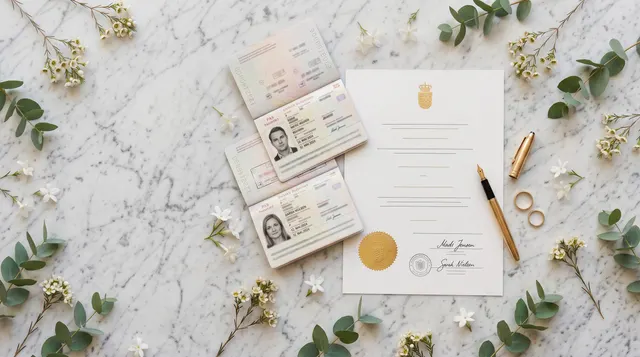
No. Familieretshuset says photos of the couple are not required for the application for a Certificate of Marital Status (prøvelsesattest). If the relationship is insufficiently documented in your application, it may ask for "unedited photos of the two of you together".
So photos are not a fixed requirement, but they are the kind of proof the agency may ask for. Preparing them before you apply avoids losing time if the request comes.
Which proof of relationship helps most?
The official guidance names what speaks for a genuine relationship: having lived together for several years, having children together, or having shared finances, for example a loan taken out together. In many cases this is enough to settle the question on paper.
Couples who do not live together yet usually show the relationship through its history. To avoid a delay, we ask our couples with a non-EU partner to prepare three kinds of proof in advance:
- Photos of the two of you together from different moments of the relationship, going back up to about three years, unedited and with the original dates visible.
- Messages from your first contact until today, as a selection that shows the timeline, with dates visible.
- Travel tickets or boarding passes from visits to each other.
This list is our practice, not an official requirement. If you have children together, their birth certificates usually say a lot, but Familieretshuset decides what is enough, so we still recommend preparing the proof.
How do we prepare the proof so it matches the application?
Consistency matters more than volume. The dates in your photos, messages and tickets should match what you state about when and where you met and how often you have visited each other. Send originals as they are: no filters, crops or edits that change what the picture shows.
Choose excerpts rather than entire chat histories. Your private conversations only need to show that the relationship exists and how it developed. For how to photograph and upload documents so they are readable, see photographing documents for Familieretshuset.
Is there a minimum relationship length?
The official sources we read state no minimum. How long you have known each other is one of the questions, and Familieretshuset makes an overall assessment of all circumstances in the case.
We met online, do not live together or have a large age gap. Is that a problem?
None of these decides the case on its own. The guidance lists factors that can be included in the assessment: not living together at a shared address, being unable to communicate in a common language, a large age gap, and limited personal knowledge of each other. It can also count if the EU partner was previously married to a non-EU citizen and that marriage ended shortly after the non-EU partner obtained a right of residence through it.
The guidance stresses that a marriage is not necessarily a sham marriage just because of a large age gap or because the couple does not live together. Meeting online is not named as a factor. What matters is the overall picture, which is why a clear, honest and consistent application helps.
When is there an interview?
Familieretshuset may invite you to an interview if it believes there is a need for it. The guidance is more precise: if there is a suspicion of a sham marriage or of false documents and it cannot be cleared in writing, Familieretshuset must invite the couple to an interview, and possibly to an authenticity check of their documents, before it decides. If you do not attend, it can refuse the application.
An interview is not a verdict. It is the step that lets you answer doubts in person. If you receive an invitation, take it seriously and keep the appointment.
What happens if Familieretshuset refuses on these grounds?
Life in Denmark, the official portal for international citizens, states that you cannot appeal against a rejection on the basis of pro forma. Under § 22 a of the Marriage Act, Familieretshuset may pass information about such a refusal to the Danish Immigration Service, the Agency for International Recruitment and Integration and the police where they need it for their tasks.
The check does not end with the approval either. A registrar must not perform the ceremony if it is evident that the marriage is a sham marriage, for example if it becomes clear at the ceremony that the couple does not know each other. A marriage that breaks § 8 a is not valid under § 21 of the Marriage Act.
Does a Danish approval settle family reunification?
No. The country where you later apply for residence as a spouse makes its own assessment of whether the marriage is genuine. In Germany, for example, § 27(1a) of the Residence Act rules out family reunification if it is established that the marriage was entered into solely to enable residence. In Denmark the Aliens Act has its own rule on pro forma marriages.
If one partner is a Danish or Nordic citizen or holds a Danish residence permit and the other is only temporarily in Denmark, both also sign the 11b declaration, confirming that you know the Danish family reunification rules. Familieretshuset notes that you do not give up your right to apply for family reunification by signing it. What comes next is covered in family reunification after a Danish wedding.
How long does the check take?
Familieretshuset says that, as a rule, you can expect the Certificate of Marital Status within 5 working days if the application is complete and you meet the conditions. That is a target, not a guarantee; more about the agency itself is in our guide to the Danish Agency of Family Law. Where the agency has asked for more information, it is currently processing applications received in October 2026. What to do when such a request arrives is explained in Familieretshuset asked for more documents.
Living apart? See long-distance couples marrying in Denmark.
How DWS helps
We check every document before you pay anything; the payment link comes only after our check. For couples with a non-EU partner we go through your proof of relationship before submission and check that the photos, messages and tickets match what the application says about where and when you met.
With the Comfort Package for €799.00 we fill in the forms for you, submit the application to Familieretshuset, handle the agency's questions, including any request for photos or an interview invitation, and book the ceremony date in the Danish kommune you choose, always with two witnesses provided by us. The official 2,100 DKK fee (2026) is included in our package. If a kommune charges its own fee for the ceremony, that is the town's charge, and we show it to you before you choose. We cannot promise approval: Familieretshuset decides. Get your personal document list with the free wedding checklist, see the full documents for marrying in Denmark, or read about binational couples and how the process works.
Denmark Wedding Services is not a law firm. We provide practical and administrative support for marrying in Denmark; questions about refusals, residence or family reunification in an individual case should go to the relevant authority or a qualified legal professional.
Written by Ludmila Bernowski, CEO & Co-Founder of Denmark Wedding Services, state-sworn translator for Russian and German. Updated 23 November 2026.
Frequently asked questions about proof of relationship
Are photos mandatory for a Danish marriage application?
No. Familieretshuset says photos are not required with the application. If the relationship is insufficiently documented, it may ask for unedited photos of the two of you together, so it helps to have them ready.
What does Familieretshuset ask about our relationship?
How long you have known each other, where you met, whether you have children together and whether you live or have lived together. It may contact you with further questions while it processes the application.
How long must we have known each other to marry in Denmark?
The official sources we read state no minimum. How long you have known each other is one question among several, and Familieretshuset makes an overall assessment.
When does Familieretshuset invite a couple to an interview?
When a suspicion of a sham marriage or of false documents cannot be cleared in writing. If you do not attend, the application can be refused.
Can a refusal for a sham marriage be appealed?
Life in Denmark states that a rejection on the basis of pro forma cannot be appealed. Questions about a refusal in an individual case should go to a qualified legal professional.
Does a Danish approval decide our family reunification?
No. The country where you later apply for residence as a spouse makes its own assessment of whether the marriage is genuine, for example Germany under § 27(1a) of its Residence Act.
Sources
- Familieretshuset: Banning sham marriages (read 2026-11-23)
- Familieretshuset: Processing time for certificates of marital status (read 2026-11-23)
- Familieretshuset: Family reunification rules, the 11b declaration (read 2026-11-23)
- Life in Denmark: If you wish to get married in Denmark (read 2026-11-23)
- Retsinformation: Danish Marriage Act, LBK no. 663 of 1 July 2026, §§ 8 a, 11 b, 21 and 22 a (Danish) (read 2026-11-23)
- Retsinformation: Vejledning om behandling af ægteskabssager, VEJ no. 10410 of 19/12/2022, points 2.11, 3.4 and 3.5 (Danish) (read 2026-11-23)
- Gesetze im Internet: § 27 Residence Act (AufenthG), family reunification (German) (read 2026-11-23)
Watch Our Video
Follow us on YouTube, Instagram & TikTok for more wedding tips
Ready to Start Your Danish Wedding?
Fill out our free checklist in about 2 minutes — we'll send you a personalized document list and guide you through every step.
Start Free Checklist →