Declaration of Truth and Power of Attorney: The Forms You Sign to Marry in Denmark
Reviewed by Ludmila Bernowski, CEO & Co-Founder of Denmark Wedding Services. Last reviewed: November 2026. Practical, experience-based information, not legal advice — for legal questions, consult a qualified lawyer. Our Google Business Profile and reviews
Short answer: When you apply to marry in Denmark, both partners sign a one-page declaration of truth for the Danish Agency of Family Law (Familieretshuset): your information is true, and false information is punishable. If an agency or relative applies for you, you also sign a power of attorney. The representative may run the whole application, but may never sign the declaration of truth for you. Signatures are handwritten unless you both apply with MitID.
On this page
- Who signs which form?
- What is the declaration of truth for a marriage in Denmark?
- Can an agency or a relative sign the declaration of truth for us?
- What does the power of attorney for Familieretshuset allow?
- How long is the power of attorney valid, and can we withdraw it?
- Can we sign the forms digitally?
- Do we both have to sign the same sheet?
- Do the forms have to be translated?
- What is the § 11 b declaration, and do we need it?
- How do we photograph and upload the signed forms?
- What happens if a signature is missing or the form is wrong?
- How DWS helps
- Frequently asked questions about the declaration of truth and power of attorney
Who this guide is for: Couples who are applying to marry in Denmark, with us or on their own, and want to know what the declaration of truth, the power of attorney and the § 11 b declaration say before they sign them.
Key points
- The declaration of truth is one page, signed and dated by both partners. Familieretshuset calls it "the signature page of the application".
- You must always sign the declaration of truth yourselves. A power of attorney never covers it.
- The power of attorney lets your representative manage the entire application, and all letters from Familieretshuset go to that representative.
- Both are official Familieretshuset templates in English. Familieretshuset accepts English, so they do not need translating.
- Signatures must be handwritten; the only exception is when you both apply yourselves with MitID.
- The § 11 b declaration is a third, separate form. It is needed only when one partner is Danish or Nordic (or holds a Danish residence permit) and the other is in Denmark only temporarily, and never when the second partner is an EU/EEA citizen.
Who signs which form?
| Form | Partner 1 | Partner 2 | Representative (for example DWS) |
|---|---|---|---|
| Declaration of truth | Signs and dates | Signs and dates | Cannot sign for you |
| Power of attorney | Signs (place and date) | Signs (place and date) | Signs as the authorised representative |
| § 11 b declaration (only some couples) | Signs | Signs | Cannot sign for you |
Sources: Familieretshuset's templates and application guide (see Sources). The § 11 b page says both partners must sign it; it names no representative.
What is the declaration of truth for a marriage in Denmark?
It is a one-page Familieretshuset form, titled "Truth declaration". By signing it, each of you declares two things:
- that the information you have given is true, and that you understand false information is a punishable offence under section 163 of the Danish Criminal Code;
- that you have read the pamphlet "Når I skal giftes – husk økonomien" (in Danish), which explains how property is shared between spouses on separation, divorce and death.
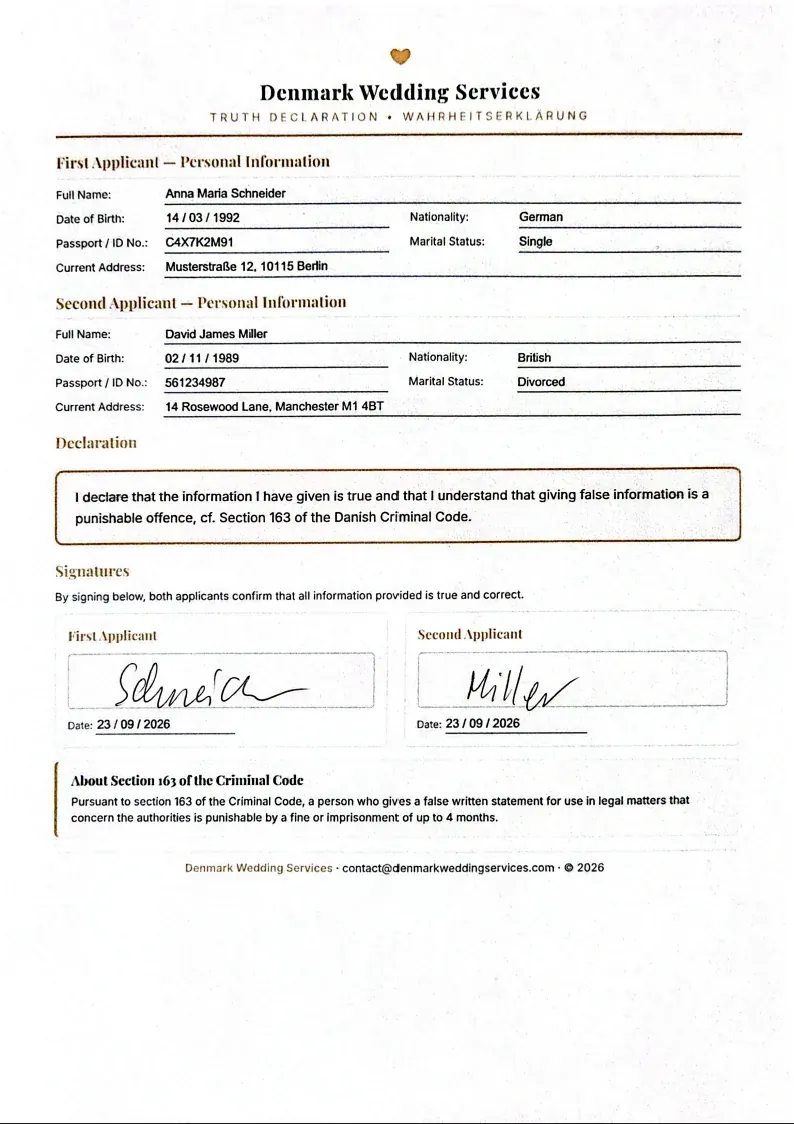
The form itself explains section 163: a false written statement for use in legal matters before the authorities can be punished by a fine or imprisonment of up to 4 months. Below that there are two lines: first applicant signature and date, second applicant signature and date. In Familieretshuset's online form, the upload slot for this page is labelled "Solemn declaration (from both parties)".
Can an agency or a relative sign the declaration of truth for us?
No. Familieretshuset's application guide is explicit: the power of attorney does not authorise a third party to sign the declaration of truth on your behalf, and you must always sign it yourselves. That is why every agency, including us, sends you this page to sign even though the agency fills in the rest of the application.
What does the power of attorney for Familieretshuset allow?
The official template (in Danish: *fuldmagt*) authorises one named person to manage "the entire process" of your application to Familieretshuset for a Certificate of Marital Status, the approval you need before the ceremony. Its fields are:
- Signatory 1 and Signatory 2: name, address, postcode, city, country, phone and e-mail of each partner.
- Authorizes power of attorney to: the same details for your representative, plus an optional case number.
- Three signature lines: place, date and signature for partner 1, for partner 2 and for the authorised representative.
By signing, you also confirm that all future correspondence from Familieretshuset goes to your representative. Familieretshuset's apply page adds that a representative applying for you uses the digital application form, logs in with SMS login, and must attach the power of attorney with both of your original signatures.
How long is the power of attorney valid, and can we withdraw it?
According to the template, it is valid as long as your Certificate of Marital Status is valid, and it can also be used during a possible appeal period after a case is closed. You can withdraw it at any time. Familieretshuset's apply page says to do this in writing, to both Familieretshuset and the person you appointed.
Can we sign the forms digitally?
Usually not. Life in Denmark (the official guide for newcomers) says the signature must be signed by hand, and that digital signatures, for example from Adobe or Paint, are not accepted. This requirement does not apply if you both apply with MitID. Most couples from abroad have no MitID, so in practice: print, sign with a pen, then photograph.
Do we both have to sign the same sheet?
The templates put both signature lines on one page, and that is the safe way: one sheet, signed by both of you. Familieretshuset's guidance that we read does not say whether two separately signed copies are accepted. If you live in different countries and cannot meet before applying, talk to us before you sign, and we will look at your case.
On the date: write the date on which you sign. We found no official rule on how recent the signature date must be.
Do the forms have to be translated?
No. The declaration of truth and the power of attorney are Familieretshuset's own templates in English, and Familieretshuset accepts documents in Danish, English or German. Sign the English original. If you write to us in German or Russian, our forms e-mail adds a translation of the template text, for your understanding only. Your other documents, such as birth or divorce certificates in another language, are a separate matter; see our guide to documents for a Danish wedding.
What is the § 11 b declaration, and do we need it?
It is a declaration under section 11 b of the Danish Marriage Act that you both know the rules on spousal family reunification in the Danish Aliens Act. According to Familieretshuset, both partners must sign it when:
- one of you is a Danish or Nordic citizen or holds a Danish residence permit, and
- the other has only a temporary basis for staying in Denmark, for example a tourist visa or visa-free entry.
This applies even if you do not plan to live in Denmark. It does not apply when the non-Danish/Nordic partner is an EU/EEA citizen, when both of you are Danish/Nordic or hold Danish residence permits, or when both of you are in Denmark only temporarily. Without it, you cannot marry in Denmark in those cases. Signing it does not take away your right to apply for family reunification later.
The official form has 7 pages and lists the reunification conditions. We do not repeat them here, because they change; the current rules are on New to Denmark. For couples with a non-EU partner, see also our guide for binational couples.
How do we photograph and upload the signed forms?
- Print the forms, both sign with a pen, and write place and date where the form asks for them.
- Photograph each page on its own: flat, from directly above, all four corners visible, the signatures sharp.
- With us, upload photos (JPG or PNG), not PDFs, and put each form on its own card on your upload page.
The photo at the top of this page is an example from our upload page: a signed declaration with sample names, photographed the way we need it. It shows our older form layout; since 20 November 2026 we use Familieretshuset's official templates, whose wording is summarised above. Our upload explainer video walks through the photos step by step: in English and in German.
What happens if a signature is missing or the form is wrong?
Familieretshuset then asks for more information, and that costs time. If it has asked you for more information, it is currently working on applications received in October 2026 (Familieretshuset, read 23 November 2026). When the application is complete from the start, Familieretshuset aims to decide within about 5 working days; that is a target, not a guarantee. If you apply yourselves through the self-service, note one more rule: if both partners' parts are not received within 14 days after the application was started, Familieretshuset closes the case, and you apply and pay again.
How DWS helps
- Comfort Package, €799.00: the official 2,100 DKK fee (2026) is included in our package. We fill in the power of attorney and the declaration of truth with your details and Denmark Wedding Services as your representative, send them to you by e-mail and on your upload page, check your photographed signatures before we submit, and file everything with Familieretshuset.
- § 11 b declaration: if your situation needs it, your upload page shows a separate card with a link to Familieretshuset's official form. You fill it in, both sign by hand, and upload a photo; we check it with the rest.
- Questions before you sign: see how the whole process runs on our process page, or contact us.
The video on this page shows how our service works from application to wedding day. For the agency that decides your application, read our guide to the Danish Agency of Family Law. If your own certificates need an apostille or legalisation first, see apostille and legalisation by country.
Frequently asked questions about the declaration of truth and power of attorney
What is the declaration of truth for a marriage in Denmark?
A one-page Familieretshuset form on which both partners declare that their information is true, knowing that false information is punishable under section 163 of the Danish Criminal Code, and that they have read the pamphlet "Når I skal giftes – husk økonomien".
Can our agency sign the declaration of truth for us?
No. Familieretshuset's application guide says a power of attorney never authorises a third party to sign the declaration of truth. Both of you always sign it yourselves.
What does the power of attorney allow?
It authorises your representative to manage the entire application to Familieretshuset for a Certificate of Marital Status, and all correspondence from Familieretshuset goes to the representative.
Can we sign digitally?
No. Life in Denmark says signatures must be handwritten and digital signatures are not accepted, unless you both apply yourselves with MitID.
Do we need the § 11 b declaration?
Only if one of you is Danish or Nordic or holds a Danish residence permit and the other is in Denmark only temporarily, for example on a tourist visa. It never applies when the other partner is an EU/EEA citizen, and signing it does not take away the right to apply for family reunification later.
Sources
- Familieretshuset – Truth declaration (official template, PDF) – read 23 November 2026
- Familieretshuset – Power of Attorney (official template, PDF) – read 23 November 2026
- Familieretshuset – Application for a Certificate of marital status, guide (PDF) – read 23 November 2026
- Familieretshuset – Apply for a Certificate of Marital Status – read 23 November 2026
- Familieretshuset – Family reunification rules: section 11b declaration – read 23 November 2026
- Familieretshuset – Declaration under section 11b of the Danish Marriage Act (form, PDF) – read 23 November 2026
- Familieretshuset – Documentation requirements – read 23 November 2026
- Familieretshuset – Processing time for certificates of marital status – read 23 November 2026
- Life in Denmark – If you wish to get married in Denmark – read 23 November 2026
- Pamphlet "Når I skal giftes – husk økonomien" (PDF, in Danish) – read 23 November 2026
- New to Denmark – Family reunification – read 23 November 2026
Written by Ludmila Bernowski, co-founder of Denmark Wedding Services; reviewed by Shenol Reetz, co-founder. Denmark Wedding Services is not a law firm; this guide is general information, not legal advice. Last checked: 23 November 2026.
Watch Our Video
Follow us on YouTube, Instagram & TikTok for more wedding tips
Ready to Start Your Danish Wedding?
Fill out our free checklist in about 2 minutes — we'll send you a personalized document list and guide you through every step.
Start Free Checklist →