Danish Civil Wedding Ceremony: What Happens on the Day
Reviewed by Ludmila Bernowski, CEO & Co-Founder of Denmark Wedding Services. Last reviewed: November 2026. Practical, experience-based information, not legal advice — for legal questions, consult a qualified lawyer. Our Google Business Profile and reviews
Short answer: A civil wedding in Denmark is short and simple. You arrive a little early, the town hall checks your identity, and the registrar gives a short speech and asks each of you by full name whether you will marry the other. After both of you say yes, you are pronounced married, may exchange rings, and sign the marriage book with two witnesses. You receive your marriage certificates straight away. The ceremony itself takes about 10–15 minutes.
On this page
- What happens at a Danish civil wedding, step by step?
- How long does a civil ceremony in Denmark take?
- What do we need to bring on the wedding day?
- What does the registrar say at a Danish civil ceremony?
- Can we exchange rings and say our own vows?
- Copenhagen, Tønder and Aabenraa compared
- Who can come, and can guests take photos?
- What if one of us does not understand the language?
- When do we get the marriage certificate?
- Can we change our surname at the wedding?
- Can the wedding be refused on the day?
- What happens after the ceremony?
- How DWS helps
- Frequently asked questions about the ceremony
Who this guide is for: Couples who already have, or will soon have, their approval from the Danish Agency of Family Law (Familieretshuset) and want to know what the wedding day itself looks like: what to bring, who can come, what the registrar says and what you take home.
Key points
- Before the ceremony the municipality must establish who you are; bring the same passports or ID cards you sent to Familieretshuset.
- The legal core is the same everywhere: both partners present at the same time, the question to each of you by full name, two yeses, the pronouncement, at least two witnesses (Marriage Act § 20; guidance VEJ, point 3.4).
- Copenhagen says the ceremony lasts about 10 minutes; Aabenraa plans about 20 minutes for the whole event.
- You leave with two multilingual marriage certificates (Danish, English, German, French, Spanish) in Copenhagen, Tønder and Aabenraa.
- Civil weddings in Denmark are open to the public by law, and guests may take photos in Copenhagen and Aabenraa.
- In Kolding, Sønderborg and Haderslev couples from abroad must register in person before the wedding day; Copenhagen needs no check-in.
- Our Comfort Package (€799.00, Danish authority fee included) books your date and includes two witnesses in every Danish municipality.
What happens at a Danish civil wedding, step by step?
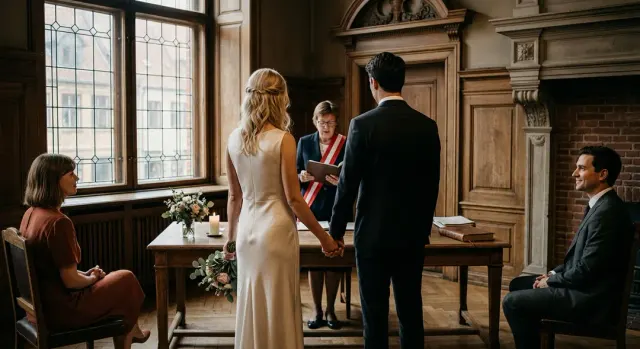
Each municipality may organise the ceremony its own way, if it wishes together with the couple (VEJ, point 3.4). The order below is how Copenhagen and Aabenraa describe it on their official pages:
- You arrive 10–15 minutes early and wait in the waiting area with your guests.
- Your identity is checked. In Aabenraa this happens in the waiting room, using the travel documents you sent to Familieretshuset.
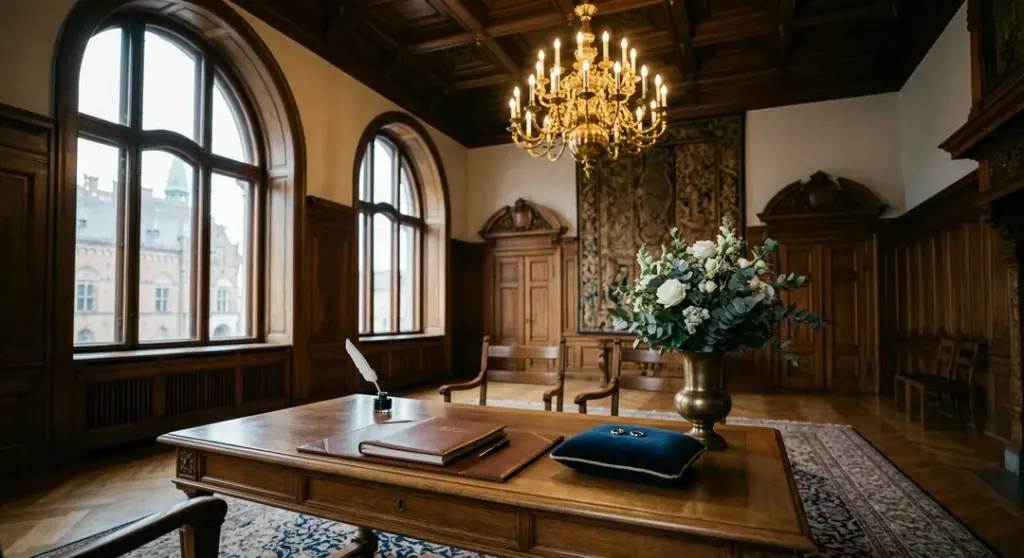
- The registrar takes you into the wedding room. In Aabenraa you sit in front of the registrar, the witnesses close by and the guests behind you.
- The registrar gives a short speech.
- The registrar asks each of you, by full name, whether you will take the other as your spouse. In Aabenraa you stand up for this question.
- After both of you have said yes, the registrar pronounces you married.
- You exchange rings, if you wish.
- You, your two witnesses and the registrar sign the marriage book.
- You receive your two marriage certificates.
Aabenraa adds a small gift from the municipality and a group photo taken by the registrar before you leave. Kolding also presents a gift from the municipality at the end.
How long does a civil ceremony in Denmark take?
Short. The City of Copenhagen says a City Hall ceremony lasts about 10 minutes from start to finish. Aabenraa says the whole event takes about 20 minutes. As a general guide, plan 10–15 minutes for the ceremony itself, and a little longer for arrival, the ID check and photos. Copenhagen warns that small delays can happen, so do not plan a tight connection straight afterwards.
What do we need to bring on the wedding day?
Bring the passports or ID cards you used for your application. Aabenraa says it plainly: bring the same travel documents you sent to Familieretshuset. In Copenhagen, partners without a Danish or Nordic CPR number follow the ID instructions in their booking receipt. Kolding asks couples from abroad to bring their passport and, where relevant, residence permit or visa. Haderslev asks for a valid passport and your permission to stay.
Some town halls want to see you before the wedding day:
- Kolding: register in person at the Citizen Service Office before the wedding; for a weekend ceremony or one outside opening hours, the day before.
- Sønderborg: couples from abroad marry on Fridays and register in person on the Thursday before.
- Haderslev: registration the day before the wedding.
- Copenhagen: no check-in; just follow the hearts on the floor to the waiting area.
Your approval must still be valid on the day: Tønder notes that it is valid for at most four months. Your legal stay in Denmark matters too. If the registrar learns that one of you no longer stays legally in Denmark, the wedding cannot go ahead (VEJ, point 3.5).
Rings, outfits and flowers are up to you. Aabenraa has a changing room in the waiting area.
What does the registrar say at a Danish civil ceremony?
The official guidance on marriage cases (VEJ, point 3.4) sets the wording of the legal part. After confirming your identity, the registrar reminds you that you have said you want to marry each other and asks the first partner, by full name, whether they will take the other, also by full name, as their spouse. The same question then goes to the second partner. When both have said yes, the registrar declares that you are now married.
Everything around this core, such as the short speech, music or the exchange of rings, is up to the municipality. Copenhagen and Aabenraa hold ceremonies in English, German or Danish; in Tønder the staff speak German and English.
Can we exchange rings and say our own vows?
Rings, yes. Copenhagen invites you to exchange rings after the question if you wish, and Aabenraa offers it after the pronouncement. Rings are not a legal requirement.
Personal vows are not mentioned on the official pages of Copenhagen, Tønder or Aabenraa. The legal part is always the registrar's question and your yes. If you would like to add a few words of your own, ask the town hall before the day; we can ask for you when we book.
Copenhagen, Tønder and Aabenraa compared
| Copenhagen | Tønder (Tondern) | Aabenraa (Apenrade) | |
|---|---|---|---|
| Length | About 10 minutes | Not stated | About 20 minutes for the whole event |
| Where | Wedding Hall, 1st floor of City Hall | Jomfrustien 8, 1st floor, opposite the town hall | Det gamle Rådhus, Storegade 30, 1st floor |
| Lift | No; the ceremony can move to the Great Hall if you ask at least one week ahead | No; couples with a disability marry in another building | Tell the town hall in advance if you or a guest need the lift |
| Guests | Up to 75, including children and the photographer | No limit stated | Seats for 20, up to 50 guests |
| Witnesses | Always two official witnesses | Free municipal witnesses Tue and Thu mornings | Free municipal witnesses Mon–Thu |
| Certificates | Two, in 5 languages | Two, in 5 languages, right after the ceremony | Two, in 5 languages |
| Extras | Drink and small cake allowed on the ground floor or in the garden | Staff speak German and English | Changing room, gift, group photo by the registrar |
Status: municipal websites, read on 23 November 2026. Details for each town are on our pages for Copenhagen, Tønder and Aabenraa. Days and times for your own or the municipality's witnesses are compared in our guide to witnesses at a Danish wedding.
Who can come, and can guests take photos?
Civil weddings in Denmark are public: the municipality must allow others to attend (VEJ, point 3.3). In practice you decide whom to invite, within the room's limit: up to 75 guests in Copenhagen, including children and the photographer, and up to 50 in Aabenraa, which has seats for 20.
Guests may take photos and film in Copenhagen, and family who cannot travel can join by video call. In Aabenraa a photographer or a guest may stand next to the registrar. Without guests, the witnesses can take photos with your phone in both towns. For a professional photographer and the best spots afterwards, read our guide to a wedding photographer in Denmark.
Copenhagen does not allow rice, confetti or similar inside City Hall or on its steps (rice is fine on City Hall Square), no helium balloons inside, and no dogs except service dogs.
What if one of us does not understand the language?
Both of you must understand the ceremony. Copenhagen says this is required by law; Aabenraa says that if it cannot communicate with both of you, it cannot marry you. For any language other than English, German or Danish, you bring your own interpreter. Since 1 July 2025, children under 18 may generally not interpret with Danish authorities (Marriage Act § 58 e), with narrow exceptions. Plan for an adult interpreter and confirm the arrangement with the town hall before the day.
When do we get the marriage certificate?
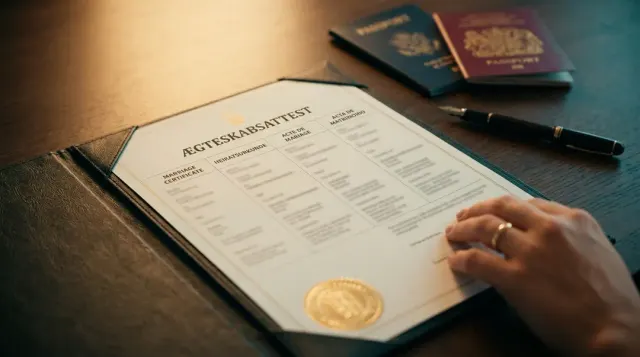
Immediately. Danish rules say the municipality hands over the marriage certificate (vielsesattest) straight after the ceremony, and the registrar, the two of you and the witnesses sign the marriage book (VEJ, point 3.4; borger.dk). Copenhagen, Tønder and Aabenraa each give you two international certificates in Danish, English, German, French and Spanish.
The marriage is valid under Danish law; recognition and legal effects abroad depend on the destination country. What the certificate shows, and when you need an apostille on it, is explained in our guide to the Danish marriage certificate.
Can we change our surname at the wedding?
Usually not, if you live abroad. Tønder states that a name change at a Danish wedding is not possible for people who are not registered in Denmark, and the certificate shows your names as in your passports on the wedding day. Aabenraa says the same for couples living abroad. You change your name later in your home country; see name change after a Danish wedding.
Can the wedding be refused on the day?
Rarely, but yes. The registrar must not marry you if it becomes clear that the conditions for marriage are not met after all, for example if one of you no longer stays legally in Denmark, if documents appear false, if someone tries to marry on another person's passport, or if it is obviously a sham marriage (VEJ, points 3.4 and 3.5). With complete, genuine documents and a valid approval, this is not something you need to worry about.
What happens after the ceremony?
In Copenhagen you may celebrate with a drink and a small cake in the Great Hall, the ground-floor corridors or the City Hall Garden, but not on the first floor or the balcony. City Hall closes at 16:00 on weekdays and 13:00 on Saturdays. Many couples then go for photos around the city; our romantic photo spots in Copenhagen and the guide to a reception or dinner in Copenhagen help with the rest of the day.
Haderslev, for example, reminds couples to register their marriage with the authorities at home. What to do next, country by country, is in married in Denmark: what next.
What to wear, including for the stairs and the weather, is in what to wear to a town hall wedding in Denmark.
How DWS helps
- Comfort Package, €799.00: the official 2,100 DKK fee (2026) is included in our package. We check your documents, submit your application to Familieretshuset, book your ceremony date and make sure two witnesses are there, in Copenhagen, Tønder, Aabenraa or any other Danish municipality.
- Your day plan: before the wedding we tell you when to arrive, which documents to bring and whether your town hall wants you to register the day before. If you would like personal words or a ceremony in German or English, we ask the town hall when we book.
- After the wedding: if you need an apostille on your Danish marriage certificate, our optional Apostille Service (€100) takes care of it, also after you have left Denmark.
Our founders married at Copenhagen City Hall themselves in 2018; you can read our story. The short video on this page shows how a City Hall wedding works.
Frequently asked questions about the ceremony
How long does a civil wedding ceremony in Denmark take?
About 10–15 minutes. The City of Copenhagen says a City Hall ceremony lasts about 10 minutes; Aabenraa plans about 20 minutes for the whole event.
What do we need to bring to the ceremony?
The same passports or ID cards you sent to Familieretshuset with your application. Copenhagen sends ID instructions with the booking receipt, and Kolding, Sønderborg and Haderslev ask couples from abroad to register in person before the wedding day.
Can we exchange rings at a Danish town hall wedding?
Yes. Copenhagen and Aabenraa both offer the exchange of rings during the ceremony if you wish. Rings are not a legal requirement.
When do we receive the marriage certificate?
Straight after the ceremony. Copenhagen, Tønder and Aabenraa each hand over two international marriage certificates in Danish, English, German, French and Spanish.
Can guests attend and take photos?
Yes. Civil weddings in Denmark are public by law. Copenhagen allows up to 75 guests and lets guests photograph and film; Aabenraa welcomes up to 50 guests and lets a photographer stand next to the registrar.
Sources
- Danish Marriage Act (ægteskabsloven), LBK no. 663 of 1 July 2026, § 20, § 21 and § 58 e (in Danish) – read 23 November 2026
- Guidance on marriage cases, VEJ no. 10410 of 19 December 2022, points 3.3–3.5 (in Danish) – read 23 November 2026
- borger.dk – Når I vil giftes (in Danish) – read 23 November 2026
- City of Copenhagen – City Hall wedding – read 23 November 2026
- Tønder Kommune – Marriage – read 23 November 2026
- Aabenraa Kommune – Marriage Registry Office – read 23 November 2026
- Aabenraa Kommune – Vielse (in Danish) – read 23 November 2026
- Kolding Kommune – International marriages – read 23 November 2026
- Sønderborg Kommune – Wedding – read 23 November 2026
- Haderslev Kommune – Marriage – read 23 November 2026
Written by Ludmila Bernowski, co-founder of Denmark Wedding Services; reviewed by Shenol Reetz, co-founder. Denmark Wedding Services is not a law firm; this guide is general information, not legal advice. Last checked: 23 November 2026.
Watch Our Video
Follow us on YouTube, Instagram & TikTok for more wedding tips
Ready to Start Your Danish Wedding?
Fill out our free checklist in about 2 minutes — we'll send you a personalized document list and guide you through every step.
Start Free Checklist →