Both Partners Non-EU: Marrying in Denmark
Reviewed by Ludmila Bernowski, CEO & Co-Founder of Denmark Wedding Services. Last reviewed: November 2026. Practical, experience-based information, not legal advice — for legal questions, consult a qualified lawyer. Our Google Business Profile and reviews
Short answer: Yes, two non-EU citizens can marry in Denmark. Neither of you needs to live in Denmark or in Europe, but each partner must be able to enter and stay in Denmark lawfully, and each uploads their own proof: a Schengen visa or visa-free entry with the EES printouts, or a Schengen residence permit. Documents follow the rules of the country that issued them, and the marriage itself gives neither of you a right to stay.
On this page
- Can two non-EU citizens marry in Denmark?
- Does each of us need lawful stay?
- What lawful-stay proof does each partner upload?
- What do our passports need?
- Which documents does each of us need, and do they need an apostille?
- We live together in a third country. What changes?
- Do we need the section 11 b declaration?
- Will Familieretshuset ask about our relationship?
- Does a Danish marriage give either of us a right to stay?
- Is our marriage recognised in our home countries?
- Is there a guide for your nationality?
- How DWS helps
- Frequently asked questions
Who this guide is for: Couples where neither partner is a citizen of an EU or EEA country: for example an Indian and a Pakistani partner, a Russian and a Kazakh, an American and a Filipino, or two partners who live together in the Gulf states or in Asia. If one of you is an EU citizen, our guide for binational couples fits better.
Key points
- The Danish Agency of Family Law (Familieretshuset) handles the application whenever at least one partner is a citizen of a country outside Europe or the EEA, so two non-EU partners apply there together.
- Each partner must be able to enter and stay in Denmark lawfully on the wedding day; one partner's visa or permit does not cover the other.
- Since 10 April 2026, visa holders and visa-free travellers upload printouts from the EU "Check how long you can stay" calculator; a Schengen residence permit is proof on its own.
- Each passport must be valid for at least 3 months beyond the stay, have at least 2 empty pages and have been issued within the last 10 years.
- Apostille or legalisation depends on the country that issued each document, not on your nationality, so you may have two different chains.
- The section 11 b declaration is not needed when both of you have only a temporary stay in Denmark.
- A Danish wedding is valid under Danish law; recognition and legal effects abroad depend on each home country.
- The Denmark Wedding Services Comfort Package costs €799.00 and includes the Danish authority fee (2,100 DKK in 2026) and two witnesses, in every Danish kommune.
Couples from two countries outside Europe often assume that Denmark is only for couples with a European partner. It is not. This guide sets out what is different when you both come from outside the EU: two passports, two sets of lawful-stay proof, documents from two issuing countries and recognition in two home countries. Entry rules by nationality are in our guide to the visa requirements for marrying in Denmark; this page does not repeat them. The video on this page sums up visa and entry for international couples.
Can two non-EU citizens marry in Denmark?
Yes. Familieretshuset handles international marriages where at least one partner is a citizen of a country outside Europe or the EEA, and that includes couples where both are. You do not need a Danish address, a Danish personal number or residence in Europe. You must meet the conditions of the Danish Marriage Act and be able to enter and stay in Denmark lawfully.
Familieretshuset publishes how its cases split by citizenship. In 2021 it received 13,454 applications; 2,818 of them came from couples where both partners were third-country citizens, about one in five. In the same year 2,339 of the 11,650 cases closed with a certificate were in that group. These are counts of cases received and closed within the year, not an approval rate, and 2021 is the latest breakdown we could verify.
Does each of us need lawful stay?
Yes, each partner separately. Familieretshuset says you must be able to legally enter and stay in Denmark to marry, and adds: "It is your responsibility to ensure that your entry into Denmark is lawful." Lawful residence can rest, among other things, on citizenship of a visa-free country, a Danish residence permit, or a visa for Denmark or another Schengen country, including a tourist visa.
There is no special marriage visa. Short stays in the Schengen area are limited to 90 days in any 180-day period. If one of you travels visa-free and the other needs a visa, each follows their own rules, and the stay must still be lawful on the wedding day itself.
Procedural residence does not count. Life in Denmark states that "procedural residence is not lawful residence in the sense of the Danish Marriage Act", so someone who may stay only while an application is being processed will normally not be allowed to marry. A waiver exists only in special circumstances. Which residence papers count is covered in our guide on which residence permits count.
What lawful-stay proof does each partner upload?
Since 10 April 2026, when the EU Entry/Exit System (EES) became fully operational, Familieretshuset asks for the following per partner:
| Partner's situation | What to upload |
|---|---|
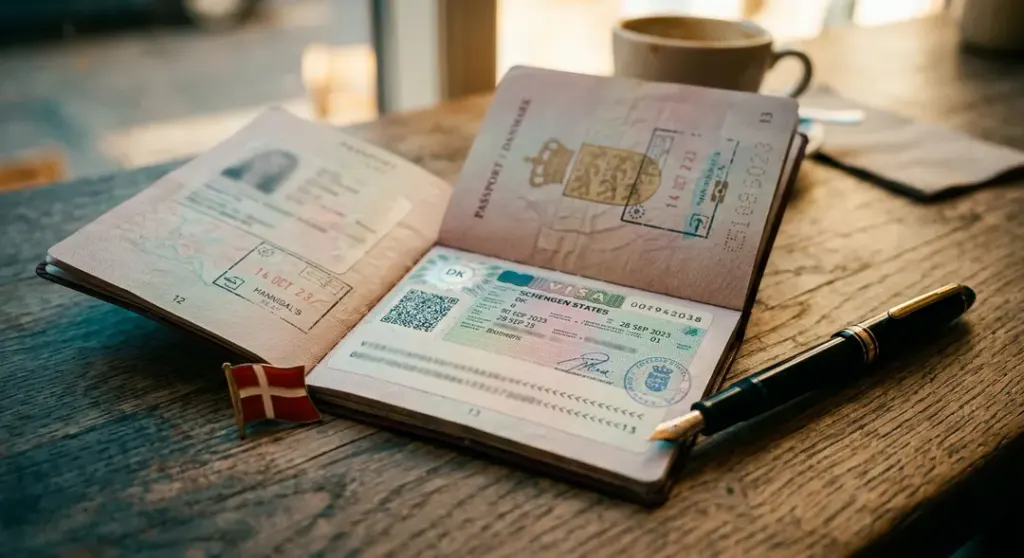
| Schengen visa holder | Visa sticker, printouts of the EES calculator data and result pages, plane tickets or boarding passes |
| Visa-free traveller | Printouts of the EES calculator data and result pages, plane tickets or boarding passes |
| Not yet in the Schengen area when applying | Visa sticker (if any) and the EES printouts for the planned stay |
| Residence permit from a Schengen country | The residence permit alone |
So a couple can need two different sets: for example one visa sticker with printouts for one partner and only the printouts for the other. Our guide on how to create the EES printout shows each step.
What do our passports need?
For non-EU citizens Familieretshuset sets three rules: the passport must be valid for at least 3 months beyond your stay, contain at least 2 empty pages and have been issued within the last 10 years. A passport older than 10 years cannot be used for travel to Denmark, even if its validity was extended.
You upload colour pictures of every page of each passport, including the covers and blank pages, in very high quality. The approval is valid for 4 months, but if either partner's passport, visa or residence permit expires earlier, Familieretshuset shortens it to match. With two passports and two visas, the earliest expiry date counts.
Which documents does each of us need, and do they need an apostille?
Many couples need fewer papers than they fear. Each partner uploads a passport and the lawful-stay proof above. Other documents depend on your situation:
- a divorce decree, death certificate or annulment if one of you was married before;
- birth certificates if you have children together;
- a residence certificate or similar document if you live together outside Denmark.
The Familieretshuset application does not ask for a marital status certificate up front. Life in Denmark mentions one from your current country of residence, and Familieretshuset may ask for it while processing the case; if it does, we tell you exactly what to get.
The apostille rule follows the country that issued each document, not your passport. Documents from the USA, Canada, Australia, New Zealand, Turkey, the UK and most European countries normally need neither an apostille nor legalisation. Documents from Albania, Armenia, Azerbaijan, Belarus, Bosnia and Herzegovina, Georgia, Kazakhstan, Kosovo, Kyrgyzstan, Russia, Tajikistan, Ukraine and Uzbekistan, and from other countries that have joined the Apostille Convention, need an apostille from the issuing country. Documents from countries outside the Convention normally need legalisation in the issuing country. Our apostille and legalisation guide by country has the details.
Documents not in Danish, English or German must be translated by an authorised translator, and the translation must include the apostille or, for legalised documents, all stamps and markings.
We live together in a third country. What changes?
If you live together outside Denmark, for example in the United Arab Emirates, Familieretshuset asks for a residence certificate or a similar document. Upload it in the original language with a translation into Danish, English or German if needed. Whether it also needs an apostille or legalisation depends on the country that issued it, so we check it before we submit.
Where you live does not change your visa situation: each partner enters Denmark under the rules for their own nationality, unless one of you holds a residence permit from a Schengen country.
Do we need the section 11 b declaration?
Normally not. The declaration on the family reunification rules is required when one partner has a residence basis through Danish or Nordic citizenship or a Danish residence permit and the other has only a temporary basis. It is not needed when both of you have only a temporary residence basis in Denmark, which is the usual case for two non-EU partners travelling in for the wedding.
Will Familieretshuset ask about our relationship?
It may. To prevent sham marriages, Familieretshuset can ask how long you have known each other, where you met, whether you have children together and whether you live or have lived together. It may contact you during processing or invite you to an interview. Photos are not required, but if the relationship is insufficiently documented it may ask for unedited photos of you together. Our guide to proof of relationship explains what helps.
Familieretshuset aims for about 5 working days once the application is complete; that is a target, not a guarantee. Where it has asked for more information, it is currently working on applications received in October 2026. The wedding date is a separate step and depends on the town hall.
Does a Danish marriage give either of us a right to stay?
No. Marrying in Denmark does not by itself give either partner a right to live in Denmark or anywhere else in the EU. Where you live after the wedding is decided under the immigration rules of that country, in a separate application. Signing the section 11 b declaration, where it applies, does not take away the right to apply for family reunification later. Our guide to family reunification after a Danish wedding covers the next steps.
Denmark Wedding Services is not a law firm. We provide practical and administrative support for marrying in Denmark; questions about residence, immigration or family reunification belong with the relevant authority or a qualified lawyer.
Is our marriage recognised in our home countries?
A Danish marriage is valid under Danish law; recognition and legal effects abroad depend on the destination country. With two home countries, the rules of both apply, and they can differ: one country may register the marriage, the other may ask for further steps. Ask each country's authority or embassy before the wedding.
To use the Danish certificate abroad you usually need an apostille on it; for countries outside the Apostille Convention the route is legalisation. An apostille authenticates the certificate; it does not create recognition. The certificate itself is explained in our guide to the Danish marriage certificate, and the stamp in our guide to the apostille on a Danish marriage certificate. For Russia there is a separate guide on recognition of a Danish marriage in Russia.
Country detail for the most common partner nationalities is in our guides for couples with an Indian, Ukrainian, Russian or Belarusian, Turkish, Filipino, Chinese or American partner.
If one of you lives in Denmark, whether you apply to the kommune or to Familieretshuset is explained in living in Denmark and marrying a foreign partner.
Is there a guide for your nationality?
The rules on this page apply to every nationality. What differs, mainly the authentication of documents and entry, is covered country by country in these guides:
- Europe and the Caucasus: a Ukrainian partner, a Russian or Belarusian partner, a Moldovan partner, a partner from the Western Balkans, a partner from Georgia, Armenia or Azerbaijan, a Turkish partner
- Central Asia: a Kazakh partner, an Uzbek, Kyrgyz or Tajik partner
- East and South-East Asia: a Chinese partner, a Japanese or Korean partner, a Vietnamese partner, a Thai partner, a Filipino partner, an Indonesian partner
- South Asia: an Indian partner, a Pakistani partner, a Sri Lankan, Bangladeshi or Nepali partner
- Middle East: an Afghan, Iranian or Iraqi partner, a Syrian partner, civil marriage for Israelis, civil marriage for Lebanese couples, couples from the Gulf states
- Africa: an Egyptian partner, a partner from Morocco, Tunisia or Algeria, a Nigerian or Ghanaian partner, a Kenyan or East African partner, a partner from Cameroon, Togo, Senegal or Côte d’Ivoire, South African citizens
- Americas and Oceania: an American partner, US service members stationed in Germany, a Latin American partner, Canadian citizens, Australians and New Zealanders
How DWS helps
We give each partner a separate document list, check both apostille or legalisation chains and both partners' lawful-stay proof before you book your travel, and tell you in advance if a document is likely to cause a request for more information.
The Comfort Package costs €799.00 and includes the Danish authority fee (2,100 DKK in 2026), a personal checklist, the check of all documents, the application to Familieretshuset with all communication, the booking of your wedding date and two witnesses, in every Danish kommune. Optional extras: the €100 Apostille Service on your finished Danish certificate, and German ⇄ Russian translation at €50 per document. Your first step is the free document checklist, which asks for each partner's citizenship separately; if your situation is unusual, write to us before you apply. The full list of papers is in our guide to the documents for a Danish wedding.
Frequently asked questions
Can two non-EU citizens marry in Denmark?
Yes. Neither of you needs to live in Denmark or in Europe. You must meet the conditions of the Danish Marriage Act, and each partner must be able to enter and stay in Denmark lawfully on the wedding day.
Do we each need a visa to marry in Denmark?
There is no special marriage visa. Each partner needs their own basis to stay: a Schengen visa, visa-free entry for their nationality, or a residence permit from a Schengen country.
What lawful-stay proof does each of us upload?
A visa holder uploads the visa sticker, the EES calculator printouts and the tickets; a visa-free traveller uploads the EES printouts and the tickets; a holder of a Schengen residence permit uploads the permit alone.
Do both partners’ documents need an apostille?
It depends on the country that issued each document, not on your nationality. Documents from the USA, Canada, Australia, New Zealand, Turkey, the UK and most European countries normally need none; others need an apostille or legalisation in the issuing country.
Do we need the section 11 b declaration?
Not if both of you have only a temporary stay in Denmark. It is needed when one partner has Danish or Nordic citizenship or a Danish residence permit and the other only a temporary stay.
Does a Danish marriage give either of us a right to live in Denmark?
No. Marrying in Denmark does not by itself give a right to live in Denmark or elsewhere in the EU. Residence after the wedding is a separate application under the rules of the country concerned.
Sources
- Familieretshuset — You are a citizen of a country outside Europe/EEA, read 2026-11-23
- Familieretshuset — Legal residence for marriage in Denmark, read 2026-11-23
- Familieretshuset — Documentation of legal stay in Schengen for non-EU citizens (from 10 April 2026), read 2026-11-23
- Familieretshuset — Apply for a certificate of marital status, read 2026-11-23
- Familieretshuset — Documentation requirements, read 2026-11-23
- Familieretshuset — Family reunification rules, section 11b declaration, read 2026-11-23
- Familieretshuset — Banning sham marriages, read 2026-11-23
- Familieretshuset — International marriages 2021 (statistics, Danish, PDF), read 2026-11-23
- Life in Denmark — If you wish to get married in Denmark, read 2026-11-23
- European Commission — Entry/Exit System fully operational from 10 April 2026, read 2026-11-23
Written by Ludmila Bernowski, CEO and co-founder of Denmark Wedding Services. All facts checked against the official sources above on 23 November 2026.
Watch Our Video
Follow us on YouTube, Instagram & TikTok for more wedding tips
Ready to Start Your Danish Wedding?
Fill out our free checklist in about 2 minutes — we'll send you a personalized document list and guide you through every step.
Start Free Checklist →