Is a Danish Marriage Recognised in Russia? Apostille, Translation, ZAGS and Passport Stamp
Reviewed by Ludmila Bernowski, CEO & Co-Founder of Denmark Wedding Services. Last reviewed: November 2026. Practical, experience-based information, not legal advice — for legal questions, consult a qualified lawyer. Our Google Business Profile and reviews
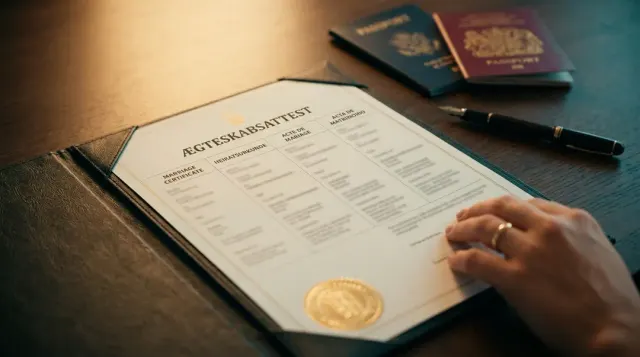
Short answer: Yes, under the conditions of Russian law. Article 158 of the Russian Family Code recognises a marriage of a Russian citizen concluded abroad under the law of that country, unless an impediment under Article 14 applies, such as an existing marriage. You do not marry again in Russia. To use the Danish certificate there, it needs an apostille and a Russian translation with notarised accuracy; the passport stamp is optional.
On this page
- Is a marriage concluded in Denmark valid in Russia?
- Do we have to register the marriage again in Russia?
- What steps make the Danish certificate usable in Russia?
- Why does the Danish certificate need an apostille for Russia?
- Who translates the certificate into Russian?
- Do we have to inform the ZAGS in Russia?
- Is the passport stamp required?
- Does Russia recognise a same-sex marriage from Denmark?
- What if we live in Germany or another EU country?
- What about Kazakhstan, Uzbekistan, Kyrgyzstan or Tajikistan?
- How does Denmark Wedding Services help?
- Frequently asked questions about recognition in Russia
Who this guide is for: Couples where at least one partner is a Russian citizen, living in Russia, Germany or elsewhere, who have married in Denmark or plan to, and who want to know what to do so that the marriage can be used with Russian authorities. A short section at the end covers Kazakhstan, Uzbekistan, Kyrgyzstan and Tajikistan.
Key points
- The marriage is valid under Danish law; recognition and legal effects abroad depend on the destination country. In Russia, Article 158 of the Family Code applies.
- There is no second wedding and no separate recognition procedure in Russia.
- Russian law recognises foreign civil-status documents once they are legalised, unless a treaty says otherwise. Denmark and Russia are both parties to the Hague Apostille Convention, so an apostille replaces legalisation.
- Russian authorities need a translation into Russian whose accuracy is notarised; it should cover the apostille as well.
- Russian law provides that a Russian citizen sends information about a marriage registered abroad to a ZAGS office or a Russian consulate within one month of the wedding.
- The marriage stamp in the Russian internal passport is made only at the citizen's request.
- Russia does not recognise same-sex marriages.
Our co-founder Mila was born in Russia and is a state-sworn translator for Russian and German in Germany, so Russian-speaking couples often ask us what happens with the marriage "back home". This guide sets out the steps in the order they usually happen, with the official Russian sources as of November 2026. It covers the time after the wedding; the documents a Russian partner needs before the wedding are in our guide to marrying a Russian or Belarusian partner in Denmark.
Is a marriage concluded in Denmark valid in Russia?
Yes, if the conditions are met. Under Article 158(1) of the Russian Family Code, marriages between Russian citizens, or between a Russian citizen and a foreign citizen or stateless person, concluded outside Russia in line with the law of the country where they were concluded, are recognised as valid in Russia if none of the impediments in Article 14 apply. Article 158(2) applies the same rule to marriages between foreign citizens.
The impediments in Article 14 are: one partner is already in another registered marriage, the partners are close relatives, one is the adoptive parent of the other, or one has been declared legally incapacitated by a court. A civil ceremony at a Danish town hall follows the Danish form once the Danish Agency of Family Law (Familieretshuset) has examined and approved the application.
Do we have to register the marriage again in Russia?
No. Russian law does not ask you to marry again or to have the Danish marriage confirmed by a court. What Russian law does ask for is information about the wedding (next section) and, for every official use, the Danish certificate in a form that Russian authorities accept: with an apostille and a notarised Russian translation.
What steps make the Danish certificate usable in Russia?
The usual order is:
| Step | What happens | Who |
|---|---|---|
| 1. Marriage certificate | After the ceremony you receive the Danish marriage certificate, available in an international version in Danish, English, German, French and Spanish | The kommune |
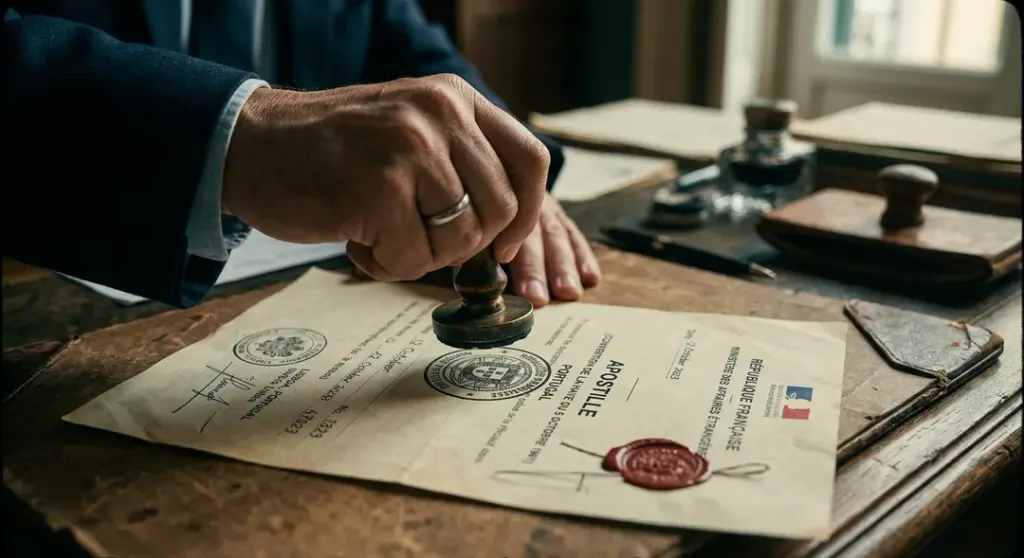
| 2. Apostille | An apostille is placed on the Danish certificate | Danish authorities; DWS arranges it as the Apostille Service for €100 |
| 3. Translation | The certificate and the apostille are translated into Russian and the accuracy of the translation is notarised | A Russian notary, or a Russian consulate abroad |
| 4. Notice to the ZAGS | Information about the marriage is sent to a ZAGS office or a Russian consulate within one month of the wedding | The Russian spouse |
| 5. Passport stamp (optional) | At your request, the marriage stamp is put in the internal passport | ZAGS |
What the Danish certificate shows and how to get more copies is explained in the Danish marriage certificate explained.
Why does the Danish certificate need an apostille for Russia?
Under Article 13(1) of the Russian Federal Law on civil-status acts, documents issued by foreign authorities to certify civil-status acts are recognised in Russia once they are legalised, unless an international treaty of Russia provides otherwise. The Hague Apostille Convention is such a treaty: according to the HCCH status table, it has applied in Russia since 31 May 1992 and in Denmark since 29 December 2006. An apostille therefore replaces consular legalisation.
This apostille goes on the finished Danish marriage certificate. It is a different step from the apostille on your own Russian documents, such as a divorce certificate, before the application in Denmark. How the apostille on the Danish certificate works is explained in our guide to the apostille on the Danish certificate. The video on this page (in English) shows the same step in one minute.
Who translates the certificate into Russian?
Article 7(1) of the same law says that documents issued by foreign authorities must be translated into Russian and that the accuracy of the translation must be notarised. In practice this is done by a translator whose signature a Russian notary certifies, or at a Russian consulate abroad. The translation should cover the apostille, so ask for both to be translated together.
The Danish certificate has no Russian version. Denmark Wedding Services offers certified German ⇄ Russian translation for €50 per document, done by a translator sworn in Germany. Whether a Russian office accepts a translation made in Germany for this purpose is decided by that office, so ask it before you order one. Translation before the wedding is a separate topic, covered in our guide to translating documents for a Danish wedding.
Do we have to inform the ZAGS in Russia?
Russian law provides for it. Under Article 13.1(4) of the Federal Law on civil-status acts, a Russian citizen whose civil-status act was registered by a foreign authority sends information about it to the ZAGS office at their place of residence or to a Russian consulate, no later than one month after the registration abroad. The procedure is set by Government Decree No. 1193 of 4 October 2018, as amended on 14 February 2024.
According to these rules:
- You send the notice in person, by post or through your personal account on Gosuslugi (not available for consulates).
- You attach copies of the Danish certificate with a Russian translation and of your Russian ID; copies and the translation must be notarised unless you show the originals in person.
- The notice states whether the foreign document carries an apostille.
- If the information is accepted, you receive a certificate with the record number in the Unified State Register of civil-status records.
The rules also say that including the information in the register does not in itself recognise the foreign document as valid in Russia. Because of the one-month time limit, order the apostille straight after the wedding. What happens if the deadline is missed is not explained in these sources; ask the ZAGS office or a Russian consulate.
Is the passport stamp required?
No. Under item 6 of the Regulation on the Russian internal passport (Government Decree No. 2267 of 23 December 2023), the marriage and divorce stamps are made at the citizen's request, by the bodies that register civil-status acts. The regulation lists a marriage certificate issued by a foreign competent authority among the documents that can be presented for the stamp. Ask your ZAGS office which form of the certificate it wants to see.
Does Russia recognise a same-sex marriage from Denmark?
No. Denmark allows same-sex marriage, but the Russian Constitution, since the 2020 amendments, protects "the institution of marriage as a union of a man and a woman" (Article 72(1)(ж.1)), and Russia does not recognise same-sex marriages concluded abroad. More on the Danish side in our guide to same-sex marriage in Denmark.
What if we live in Germany or another EU country?
Then the Danish certificate is used there first. Within the EU it needs no apostille (Regulation (EU) 2016/1191), and the international version includes German. What it means in Germany is explained in our guide to recognition of a Danish marriage in Germany. For Russian authorities, for example at a consulate, you still need the apostille and the Russian translation described above.
What about Kazakhstan, Uzbekistan, Kyrgyzstan or Tajikistan?
Each country applies its own law, so check with its authorities or consulate. What the official sources show so far:
- Apostille: according to the HCCH status table, the Apostille Convention applies in Kazakhstan (since 30 January 2001), Kyrgyzstan (31 July 2011), Uzbekistan (15 April 2012) and Tajikistan (31 October 2015). For Kyrgyzstan, Tajikistan and Uzbekistan the table marks objections by some states to their accession, so ask the authority there whether the apostille alone is enough.
- Uzbekistan: the government portal gov.uz states that marriages of Uzbek citizens concluded abroad under the law of that country are recognised as valid, unless an impediment under the Uzbek Family Code applies.
- Kazakhstan: the details for Kazakh citizens are in our guide to marrying a Kazakh partner in Denmark.
Before the wedding, documents from all four countries need an apostille for Familieretshuset, as our guide to apostille and legalisation by country explains.
How does Denmark Wedding Services help?
We handle the Danish side, so the marriage rests on sound paperwork from the start. The Comfort Package costs €799.00: we check your documents and their apostilles, file the application with Familieretshuset, book the ceremony date in the Danish kommune you choose and provide two legal witnesses. The official 2,100 DKK fee (2026) is included in our package. After the wedding, our Apostille Service puts the apostille on the Danish certificate for €100; it is optional and can be ordered after you have left Denmark.
We answer in Russian, English, German, Spanish and French. The steps in Russia itself (translation, notice to the ZAGS, passport stamp) are done by you with the Russian authorities. Your first step is the free document checklist; what else to arrange at home is listed in married in Denmark: what to do next. Questions: write to us.
Denmark Wedding Services is not a law firm. We provide practical and administrative support for marrying in Denmark; for individual questions about recognition or civil-status registration in Russia, ask the Russian authorities, a Russian consulate or a qualified lawyer.
Written by Ludmila Bernowski, CEO & Co-Founder of Denmark Wedding Services, state-sworn translator for Russian and German; reviewed by Shenol Reetz, co-founder. Last reviewed: 23 November 2026.
Frequently asked questions about recognition in Russia
Is a marriage from Denmark valid in Russia?
Yes, if it was concluded under Danish law and no impediment under Article 14 of the Russian Family Code applies, such as an existing marriage or close kinship (Article 158 of the Family Code). There is no separate recognition procedure.
Do we have to marry again or re-register the marriage in Russia?
No. You do not marry again. Russian law provides that the Russian spouse sends information about the marriage to a ZAGS office or a Russian consulate within one month of the wedding (Article 13.1(4) of the Federal Law on civil-status acts).
Does the Danish certificate need an apostille for Russia?
Yes. Russia recognises foreign civil-status documents once they are legalised, and under the Hague Apostille Convention, which applies in both Denmark and Russia, an apostille replaces legalisation. DWS arranges it through the Apostille Service for €100.
Does the certificate need a Russian translation?
Yes. The Danish certificate has no Russian version. Russian law asks for a translation into Russian whose accuracy is notarised, for example by a Russian notary or at a Russian consulate; it should cover the apostille as well.
Is the marriage stamp in the Russian passport mandatory?
No. Under item 6 of the Regulation on the Russian passport (Decree No. 2267 of 23 December 2023), the marriage stamp is made only at the citizen’s request, by the civil registry.
Does Russia recognise a same-sex marriage from Denmark?
No. The Russian Constitution protects marriage as a union of a man and a woman (Article 72), and Russia does not recognise same-sex marriages concluded abroad.
Sources
- Family Code of the Russian Federation, Article 158 (in Russian) (read 2026-11-23)
- Family Code of the Russian Federation, full text incl. Article 14 (in Russian) (read 2026-11-23)
- Federal Law No. 143-FZ on civil-status acts, Articles 7, 13 and 13.1 (in Russian) (read 2026-11-23)
- Government Decree No. 1193 of 4 October 2018, rules for sending information on civil-status acts registered abroad, as amended 14 February 2024 (in Russian) (read 2026-11-23)
- Government Decree No. 2267 of 23 December 2023, Regulation on the Russian passport (in Russian) (read 2026-11-23)
- Constitution of the Russian Federation, Article 72 (in Russian) (read 2026-11-23)
- HCCH: status table of the Apostille Convention (read 2026-11-23)
- Your Europe: getting your public documents accepted in the EU (read 2026-11-23)
- City of Copenhagen: get a new marriage certificate, international version (read 2026-11-23)
- gov.uz: recognition of marriages of Uzbek citizens concluded abroad (in Russian) (read 2026-11-23)
- Familieretshuset: documentation requirements (apostille and translation) (read 2026-11-23)
Watch Our Video
Follow us on YouTube, Instagram & TikTok for more wedding tips
Ready to Start Your Danish Wedding?
Fill out our free checklist in about 2 minutes — we'll send you a personalized document list and guide you through every step.
Start Free Checklist →