Marrying a Non-EU Partner in Denmark: Law and Life After the Wedding
Reviewed by Ludmila Bernowski, CEO & Co-Founder of Denmark Wedding Services. Last reviewed: October 2026. Practical, experience-based information, not legal advice — for legal questions, consult a qualified lawyer. Our Google Business Profile and reviews
Short answer: Yes. You can marry a non-EU partner in Denmark, and neither of you has to live there: both must be 18 or older, unmarried, not closely related and lawfully in Denmark. Denmark asks for no Certificate of No Impediment. What changes for a mixed couple is whose law applies at home and where you can live together afterwards.
On this page
- Whose law applies when you have different nationalities?
- Why do binational couples choose Denmark?
- Which documents does each partner need?
- What is different in the process for a binational couple?
- What applies to partners from Russia, Ukraine, Turkey, China, India or Latin America?
- Can same-sex binational couples marry in Denmark?
- Where can you live together after the wedding?
- Do you have to register a Danish marriage in your home countries?
- How does Denmark Wedding Services help binational couples?
- FAQs About Marrying a Non-EU Partner in Denmark
Who this guide is for: Couples with two different nationalities, especially where one partner is from outside the EU/EEA, whether you live together, in two different countries or in a third country.
Key points
- Danish law decides whether you may marry in Denmark; your home countries decide whether they recognise the marriage and what it changes for you there.
- The non-EU partner must be in Denmark lawfully (visa-free, on a Schengen visa or with a Schengen residence permit) and shows it with the visa, the residence permit or, if visa-free, proof of the entry date.
- An apostille or legalisation depends on the country that issued the document; a passport never needs one.
- Familieretshuset generally processes complete applications in about 5 working days after submission (as of September 2026; a target, not a guarantee).
- A Danish marriage does not by itself give either partner the right to live in Denmark or in the other partner's country.
- The Comfort Package from Denmark Wedding Services costs €799.00, including the Danish authority fee and two legal witnesses.
If one of you is not an EU citizen, Denmark asks for fewer documents than many countries do: no Certificate of No Impediment, no birth certificates of the couple, and documents in Danish, English or German are accepted without translation. This is one reason couples with different nationalities choose a civil wedding in Denmark. Our founder Ludmila Bernowski married her partner, who has a different nationality, in Denmark in 2018. This guide covers what is specific to mixed-nationality couples: whose law applies, what each partner needs, how to enter Denmark and where you can live afterwards. For the general overview of requirements, process and locations, see our guide to marrying in Denmark as an international couple.
Whose law applies when you have different nationalities?
A binational marriage touches three sets of rules. Keeping them apart avoids most surprises:
| Question | Decided by |
|---|---|
| May you marry in Denmark? | Danish law, checked by Familieretshuset (Danish Agency of Family Law) |
| Is the ceremony valid? | Danish law; the Danish marriage certificate is the proof |
| Is the marriage recognised at home, and with what effects? | The law of each partner's home country |
| May the non-EU spouse live with you? | The immigration rules of the country where you want to live |
Denmark applies its own conditions to every couple, whatever the nationalities: both partners must be at least 18, unmarried (a previous marriage must be dissolved), not closely related, and lawfully able to enter and stay in Denmark. A pending asylum or residence application is not lawful stay in this sense, so couples in that situation normally cannot marry in Denmark. Familieretshuset also checks that the marriage is genuine and asks about your relationship: how long you have known each other, where you met, whether you live or have lived together and whether you have children together. Photos of you as a couple are not a requirement, but the agency may ask for unedited photos if the application does not document the relationship well enough. That is why Denmark Wedding Services asks for photos, travel tickets or chat history to support your answers.
Most countries recognise a marriage that was validly concluded where it took place. There are exceptions, for example for same-sex marriages or where a partner could not marry under the law of their own country. Check with the registry office or consulate of each home country before the wedding if you are unsure.
Why do binational couples choose Denmark?
EU and non-EU citizens marry under the same Danish rules, neither partner has to live in Denmark, and there is no Certificate of No Impediment. The general reasons couples choose Denmark are in our guide to marrying in Denmark as an international couple, and the entry rules for each combination of nationalities are in our Denmark wedding visa guide.
If your partner is British, read our guide to getting married in Denmark as a UK citizen after Brexit: since Brexit, British citizens are third-country nationals in the EU, but they still enter the Schengen area visa-free for up to 90 days.
Which documents does each partner need?

Each partner brings their own set of documents; both sets go into one joint application. The 5-working-day target starts only when both sets are complete. Nationality plays no role in the approval; with a non-EU partner, Familieretshuset adds two checks: lawful stay in Denmark and, depending on the country that issued the documents, an apostille or legalisation.
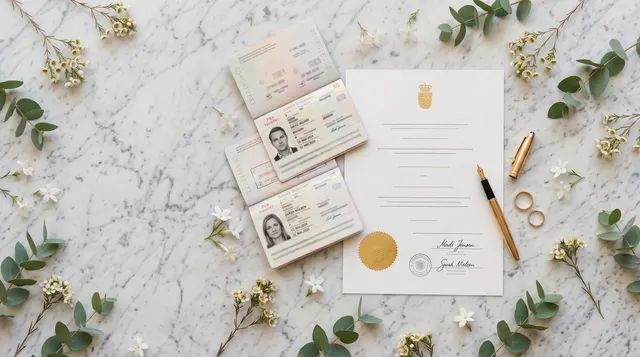
- Passport: colour scans or photos of all pages. EU/EEA citizens may use a national ID card instead.
- Proof of address: an official document from the country where the partner lives, not older than 3 months.
- Proof of civil status: not older than 3 months (Denmark Wedding Services asks for this; Familieretshuset publishes no fixed limit).
- If previously married: the final divorce decree or the death certificate of the former spouse.
- Proof of lawful stay (non-EU partner): a visa, a residence permit from Denmark or another Schengen country, or proof of the entry date (see the table below).
- Supporting your relationship (requested by Denmark Wedding Services): photos together, travel tickets, chat history. If you have children together, each child's birth certificate is submitted instead.
Whether a document needs an apostille or legalisation depends on the country that issued it, not on the partner's nationality. Documents from EU/EEA countries and Switzerland need neither, and those from the USA, Canada, Australia, New Zealand, Turkey, the UK and most other European countries typically need none either; documents from many other members of the Hague Apostille Convention need an apostille, and documents from countries outside the Convention need legalisation via the embassy. The apostille is issued in the country that issued the document; the details are in our apostille guide. Denmark Wedding Services checks for every document whether an apostille or legalisation is needed. Documents that are not in Danish, English or German need an authorised translation into one of these languages, and the translation must also cover the apostille. Denmark Wedding Services offers certified translation only between German and Russian (€50 per document); for other languages, use an authorised translator. The full list by life situation is in our documents guide for a Danish wedding.
How does the non-EU partner enter Denmark?
| Situation of the non-EU partner | Entry to Denmark | Proof of lawful stay |
|---|---|---|
| lives in a Schengen country with a residence permit | with that residence permit | copy of the residence permit |
| lives abroad, needs a visa (for example Russia, Turkey, India, China) | with a Schengen visa (a tourist visa is accepted) | the visa, covering the wedding date |
| lives abroad, visa-free (for example the USA, the UK, Brazil, Ukraine with a biometric passport) | visa-free, up to 90 days in any 180 days | proof of the entry date, such as a boarding pass or e-ticket |
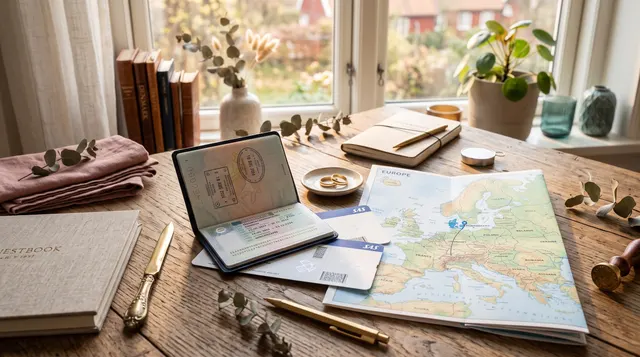
Since the EU Entry/Exit System (EES) became fully operational on 10 April 2026, the passports of non-EU short-stay travellers are no longer stamped. Visa-free travellers can check their remaining days with the official EU calculator and keep the boarding pass or e-ticket as proof of the entry date. If you enter visa-free or on a Schengen visa, we also ask you to upload the result of the EU calculator. Make sure the visa or the remaining days safely cover the planned wedding date.
What is different in the process for a binational couple?
The process is the same as for any couple: you start with the free Denmark wedding checklist, answer the application questions, sign the three pre-filled forms by hand and upload your documents; we check everything, submit the application to Familieretshuset and book the ceremony in Copenhagen, Aabenraa or Tønder. All six service steps are explained on the page about the Denmark wedding process.
For a binational couple, two points need extra planning. The approval is valid for 4 months, or less if the non-EU partner's passport, visa or residence permit expires earlier. The target of about 5 working days counts only from the submission of a complete application, so both partners' documents must be ready first.
What applies to partners from Russia, Ukraine, Turkey, China, India or Latin America?
The Danish procedure is the same for every nationality. The full rules country by country are in our guide to marriage in Denmark for foreigners by nationality, and entry is covered in the Denmark wedding visa guide. The notes below cover only what matters for a mixed couple: the authentication of the partner's documents and the registration at home (as of September 2026).
Russia and Ukraine
Civil-status documents such as divorce decrees need an apostille issued in the country that issued them, plus an authorised translation that also covers the apostille; passports are accepted as they are. Russian law recognises a marriage validly concluded abroad between a Russian and a foreign citizen if there was no impediment under Russian law (Family Code of the Russian Federation, Article 158), without registration at a Russian registry office (ZAGS). Russian authorities usually want the Danish certificate with an apostille and a Russian translation; ask whether a certified translation from German is accepted (we offer German to Russian for €50 per document).
Turkey
Familieretshuset typically does not require an apostille on Turkish documents, but they need an authorised translation into Danish, English or German. No separate Turkish ceremony is needed; the marriage is registered afterwards with the Turkish authorities, for example via the consulate.
China
Chinese documents are submitted with an apostille, since China's accession to the Apostille Convention has applied from 7 November 2023. If a Chinese authority needs to see the marriage, it will usually want the Danish certificate with an apostille and a Chinese translation; ask that authority first. Denmark Wedding Services does not arrange Chinese translations.
India, Pakistan and Bangladesh
All three are members of the Apostille Convention (Bangladesh since 30 March 2025), so civil-status documents need an apostille; where a contracting state has objected to a new member's accession, legalisation remains. We check which form applies to your documents before you apply.
Iran and Iraq
Neither country is a member of the Apostille Convention, so their documents need legalisation via the embassy or consulate, which usually takes longer than an apostille. The Danish certificate likewise needs legalisation for use back home (see our apostille guide for the Danish marriage certificate).
USA and Latin America
Familieretshuset typically accepts US documents without an apostille; documents from Brazil, Mexico or Argentina need an apostille and an authorised translation. The Danish marriage certificate is already issued in Spanish, one of its five languages; for Portuguese in Brazil, ask the receiving authority which translation it accepts.
Can same-sex binational couples marry in Denmark?
Yes. Same-sex marriage has been legal in Denmark since 2012, through exactly the same process; what differs for a binational couple is recognition in each partner's home country. Russia, Turkey and many other countries do not recognise such a marriage: it is valid in Denmark but creates no spousal rights there. The EU Court of Justice ruling of 25 November 2025 (case C-713/23) and recognition country by country are covered in our guide to same-sex marriage in Denmark; check with each home registry office before the wedding.
Where can you live together after the wedding?
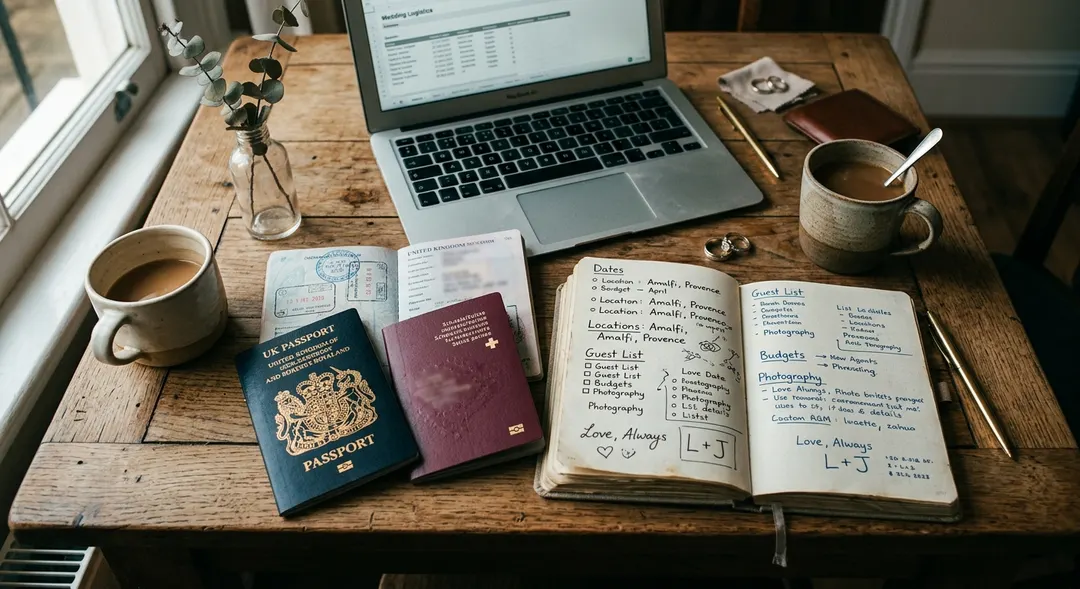
A Danish marriage does not change residence, citizenship or tax status anywhere by itself. It is the basis for the next step, and that step depends on where you want to live:
- In the EU partner's own country: if the EU partner lives in the country of their own nationality, that country's national family reunification rules apply, often a spouse visa applied for from abroad, sometimes with a language requirement.
- In another EU country: if the EU partner lives in, or moves to, an EU country other than their own, the non-EU spouse can rely on EU free-movement rules (Directive 2004/38/EC). See Your Europe on family residence rights.
- In Denmark: getting married in Denmark does not give a right to live in Denmark. Family reunification is a separate application under Danish immigration rules (see New to Denmark in the sources).
- In the non-EU partner's country or a third country: that country's spouse visa rules apply; the Danish certificate usually needs an apostille or, for countries outside the Convention, legalisation.
Each immigration authority checks its own requirements, and processing times range from weeks to many months. Which entry status you need for the wedding itself is explained in our Denmark wedding visa guide.
Do you have to register a Danish marriage in your home countries?
That depends on the law of each home country; each partner handles it separately after the ceremony. Your Danish marriage certificate is valid under Danish law and is issued in five languages (Danish, English, German, French and Spanish), which already covers many authorities' language requirements.
Inside the EU, civil-status documents such as the marriage certificate need no apostille under EU Regulation 2016/1191; some offices still ask for one, so check with the registry office. Outside the EU, the certificate usually needs an apostille, or legalisation for countries outside the Apostille Convention, and often a translation. Our optional Apostille Service costs €100; the Danish Ministry of Foreign Affairs states about 5–7 working days for documents sent by post. The apostille confirms that the certificate is authentic; whether the marriage is recognised, and with what effects, is decided by the law of the country concerned.
How does Denmark Wedding Services help binational couples?
The Comfort Package costs €799.00 and includes the Danish authority fee, a personalised checklist, the check of all documents, the application to Familieretshuset and all communication with the authority, the booking of the ceremony date in Copenhagen, Aabenraa or Tønder, two legal witnesses and a 24/7 AI assistant. Travel, accommodation, rings and a photographer are not included; our guide to wedding costs in Denmark shows the full budget. Your first step is the free document checklist. For special cases, write to us in English, German or Russian.
FAQs About Marrying a Non-EU Partner in Denmark
Does a foreign partner need a Certificate of No Impediment to marry in Denmark?
No. Denmark does not ask for a Certificate of No Impediment or for birth certificates of the couple. Each partner submits a passport, proof of address and civil status, a divorce decree if previously married, and the non-EU partner a proof of lawful stay. Whether home-country documents need an apostille or legalisation depends on the issuing country: documents from Russia, Ukraine or India do, documents from the USA, the UK or Turkey typically do not.
Do our nationalities affect the approval?
No. Danish marriage conditions apply to every couple regardless of nationality, and the combination of nationalities does not affect the approval. What counts is that both partners are at least 18, unmarried, not closely related, can enter and stay in Denmark lawfully, and submit complete documents.
Can we live together after marrying in Denmark?
The Danish marriage is the basis for a residence application, but it does not replace one. A Schengen or tourist visa that was enough for the wedding does not by itself let the non-EU partner stay on afterwards. Where you can live depends on the destination: in the EU partner's own country, national family reunification rules apply; in another EU country, EU free-movement rules (Directive 2004/38/EC); in Denmark, a separate application under Danish immigration rules. Each authority checks its own requirements, so there is no guarantee.
Do we have to register a Danish marriage in our home countries?
That depends on the law of each home country, and each partner handles it separately after the ceremony. The Danish certificate is issued in five languages (Danish, English, German, French and Spanish). Within the EU, civil-status documents need no apostille under Regulation 2016/1191 (some offices still ask, so check with the registry office); outside the EU the certificate usually needs an apostille, or legalisation for countries outside the Hague Convention, often with a translation. Denmark Wedding Services offers the Apostille Service for €100.
Sources
- Danish Agency of Family Law (Familieretshuset) — international marriages
- Familieretshuset — legal residence for marriage in Denmark
- Life in Denmark — if you wish to get married in Denmark
- Familieretshuset — banning sham marriages: questions about your relationship and photos
- European Union — EES calculator "Check how long you can stay"
- HCCH — contracting parties of the Apostille Convention
- Danish Ministry of Foreign Affairs — legalisation of documents
- EU Regulation 2016/1191 on public documents (EUR-Lex)
- EU Court of Justice — judgment of 25 November 2025, case C-713/23 (EUR-Lex)
- Your Europe — family residence rights
- Danish Immigration Service — New to Denmark
- Family Code of the Russian Federation, Article 158 (ConsultantPlus, in Russian)
Watch Our Video
Follow us on YouTube, Instagram & TikTok for more wedding tips
Ready to Start Your Danish Wedding?
Fill out our free checklist in about 2 minutes — we'll send you a personalized document list and guide you through every step.
Start Free Checklist →