Kenyan or East African Partner: Marrying in Denmark
Reviewed by Ludmila Bernowski, CEO & Co-Founder of Denmark Wedding Services. Last reviewed: November 2026. Practical, experience-based information, not legal advice — for legal questions, consult a qualified lawyer. Our Google Business Profile and reviews
Short answer: Yes, you can marry a partner from Kenya, Tanzania, Uganda, Ethiopia or Rwanda in Denmark without living there. Kenya, Tanzania, Uganda and Ethiopia are not in the Hague Apostille Convention, so a civil-status document from there is legalised: first by that country's foreign ministry, then by the Danish embassy. Rwanda is a member, so an apostille is enough. Many never-married partners need only the passport and a Schengen visa.
On this page
- Can you marry a Kenyan or East African citizen in Denmark?
- Which documents does the East African partner need?
- Apostille or legalisation: which applies to which country?
- How are Kenyan documents legalised?
- Tanzania: which steps apply?
- Uganda: which steps apply?
- Ethiopia: which steps apply?
- Rwanda: what is different?
- What about Somalia, South Sudan and other neighbours?
- Does the partner need a visa?
- How long does the approval take?
- Is the Danish marriage recognised in Kenya?
- How does Denmark Wedding Services help?
- Frequently asked questions
Who this guide is for: Couples where one partner is a citizen of Kenya, Tanzania, Uganda, Ethiopia or Rwanda: partners who live in East Africa, East Africans with a residence permit in Germany or another Schengen country, and partners who were married before.
Key points
- Denmark applies the same conditions to every couple: both 18 or older, unmarried, not closely related and lawfully in Denmark. No Danish address is needed.
- Kenya, Tanzania, Uganda and Ethiopia are not parties to the Hague Apostille Convention, so their documents are legalised. Rwanda has been a party since 5 June 2024, and Denmark did not object, so a Rwandan apostille works in Denmark.
- The Danish embassies in Nairobi, Dar es Salaam, Kampala and Addis Ababa each do the final legalisation step, after the home country's foreign ministry.
- Documents in English need no translation. A document in Kiswahili, Amharic, Kinyarwanda or another language needs an authorised translation into Danish, English or German, stamps included.
- All five nationalities need a visa for Denmark. Tanzania is in Danish visa main group 1, Kenya, Uganda and Rwanda in group 3, Ethiopia in group 4. A residence permit from a Schengen country replaces the visa.
- Kenya's Marriage Act recognises a civil marriage concluded abroad under conditions and lets a Kenyan apply to register it.
- The Comfort Package of Denmark Wedding Services costs €799.00 and includes the Danish authority fee (2,100 DKK in 2026) and two legal witnesses.
Couples with an East African partner usually ask us three things: whether the documents need an apostille, how the Danish embassy step works in their country, and whether the partner can get a visa. This guide answers them with the official rules as of November 2026, with Kenya first and short sections for Tanzania, Uganda, Ethiopia and Rwanda. For mixed couples in general, see our guide to marrying a non-EU partner in Denmark; West Africa has its own guide for Nigerian and Ghanaian partners.
Can you marry a Kenyan or East African citizen in Denmark?
Yes. Danish marriage law does not depend on nationality. The Danish Agency of Family Law (Familieretshuset) checks that both partners are at least 18, are not married to anyone else, are not closely related and are lawfully in Denmark on the wedding day. Neither of you needs a Danish address or residence in Denmark.
When one partner is from outside the EU/EEA, Familieretshuset also checks that the marriage is genuine and may ask about your relationship, for example how and when you met. Our guide to proof of relationship explains what that can mean. You apply online before you travel and come to Denmark for the ceremony.
Which documents does the East African partner need?
Fewer than many couples expect. For the application, the partner usually needs:
- Passport: colour photos or scans of every page. A passport never needs an apostille or legalisation.
- Proof of lawful stay: a Schengen visa or a residence permit from a Schengen country (see below).
- If previously married: the final divorce decision or the former spouse's death certificate, legalised (or, from Rwanda, apostilled).
- Children together: the birth certificate of each child.
A partner who has never been married signs the marriage declaration in the application under penalty of law. Familieretshuset may ask for a civil-status document from the competent authority in the home country; in Kenya, for example, the Registrar of Marriages issues a certificate of no impediment. It is not part of the standard application, so do not order one in advance. If a request comes, we tell you exactly what is needed, and the document then has to be legalised like any other. Our guide to marrying without a certificate of no impediment explains the background.
Apostille or legalisation: which applies to which country?
It depends on the Hague Apostille Convention. The status table of the Hague Conference (HCCH) lists 130 contracting parties. Rwanda is one of them, with the Convention in force since 5 June 2024; Kenya, Tanzania, Uganda and Ethiopia are not.
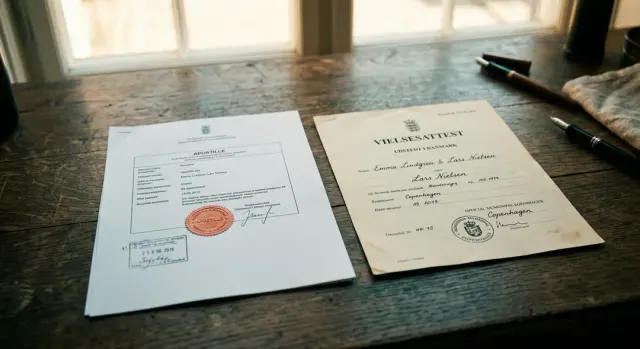
- Kenya, Tanzania, Uganda, Ethiopia: legalisation. The Danish foreign ministry describes the route: first the foreign ministry of the issuing country, then the Danish embassy.
- Rwanda: an apostille from Rwanda replaces legalisation for Denmark. According to the Dutch treaty depositary, only Germany objected to Rwanda's accession, so a Rwandan apostille is not enough for a German registry office.
Legalisation confirms the signature on the document, not that its content is true; Danish authorities may still check whether a document is genuine. Familieretshuset requires legalisation to take place in the country where the document was issued. Our overview of apostille and legalisation by country covers other countries.
How are Kenyan documents legalised?
In two steps: first the Kenyan Ministry of Foreign Affairs, then the Royal Danish Embassy in Nairobi, 13 Runda Drive. Since 7 May 2025, the embassy handles legalisation and certification of documents on Wednesdays between 13:00 and 15:00. Check the embassy page for the current procedure and fees before you go.
Kenyan civil documents are usually in English, which Familieretshuset accepts without a translation. If a document or one of its stamps is in Kiswahili, that part needs an authorised translation into Danish, English or German.
Tanzania: which steps apply?
The Royal Danish Embassy in Dar es Salaam describes two steps:
- Submit the document to the Consular Department of the Tanzanian Ministry of Foreign Affairs, which confirms and legalises it.
- Book an appointment with the embassy's consular section by email; legalisation takes place on Mondays and Thursdays between 13:00 and 15:00, by appointment only. The embassy charges a service fee and accepts card payment only.
For a recently re-issued document, the embassy may ask for supporting evidence, such as the reason for re-issuing and records from the application to RITA (for example clinic cards, baptismal or school leaving certificates). Order the documents early if a birth certificate was issued late.
Uganda: which steps apply?
The Royal Danish Embassy in Kampala describes three steps: certification by the relevant Ugandan authority (for a birth certificate, NIRA), authentication by the Ugandan Ministry of Foreign Affairs, and legalisation by the embassy. Consular services are by appointment only, booked at book.um.dk, on Mondays, Tuesdays and Thursdays between 9:00 and 11:00. The embassy accepts debit or credit cards only.
Ethiopia: which steps apply?
The Embassy of Denmark in Addis Ababa states that it can legalise only the stamp and signature of the Ethiopian Ministry of Foreign Affairs. So an Ethiopian document goes to the Ethiopian foreign ministry first and to the embassy second. The embassy page also says that the document to be verified cannot be older than 3 months; ask the embassy before you order documents.
If an Ethiopian document is in Amharic, Familieretshuset needs an authorised translation into Danish, English or German, including all stamps and legalisation marks.
Rwanda: what is different?
Rwanda is the only Apostille member in this group. A Rwandan civil-status document with an apostille from the competent Rwandan authority needs no embassy step for Denmark. If the document or the apostille is in Kinyarwanda, French or another language than Danish, English or German, Familieretshuset requires an authorised translation of both.
If you plan to live in Germany later, keep in mind that Germany objected to Rwanda's accession, so German authorities may still ask for legalisation.
What about Somalia, South Sudan and other neighbours?
The Danish foreign ministry lists Somalia and South Sudan among the countries whose documents a Danish embassy cannot endorse; the Danish authority that asks for the document decides whether it is acceptable without that step. If your partner is from one of these countries, write to us before you order anything; we take these cases and check the documents first.
Does the partner need a visa?
Yes, unless they hold a residence permit from a Schengen country. Citizens of Kenya, Tanzania, Uganda, Ethiopia and Rwanda need a visa for Denmark. A partner who lives in Germany or another Schengen country proves lawful stay with that permit and the passport. Familieretshuset accepts a visa, including a tourist visa, as proof of lawful stay; our guide to residence permits for marrying in Denmark lists which permits count.
The Danish Immigration Service sorts visa-required countries into main groups:
- Tanzania, main group 1: citizens can as a rule get a tourist visa, also without a host, unless there is a high risk that they settle in Denmark or stay there long-term.
- Kenya, Uganda and Rwanda, main group 3: a visit normally needs some connection to the host. A boyfriend or girlfriend visit is possible if the relationship is established and documented and you have met in person; contact only by phone or online is not enough.
- Ethiopia, main group 4: for private visits, Denmark normally grants visas only to the host's spouse, cohabiting partner (at least 1 year and 6 months at a shared address), child under 18 or parent.
These rules are written for visits to a host living in Denmark. If neither of you lives there, ask the Danish embassy or the visa application centre how a trip for the wedding is assessed. Nobody can guarantee a visa, and the marriage itself gives no right of residence. Our Denmark wedding visa guide covers entry for every nationality.
How long does the approval take?
As a general rule, Familieretshuset issues the approval within about 5 working days once the application is complete and nothing is missing. That is a target, not a guarantee; a missing legalisation step usually leads to a request for more information. Where it has asked for more information, Familieretshuset is currently processing applications received in October 2026.
The ceremony date is a separate step that depends on the town hall, as our guide to town hall waiting times explains. Every ceremony needs two witnesses; they are included in our package, see witnesses at a Danish wedding. If you live on different continents, our guide for long-distance couples helps you plan the trip.
Is the Danish marriage recognised in Kenya?
The marriage is valid under Danish law; recognition and legal effects abroad depend on the destination country. Kenya's Marriage Act 2014 says, in section 40, that a civil marriage contracted in a foreign country is recognised as valid if it follows the law of that country, is consistent with the Act's part on civil marriages and both partners have capacity to marry under the Act. Under section 58, a Kenyan who married abroad may apply to the Registrar to have the marriage registered; a certificate that is not in an official language of Kenya needs a certified translation.
Because Kenya, Tanzania, Uganda and Ethiopia are not in the Apostille Convention, a Danish document for use there usually needs legalisation instead of an apostille. Ask the authority that will receive the certificate what it needs, and write to us before you order anything; our guide to the apostille on the Danish marriage certificate explains the Danish side. This is a different step from the legalisation of your own documents before the application. For Rwanda, an apostille on the Danish certificate is the usual route. See also recognition of a Danish marriage by country.
If you live in Germany or another EU country, the authorities there decide on residence separately and may check East African documents again; see family reunification after a Danish wedding.
Denmark Wedding Services is not a law firm. We provide practical and administrative support for marrying in Denmark; for questions about Kenyan or other East African law, recognition, residence or family reunification, ask the competent authority or a qualified lawyer.
How does Denmark Wedding Services help?
The Comfort Package costs €799.00 and includes the Danish authority fee (2,100 DKK in 2026), a personalised checklist, the check of all documents before we submit, the application to Familieretshuset and all communication with it, the booking of the ceremony date and two legal witnesses. We arrange the ceremony in any Danish kommune. You pay only after our team has checked your documents.
For East African partners, we tell you which documents are actually needed, often only the passport and the visa or residence permit, and we check that every legalisation step or apostille and every translation is there before anything is submitted. The legalisation itself takes place in the home country, at the document holder's cost. Travel, visa fees and translations are not included.
Your first step is the free document checklist; for a divorce, a re-issued document or an open visa question, write to us before you apply.
Frequently asked questions
Do Kenyan documents need an apostille for Denmark?
No. Kenya is not in the Hague Apostille Convention, so Kenyan documents are legalised instead: first by the Kenyan Ministry of Foreign Affairs, then by the Danish embassy in Nairobi. The passport needs neither.
My partner is from Rwanda. Is it different?
Yes. Rwanda has been a party to the Apostille Convention since 5 June 2024 and Denmark did not object, so an apostille replaces legalisation for Denmark. Germany did object, so a German registry office may still ask for legalisation.
Do East African documents need a translation?
Not if they are in English. A document in Kiswahili, Amharic, Kinyarwanda or another language needs an authorised translation into Danish, English or German, including all stamps and legalisation marks.
Does my Kenyan partner need a visa to marry in Denmark?
Yes, unless they hold a residence permit from a Schengen country. Kenya is in Danish visa main group 3, where a boyfriend or girlfriend visit is possible if the relationship is documented and you have met in person. Nobody can guarantee a visa.
Is our Danish marriage recognised in Kenya?
The marriage is valid under Danish law; recognition and legal effects abroad depend on the destination country. Section 40 of the Kenyan Marriage Act recognises foreign civil marriages that meet its conditions, and under section 58 a Kenyan may apply to the Registrar to register the marriage.
Can the Danish authority still check our documents?
Yes. Legalisation confirms the signature on a document, not that its content is true, and Danish authorities may verify whether a document is genuine.
Sources
- HCCH — status table of the Apostille Convention, read 2026-11-23
- Dutch treaty database — Apostille Convention, objections to accessions, read 2026-11-23
- Ministry of Foreign Affairs of Denmark — legalisation of foreign documents, read 2026-11-23
- Ministry of Foreign Affairs of Denmark — Danish documents for use abroad, read 2026-11-23
- Royal Danish Embassy in Nairobi — consular services, read 2026-11-23
- Royal Danish Embassy in Nairobi — changed opening hours for legalisation, read 2026-11-23
- Embassy of Denmark in Dar es Salaam — legalisation, read 2026-11-23
- Embassy of Denmark in Kampala — travel and residence, legalisation, read 2026-11-23
- Embassy of Denmark in Addis Ababa — legalisation and minor translations, read 2026-11-23
- Familieretshuset — documentation requirements: apostille, legalisation, translation, read 2026-11-23
- Familieretshuset — legal residence for marriage in Denmark, read 2026-11-23
- Familieretshuset — processing time for certificates of marital status, read 2026-11-23
- New to Denmark — countries with a visa requirement, read 2026-11-23
- New to Denmark — private and tourist visits, visa main groups (in Danish), read 2026-11-23
- Kenya Law — Marriage Act No. 4 of 2014, sections 40 and 58, read 2026-11-23
- Kenya State Law Office — certificate of no impediment to marriage, read 2026-11-23
Written by Ludmila Bernowski, CEO and co-founder of Denmark Wedding Services. All facts checked against the official sources above on 23 November 2026.
Watch Our Video
Follow us on YouTube, Instagram & TikTok for more wedding tips
Ready to Start Your Danish Wedding?
Fill out our free checklist in about 2 minutes — we'll send you a personalized document list and guide you through every step.
Start Free Checklist →