Civil Marriage in Denmark for Lebanese Couples: Legalisation, Visa and Registration in Lebanon
Reviewed by Ludmila Bernowski, CEO & Co-Founder of Denmark Wedding Services. Last reviewed: November 2026. Practical, experience-based information, not legal advice — for legal questions, consult a qualified lawyer. Our Google Business Profile and reviews
Short answer: Yes, Lebanese citizens can have a civil wedding in Denmark, even if neither partner lives there. Lebanon is not a party to the Apostille Convention, so Lebanese documents other than the passport are legalised instead: first by the Lebanese authorities and the Lebanese Ministry of Foreign Affairs, then by the Danish Embassy in Beirut. A partner living in Lebanon needs a Danish visa. Afterwards, the marriage can be registered through a Lebanese mission.
On this page
- Why do Lebanese couples marry abroad for a civil marriage?
- Can Lebanese citizens have a civil wedding in Denmark?
- Which Lebanese documents do you need?
- Do Lebanese documents need an apostille?
- Do Arabic documents need translating?
- Does a Lebanese citizen need a visa for Denmark?
- How long does Familieretshuset take?
- When and where is the ceremony?
- How is the Danish marriage registered in Lebanon?
- What does the Danish certificate need for Lebanon?
- Denmark or Cyprus?
- How DWS helps
- Frequently asked questions
Who this guide is for: Lebanese couples who want a civil marriage abroad, including interfaith couples; Lebanese citizens living in Europe or the Gulf; and couples where one partner is Lebanese and the other is European or from another country.
Key points
- Inside Lebanon, only a religious marriage can be concluded; the Dutch government's guidance for Lebanon states that civil marriage is not possible there. A civil marriage abroad is the civil alternative, and Denmark is one option next to Cyprus.
- Denmark applies the same conditions to every couple: both 18 or older, unmarried, not closely related and lawfully in Denmark. No residence in Denmark is required, and religion is not a condition.
- Lebanon is not on the list of parties to the Hague Apostille Convention. Lebanese documents need legalisation in Lebanon, finished with the Danish Embassy in Beirut. The embassy asks for a sworn English translation and documents no more than 3 months old.
- Lebanon is in Danish visa main group 4, with narrow rules for private visits. A partner with a residence permit from a Schengen country needs no visa.
- After the wedding, the Danish certificate is legalised in Denmark and then, for Lebanon, by the Lebanese embassy responsible for Denmark. The certificate is issued in Danish, English, German, French and Spanish.
- Denmark Wedding Services is not a law firm. Registration and legal effects in Lebanon are decided by the Lebanese authorities.
- The Comfort Package costs €799.00 and includes the Danish authority fee (2,100 DKK in 2026) and two legal witnesses, in every Danish municipality.
Many Lebanese couples who want a civil marriage travel abroad to marry. This guide explains how that works in Denmark, step by step, with the rules as of November 2026. It covers the Danish side in full and the Lebanese registration as the official sources we could read describe it. For the comparison with the most common destination, see our Denmark vs Cyprus guide.
Why do Lebanese couples marry abroad for a civil marriage?
Because a civil marriage cannot be concluded inside Lebanon. The Dutch government's official guidance for Lebanon states that only a religious marriage is possible there, before a religious body such as a church or an Islamic court, and that it becomes valid once registered in the Lebanese civil registry. Couples who want a civil marriage therefore marry abroad and then register the marriage with the Lebanese authorities.
Denmark does not ask about religion. The town hall ceremony is a civil ceremony held by the municipality, with no religious part, and it is the same for interfaith couples, couples of the same faith and non-religious couples. What a civil marriage concluded abroad means under Lebanese personal status rules is a question for the Lebanese authorities or a Lebanese lawyer, not something we can answer.
Can Lebanese citizens have a civil wedding in Denmark?
Yes. Danish marriage law does not depend on nationality. The Danish Agency of Family Law (Familieretshuset) checks that both partners are at least 18, are not married to anyone else, are not closely related and are lawfully in Denmark. Neither of you needs a Danish address. You apply online before you travel, and the ceremony can usually be held in English.
Marriages of convenience are prohibited in Denmark, so the agency may ask how long you have known each other and how you met. Our guide to proof of relationship for a Danish marriage explains what helps.
Which Lebanese documents do you need?
For the application, each Lebanese partner usually needs:
- Passport: colour photos or scans of every page. A passport is not legalised.
- Proof of lawful stay: a Danish visa or a residence permit from a Schengen country (see below).
- If previously married: the final divorce document or the former spouse's death certificate, legalised and translated. See our guide to marrying again in Denmark after a divorce.
- If you have lived together for at least six months: a document for each partner showing the shared address.
Familieretshuset may ask for further documents in an individual case; if it does, we tell you exactly what is needed. We check every document before we submit: whether both legalisation steps are there, whether the divorce is final and whether the translation covers every stamp.
Do Lebanese documents need an apostille?
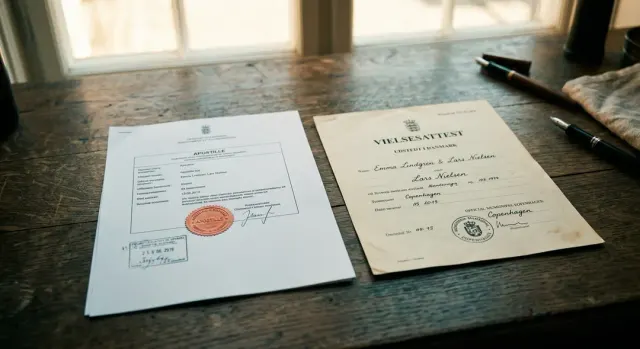
No, there is no apostille for Lebanese documents, because Lebanon is not a party to the Apostille Convention. For documents from such countries, Familieretshuset usually requires legalisation, carried out in the country where the document was issued. According to the Danish Embassy in Beirut, the chain is:
- Lebanese authorities and Lebanese Ministry of Foreign Affairs: the document is first legalised by the competent Lebanese authority and then by the Lebanese Ministry of Foreign Affairs.
- Danish Embassy in Beirut: only then does the embassy legalise it. It legalises originals only, or a true copy if the original is not available.
The embassy also states that:
- the document must be translated into English by a sworn translator;
- a document for legalisation may be no more than 3 months old, otherwise you need a new one from the issuing authority;
- an online appointment is mandatory, and the fee is paid at Blom Bank, not at the embassy; the amount is in the embassy's fee list.
The embassy publishes no processing time for Lebanese documents, so allow time for this before you fix your travel and ceremony date. A document is legalised where it was issued, so this also applies if the Lebanese partner now lives in Germany or the Gulf. Rules for other countries are in our overview of apostille and legalisation by country.
Do Arabic documents need translating?
Yes. Familieretshuset accepts documents in Danish, English or German; anything else must be translated by an authorised translator, and for legalised documents every stamp and endorsement must be translated too. The sworn English translation that the Danish Embassy in Beirut asks for usually serves both purposes, as long as it covers all stamps. Our guide to translating documents for a Danish wedding explains what counts. Denmark Wedding Services does not translate Arabic.
Does a Lebanese citizen need a visa for Denmark?
A partner with a residence permit from a Schengen country, such as Germany, France or Sweden, needs no visa: the passport and the residence permit prove lawful stay. A partner living in Lebanon or in the Gulf needs a Danish visa; Familieretshuset also accepts a visa issued for a short visit as lawful stay for the wedding.
The Danish Immigration Service places Lebanon in visa main group 4. For private visits from this group, a visa is in principle granted to the spouse or permanent cohabiting partner of a host in Denmark, to children under 18 and to parents. Permanent cohabiting partners are couples who have lived together at a shared address for at least 1 year and 6 months. The page states no separate rule for couples who travel to Denmark only to marry, so an unmarried couple without that cohabitation should expect a visit visa to be hard to obtain.
Check your case with the Danish visa authority before you fix any dates. Nobody can guarantee a visa, and Denmark Wedding Services offers no visa service. Our Denmark wedding visa guide covers entry in more detail.
How long does Familieretshuset take?
Familieretshuset usually issues the approval within about 5 working days once the application is complete. That is a target, not a guarantee. Where it has asked for more information, Familieretshuset is currently working on applications received in October 2026. The approval is normally valid for 4 months, shorter if a passport or visa expires earlier.
When and where is the ceremony?
The ceremony date is a separate step and depends on the town hall you choose; our list of town halls in Denmark shows the options, and our Copenhagen wedding page covers the capital. Every ceremony needs two witnesses; they are included in our package, as our guide to witnesses at a Danish wedding explains.
How is the Danish marriage registered in Lebanon?
The marriage is valid under Danish law; recognition and legal effects abroad depend on the destination country. Lebanese missions register marriages concluded abroad. As an example, the Lebanese Embassy in The Hague lists these documents for registering a marriage concluded in the Netherlands:
- the completed registration form;
- the original marriage certificate in international format, plus a copy;
- a recent Lebanese individual civil registry extract for each Lebanese spouse;
- the Lebanese passport or ID of each Lebanese spouse;
- for a non-Lebanese spouse, the birth certificate and passport.
That embassy registers free of charge, and a translation is needed only for a document not in Arabic, French or English. Requirements differ between missions and the Hague page covers Dutch marriages, so ask the Lebanese mission that will handle your case for its current list before the wedding. If you live in Lebanon, ask the Lebanese civil registry how it handles the registration there.
If you are considering an online wedding instead, ask the Lebanese authorities first whether they would register it; read our guide to Utah online weddings or Denmark. In Denmark, both partners are physically present at the ceremony.
What does the Danish certificate need for Lebanon?
Two steps, because Lebanon is outside the Apostille Convention. First, the Danish Ministry of Foreign Affairs legalises the Danish certificate; for documents sent by post, it states a processing time of 5–7 working days. Second, the Ministry says the receiving country's representation usually has to legalise it as well. According to the Danish Embassy in Beirut, which cannot legalise Danish documents itself, for Lebanon this is the Lebanese Embassy in Stockholm. Confirm the current responsible mission and its requirements with the embassy before you send anything.
Our Apostille Service for the Danish certificate (€100) covers the first step. Please discuss the step at the Lebanese embassy with us before the wedding. More in our guide to the apostille on the Danish marriage certificate. The Danish certificate is issued in Danish, English, German, French and Spanish, so the English and French text are on the certificate itself.
Denmark Wedding Services is not a law firm. We give practical and administrative support for marrying in Denmark; for questions on Lebanese law, registration or personal status, contact the Lebanese authorities or a Lebanese lawyer.
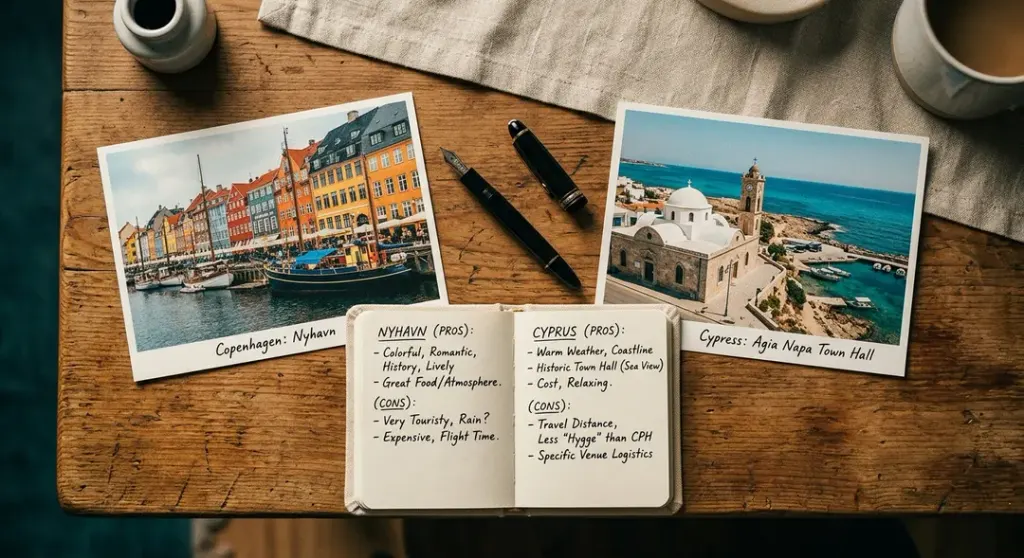
Denmark or Cyprus?
Cyprus is close to Lebanon and is the destination most Lebanese couples look at first. Both countries marry foreign couples in a civil ceremony; the differences lie in documents, travel and planning. Our Denmark vs Cyprus guide compares the two, and our overview of marrying abroad adds other destinations. If your partner is Syrian, our guide to marrying a Syrian partner in Denmark covers the rules for Syrian documents.
How DWS helps
The Comfort Package costs €799.00 and includes the Danish authority fee (2,100 DKK in 2026), a personal checklist, the check of every document before we submit (both legalisation steps, the sworn translation of all stamps, the final divorce), the application to Familieretshuset and all communication with it, the booking of the ceremony date and two legal witnesses. We arrange the ceremony in every Danish municipality. After the wedding, our optional Apostille Service for the Danish certificate costs €100. Travel, accommodation, visa fees, legalisation fees in Lebanon, the step at the Lebanese embassy and the translation of Arabic documents are not included.
We advise in English, German, Russian, Spanish and French, not in Arabic. Your first step is the free document checklist; how we work together is explained on our process page, and for special situations you can write to us before you apply. The video on this page shows how the Danish certificate is prepared for use abroad.
Frequently asked questions
Why do Lebanese couples marry abroad for a civil marriage?
Because only a religious marriage can be concluded inside Lebanon. Couples who want a civil marriage marry abroad, for example in Denmark or Cyprus, and then register the marriage with the Lebanese authorities.
Do Lebanese documents need an apostille for a wedding in Denmark?
No. Lebanon is not a party to the Apostille Convention, so Lebanese documents are legalised instead: by the competent Lebanese authority and the Lebanese Ministry of Foreign Affairs, then by the Danish Embassy in Beirut. The embassy asks for a sworn English translation and documents no more than 3 months old.
Does a Lebanese citizen need a visa to marry in Denmark?
Yes, unless they hold a residence permit from a Schengen country. Lebanon is in Danish visa main group 4, where a visit visa is in principle granted to spouses, permanent cohabiting partners, children under 18 and parents of a host in Denmark. Nobody can guarantee a visa.
How is a Danish marriage registered in Lebanon?
Through a Lebanese mission or the Lebanese civil registry. The Lebanese Embassy in The Hague, for example, asks for the original marriage certificate, a recent individual civil registry extract for each Lebanese spouse and the passports. Requirements differ between missions, and the Lebanese authorities decide on the registration.
What does the Danish marriage certificate need for Lebanon?
Legalisation by the Danish Ministry of Foreign Affairs and then, usually, by the Lebanese embassy responsible for Denmark. Our Apostille Service (€100) covers the Danish step; please discuss the Lebanese embassy step with us before the wedding.
Is Denmark or Cyprus better for a Lebanese civil marriage?
Both marry foreign couples in a civil ceremony. The differences lie in documents, travel and planning, which our Denmark vs Cyprus guide compares side by side.
Sources
- HCCH — Apostille Convention status table, read 2026-11-23
- Familieretshuset — documentation requirements: apostille, legalisation, translation, read 2026-11-23
- Familieretshuset — legal residence for marriage in Denmark, read 2026-11-23
- Familieretshuset — processing time for certificates of marital status, read 2026-11-23
- Embassy of Denmark in Lebanon — legalisation of documents, read 2026-11-23
- Danish Ministry of Foreign Affairs — legalisation of Danish documents, read 2026-11-23
- New to Denmark — countries with a visa requirement and visa-free countries, read 2026-11-23
- Ny i Danmark — private and tourist visits, visa main groups (Danish), read 2026-11-23
- Netherlands Worldwide (Government of the Netherlands) — marrying in Lebanon, read 2026-11-23
- Embassy of Lebanon in the Netherlands — civil status, read 2026-11-23
- Life in Denmark — if you wish to get married in Denmark, read 2026-11-23
Written by Ludmila Bernowski, CEO and co-founder of Denmark Wedding Services. All facts checked against the official sources above on 23 November 2026.
Watch Our Video
Follow us on YouTube, Instagram & TikTok for more wedding tips
Ready to Start Your Danish Wedding?
Fill out our free checklist in about 2 minutes — we'll send you a personalized document list and guide you through every step.
Start Free Checklist →