Married in Denmark: What to Do Next at Home
Reviewed by Ludmila Bernowski, CEO & Co-Founder of Denmark Wedding Services. Last reviewed: November 2026. Practical, experience-based information, not legal advice — for legal questions, consult a qualified lawyer. Our Google Business Profile and reviews
Short answer: Your marriage is valid under Danish law from the end of the ceremony. What happens next takes place at home: check the marriage certificate, get an apostille only if you will use it outside the EU, register or report the marriage where your country requires it, declare a new surname if you want one, apply separately for residence for a non-EU spouse, and tell your tax office, insurers, employer and bank.
On this page
- Your checklist at a glance
- What do we get right after the ceremony?
- What if we lose the certificate?
- Do we need an apostille on the Danish certificate?
- Do we have to register the marriage at home?
- Does our surname change?
- Which offices do we tell at home?
- Can my spouse now live with me?
- Which property law applies to our marriage?
- Can we still have a church wedding or a party later?
- How DWS helps
- Frequently asked questions after a wedding in Denmark
Who this guide is for: Couples who have just married in Denmark, or are planning to, and want one checklist of what comes afterwards, with a link to the detailed guide for each step.
Key points
- You leave the town hall with the Danish marriage certificate; Copenhagen hands every couple two multilingual copies.
- Inside the EU the certificate needs no apostille (Regulation (EU) 2016/1191); outside the EU it usually needs an apostille or legalisation.
- Germany: registering the marriage is voluntary. Austria and Switzerland: you must report it. The UK does not register foreign marriages.
- Your surname does not change automatically; you declare a new name at home.
- Marriage does not give a non-EU spouse an automatic right to live with you; residence is a separate application.
- Recognition and legal effects abroad depend on the destination country.
Your checklist at a glance
| Step | What to do | Where | Deadline |
|---|---|---|---|
| 1 | Check names and dates on the certificate, keep both copies safe | At the town hall, on the day | Before you leave |
| 2 | Apostille or legalisation, only for use outside the EU | In Denmark, on the Danish certificate | None; plan it before you need it |
| 3 | Register or report the marriage | Your home country's registry office or embassy | Austria and Switzerland: required; Germany: optional |
| 4 | Declare a married name, if you want one | Registry office at home | Switzerland: within 6 months |
| 5 | Update registers, tax, insurers, employer, bank | Local offices at home | As soon as practical |
| 6 | Residence for a non-EU spouse | Immigration authority of the country where you will live | Separate application |
| 7 | Check which property law applies to you | Lawyer or notary, if needed | Before major decisions |
As of 23 November 2026, based on the official sources listed at the end. Each row is explained in the sections that follow.
What do we get right after the ceremony?
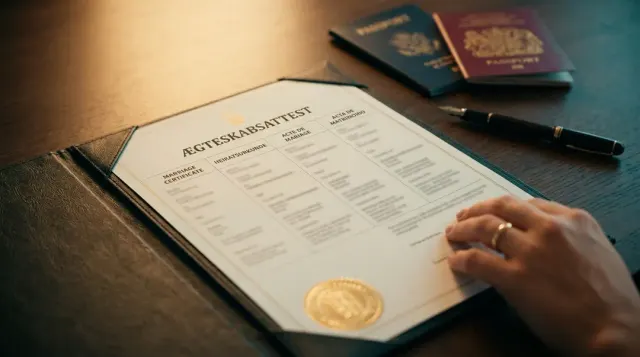
The Danish marriage certificate. Copenhagen hands couples two multilingual certificates (Danish, English, German, French and Spanish) once you have signed the marriage documents; Tønder and Aabenraa do the same. Check that names and dates match your passports before you leave. Everything about the certificate, including replacements, is in the Danish marriage certificate explained.
What if we lose the certificate?
Ask the municipality (kommune) where you married. Copenhagen reissues it free of charge and sends it within three to four weeks. The City of Copenhagen notes that a reissued certificate does not confirm your present marital status; it shows that the marriage took place.
Do we need an apostille on the Danish certificate?
Not inside the EU. Under Regulation (EU) 2016/1191, marriage certificates from one EU country are accepted in another without an apostille, although some offices still ask for one, so check first. For use outside the EU, plan for an apostille (Hague Convention countries) or legalisation (all others). The official processing time is 5–7 working days for documents sent by post or courier; an e-apostille is only possible for a certificate with a digital signature. Details and costs: apostille for a Danish marriage certificate.
This is a different apostille from the one some partners need on their own documents before the application.
Do we have to register the marriage at home?
It depends on your country:
- Germany: registration in the German marriage register (§ 34 PStG) is voluntary and needs at least one German spouse. If you live in Germany, report your new marital status at the Bürgeramt. Full guide: is a Danish marriage valid in Germany?
- Austria: Austrian citizens are legally required to report a marriage concluded abroad, either directly to an Austrian registry office (Standesamt) or through the Austrian embassy or consulate, so that the central civil register (ZPR) is complete. Foreign-language documents need a translation.
- Switzerland: a marriage abroad must be reported to the Swiss representation, because foreign authorities generally do not inform it. Originals must be no older than six months and are not returned; the procedure is free. If you live in Switzerland, ask your civil registry office which route applies to you.
- United Kingdom: you cannot register a foreign marriage in the UK or get a UK certificate for it. GOV.UK says it is recognised if it was lawful where it took place and would be allowed under UK law.
- Russia: see is a Danish marriage recognised in Russia?
- Other countries: each country has its own rules; ask your civil registry or consulate. Our overview by nationality is in marrying in Denmark as an international couple.
Does our surname change?
Not automatically. The Danish certificate shows your names as they were on the wedding day, and you declare a married name through your home authorities. In Germany, a double name made from both surnames has also been possible since 1 May 2025. In Switzerland, after a wedding abroad, the name declaration must be made within six months of the marriage. Step by step: changing your name after a Danish wedding.
Which offices do we tell at home?
- Residents' register: in Germany your marital status is changed at the Bürgeramt.
- Tax office: in Germany, the automatic tax class IV after a wedding does not apply to a wedding abroad; according to the City of Karlsruhe the tax office can only change the class once the registration office has entered the marriage.
- Health insurer, employer, bank, insurers: show them the marriage certificate when something changes, for example family health insurance, a beneficiary or a new surname.
If you live in Germany, marrying in Denmark from Germany covers the German side of the trip.
Can my spouse now live with me?
Not automatically. A residence permit for a non-EU spouse is a separate application in the country where you will live. In Germany you apply through the German mission abroad or the immigration office (Ausländerbehörde). In Denmark, the Danish Immigration Service lists its own conditions: both spouses normally need to be at least 24, the fee is DKK 8,490 and the expected maximum processing time is 10 months. Overview: family reunification after a Danish wedding; for couples with a non-EU partner, see also marrying a non-EU partner in Denmark.
Which property law applies to our marriage?
Usually not Danish law just because you married in Denmark. In the EU countries that take part in Regulation (EU) 2016/1103, such as Germany and Austria, the default is the law of the state where you take up your first common habitual residence after the wedding, unless you choose another law. Denmark does not take part in this regulation. In Germany a marriage contract (Ehevertrag) must be made before a notary. If property or a business is involved, get advice from a lawyer or notary in the country where you live.
Can we still have a church wedding or a party later?
Yes. A church blessing, a religious ceremony or a celebration at home is separate from the legal marriage and does not change it. Many couples hold the party later; ideas for the day in Denmark itself are in Copenhagen wedding reception and dinner.
Further topics after the wedding: spouse visa after a Danish wedding, which property law applies after a Danish wedding and, if it comes to that, divorce after marrying in Denmark.
How DWS helps
- Before the wedding, Comfort Package €799.00: the official 2,100 DKK fee (2026) is included in our package. We check your documents, file the application with the Danish Agency of Family Law (Familieretshuset), book your ceremony date and provide two witnesses, in Copenhagen, Tønder, Aabenraa or any other Danish municipality.
- After the wedding, Apostille Service €100 (optional): for use of the Danish certificate outside the EU. You can order it after you have left Denmark.
- Translation German ⇄ Russian, €50 per document: for example a Russian birth certificate for a German registry office.
- Questions about the next steps: book a 30-minute video consultation for €19.99, or contact us.
Approval and ceremony are two separate clocks. Familieretshuset aims for about 5 working days once an application is complete; that is a target, not a guarantee. Where it has asked for more information, it is currently working on applications received in October 2026. The ceremony date is a separate matter and depends on the town hall.
The video on this page explains how couples use a Danish marriage certificate abroad. The steps before the wedding are in our process overview.
Denmark Wedding Services is not a law firm. This guide is general information, not legal advice; for questions about recognition, residence, tax or property, ask the relevant authority or a qualified legal professional.
Frequently asked questions after a wedding in Denmark
What do we get right after the ceremony in Denmark?
The Danish marriage certificate. Copenhagen hands couples two multilingual certificates (Danish, English, German, French and Spanish) once you have signed the marriage documents; Tønder and Aabenraa do the same.
Do we have to register a Danish marriage at home?
It depends on your country. In Germany registration is voluntary; Austrian citizens are legally required to report it; in Switzerland it must be reported to the Swiss representation; the UK does not register foreign marriages.
Do we need an apostille on the Danish marriage certificate?
Not inside the EU (Regulation (EU) 2016/1191), although some offices still ask for one. For use outside the EU, plan for an apostille or legalisation.
Does our surname change automatically when we marry in Denmark?
No. The Danish certificate shows your names as they were on the wedding day, and you declare a married name through your home authorities.
Can my non-EU spouse live with me after the wedding?
Not automatically. A residence permit for a non-EU spouse is a separate application in the country where you will live.
Sources
- City of Copenhagen – City Hall wedding – read 23 November 2026
- City of Copenhagen – Get a new marriage certificate – read 23 November 2026
- Ministry of Foreign Affairs of Denmark – Marriage certificates – read 23 November 2026
- Your Europe – Getting your public documents accepted in the EU – read 23 November 2026
- Gesetze im Internet – § 34 PStG (German) – read 23 November 2026
- Federal Foreign Office – Registering a marriage concluded abroad (German) – read 23 November 2026
- Federal Foreign Office – New name law since 1 May 2025 (German) – read 23 November 2026
- City of Karlsruhe – Tax class changes after marriage (German) – read 23 November 2026
- oesterreich.gv.at – Marriage abroad (German, updated 19 January 2026) – read 23 November 2026
- Swiss Embassy in Denmark – After a marriage abroad (German) – read 23 November 2026
- Swiss Federal Office of Justice – FAQ on names (German) – read 23 November 2026
- GOV.UK – Register your marriage or civil partnership abroad – read 23 November 2026
- Danish Immigration Service – Spouse or cohabiting partner – read 23 November 2026
- EUR-Lex – Regulation (EU) 2016/1103 on matrimonial property regimes – read 23 November 2026
- Familieretshuset – Processing time for certificates of marital status – read 23 November 2026
Written by Ludmila Bernowski, co-founder of Denmark Wedding Services; reviewed by Shenol Reetz, co-founder. Last checked: 23 November 2026.
Watch Our Video
Follow us on YouTube, Instagram & TikTok for more wedding tips
Ready to Start Your Danish Wedding?
Fill out our free checklist in about 2 minutes — we'll send you a personalized document list and guide you through every step.
Start Free Checklist →