Is a Danish Marriage Valid in Germany? Recognition, Registration and Your Name
Reviewed by Ludmila Bernowski, CEO & Co-Founder of Denmark Wedding Services. Last reviewed: November 2026. Practical, experience-based information, not legal advice — for legal questions, consult a qualified lawyer. Our Google Business Profile and reviews
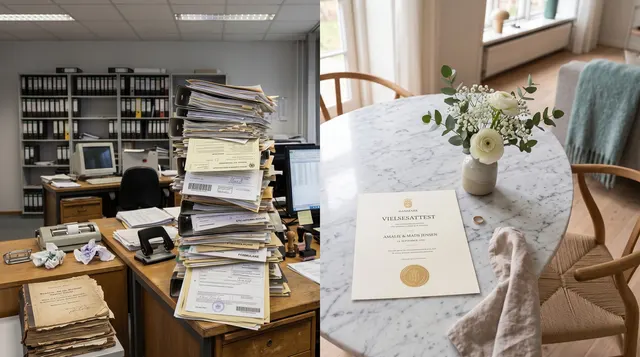
Short answer: Yes, in principle. A marriage concluded in Denmark is valid under Danish law, and Germany recognises it in principle if the Danish form was followed (Art. 11 EGBGB) and each partner met the conditions of their own national law (Art. 13 EGBGB). There is no separate recognition procedure. Entering the marriage in the German marriage register (Nachbeurkundung, § 34 PStG) is voluntary; you report your new marital status at the Bürgeramt.
On this page
- Is a marriage concluded in Denmark valid in Germany?
- Is there a recognition procedure in Germany?
- When does a German office look more closely?
- What is the Nachbeurkundung under § 34 PStG, and do we need it?
- What does registration cost, and which documents does the registry office want?
- Does the Danish marriage certificate need an apostille or a translation?
- Does our surname change through the wedding in Denmark?
- Which German offices do we update after returning?
- Is a same-sex marriage from Denmark recognised too?
- How does Denmark Wedding Services help?
- Frequently asked questions about recognition in Germany
Who this guide is for: Couples who live in Germany or are moving back there, who plan to marry in Denmark or already have, and who want to know what the Danish marriage certificate does in Germany and which steps make sense afterwards.
Key points
- The marriage is valid under Danish law; recognition and legal effects abroad depend on the destination country, and in Germany on Articles 11 and 13 EGBGB.
- There is no recognition procedure: each German authority checks the marriage itself when its own decision depends on it.
- Registration under § 34 PStG is voluntary and only possible if at least one spouse is German.
- If you live in Germany and do not register the marriage, you report it at the Bürgeramt (residents' register).
- Your surname does not change automatically. Since 1 May 2025 a double name can also be chosen as the married name.
- Within the EU the Danish marriage certificate needs no apostille (Regulation (EU) 2016/1191).
Is a marriage concluded in Denmark valid in Germany?
In principle, yes. The German Federal Foreign Office (Auswärtiges Amt) names two conditions: at the time of the wedding both partners had to meet the requirements of their own national law, such as being unmarried and of age, and the form of the place of marriage had to be followed. The legal basis is Art. 13(1) EGBGB (the conditions of marriage follow, for each partner, the law of the state of which they are a national) and Art. 11(1) EGBGB (the form is valid if it meets the law of the place where the marriage is concluded).
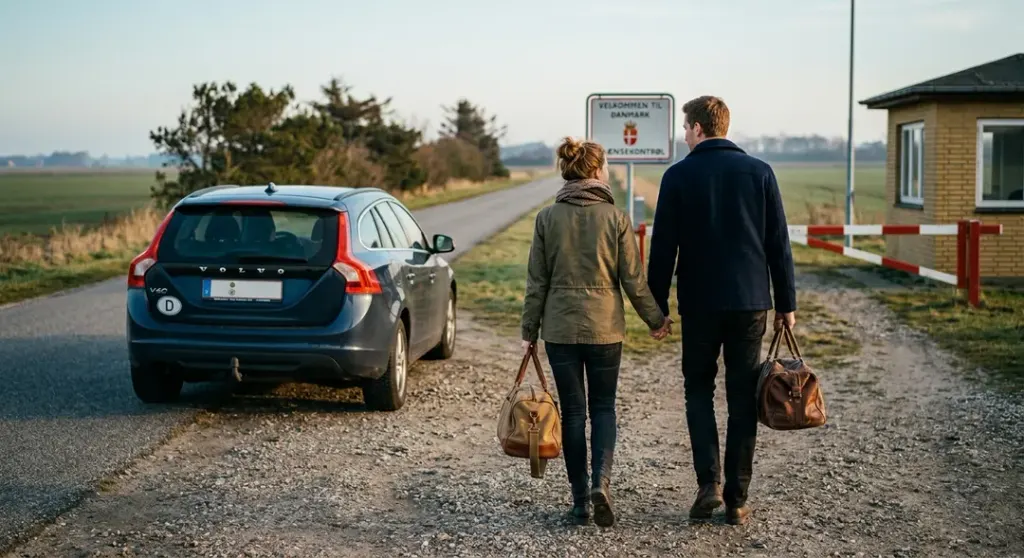
A civil ceremony at a Danish town hall, after the Danish Agency of Family Law (Familieretshuset) has examined and approved the application, meets the Danish form. The German Federal Office for Foreign Affairs says in its information sheet "Deutsche heiraten in Dänemark" that a marriage concluded in Denmark is legally valid in Germany as long as all conditions and formal requirements were met.
Is there a recognition procedure in Germany?
No. According to the Federal Foreign Office there is neither a specific procedure nor a responsible authority for recognising a marriage concluded abroad. Whether the marriage is effective is a preliminary question that each office decides for itself when its own procedure depends on it, for example the registry office (Standesamt) for a name declaration or the tax office for your tax class.
In practice this means you show the Danish marriage certificate wherever you need to prove the marriage. There is no advance confirmation.
When does a German office look more closely?
For most couples the check is straightforward. An office may look more closely if one partner's national law has special requirements or a previous marriage is involved. One important case: if a partner was divorced outside the EU, German law (§ 107 FamFG) generally recognises that divorce only once the state justice administration (Landesjustizverwaltung) has confirmed it. This does not apply if a court or authority of the state to which both spouses belonged at the time made the decision. Until that confirmation exists, a German office may assess the new marriage differently from Denmark.
Clarify such cases with your registry office or a legal adviser before the wedding. Denmark itself does not ask for a certificate of no impediment; see our guide on marrying without a certificate of no impediment.
What is the Nachbeurkundung under § 34 PStG, and do we need it?
Under § 34(1) PStG, a German who married abroad can apply to have the marriage recorded in the German marriage register. The Federal Foreign Office states clearly that registration is not required. The spouses can apply; at least one must be German (or stateless, or a recognised refugee habitually resident in Germany).
It can still be useful:
- German marriage certificate: afterwards the registry office can issue German marriage certificates. The City of Berlin names as a benefit that later translations and certifications of the foreign certificate are no longer needed.
- Later procedures: for pensions, survivors' benefits or inheritance, an office may prefer a German certificate. It is not automatically required for these.
- Name declaration: you can make the declaration of your married name at the same appointment.
The responsible office is the registry office of your current or last residence in Germany (§ 34(4) PStG). If you have never lived in Germany, you apply to Standesamt I in Berlin or, from abroad, through the German embassy or consulate.
What does registration cost, and which documents does the registry office want?
Fees are set by each federal state. An example from the official service portal of the City of Berlin (read 2026-11-23):
| Service (example: Berlin) | Fee |
|---|---|
| Registration, only German law applies | €80.00 |
| Registration, foreign law applies to one person | €125.00 |
| Registration, foreign law applies to both | €170.00 |
| Marriage certificate or international marriage certificate | €12.00 each (further copies at the same time: €6.00 each) |
Berlin usually asks for:
- the application form,
- the Danish marriage certificate,
- each spouse's birth certificate or a certified register extract,
- both spouses' ID cards or passports,
- for earlier marriages, proof that they ended (for example a divorce decree with a finality note),
- a naturalisation certificate, if there is one.
Documents must be originals or certified copies; simple copies are not enough. Foreign-language documents generally need a certified German translation. Ask your own registry office for its list, because documents and fees can differ.
Does the Danish marriage certificate need an apostille or a translation?
Usually not. Under EU Regulation 2016/1191, authorities in one EU country must accept a marriage certificate from another EU country as authentic without an apostille. The German Federal Office for Foreign Affairs says the same for Denmark: an apostille is only needed if a German authority asks for one.
The Danish marriage certificate is available in an international version that includes German (Danish, English, German, French and Spanish). What the certificate shows and how to get more copies is covered in the Danish marriage certificate explained. If an office still asks for an apostille, DWS can arrange it through the Apostille Service for €100; details in our guide to the apostille on a Danish marriage certificate.
Does our surname change through the wedding in Denmark?
Not automatically. Since 1 May 2025 a person's name follows the law of the state where they habitually live (Art. 10(1) EGBGB). For couples living in Germany, German name law applies: without a declaration, each spouse keeps their current name (§ 1355 BGB). Binational couples can instead choose, by a declaration to the registry office, the name law of a state whose nationality one of them holds (Art. 10(2) EGBGB).
You choose a joint married name by a declaration to the registry office. If you make it after the wedding, it must be publicly certified. Since 1 May 2025 a double name made from both surnames is also possible, with or without a hyphen and with no more than two parts. For marriages concluded before 1 May 2025, the Federal Foreign Office says the previous rules still apply.
Which German offices do we update after returning?
- Bürgeramt (registration office): your marital status is changed in the residents' register here. The City of Berlin points out that if you live in Germany and do not register the marriage with the registry office, you must report it to the Bürgeramt.
- Tax class: after a wedding in Germany, tax class IV is assigned automatically. According to the City of Karlsruhe this does not apply to a wedding abroad: the tax office can only change the tax class once the registration office has entered the marriage. You apply to the tax office for a different combination (such as III/V).
- Health insurer, employer, banks, insurers: show them the marriage certificate when something changes, for example family health insurance or a new surname.
- Immigration office (non-EU partner): marriage does not create an automatic right of residence. A residence permit is applied for separately, through the German mission abroad or the Ausländerbehörde.
Is a same-sex marriage from Denmark recognised too?
Denmark allows same-sex marriage, and in Germany two people of different or the same sex have been able to marry since 1 October 2017 (§ 1353(1) BGB). For same-sex marriages concluded abroad, Art. 17b(4) and (5) EGBGB contain their own rules. More in our guide to same-sex marriage in Denmark.
How does Denmark Wedding Services help?
We handle the Danish side, so the marriage rests on sound paperwork from the start. With the €799.00 Comfort Package we check your documents, file the application with Familieretshuset, reserve the ceremony date in the Danish kommune you choose and provide two witnesses. The official 2,100 DKK fee (2026) is included in our package. You pay only after our team has checked your documents and confirmed that everything is complete.
After the wedding you receive the multilingual Danish marriage certificate. You apply for the German registration and the name declaration yourself at your registry office. If you need a Russian birth certificate in German for it, our founder, a state-authorised sworn translator for Russian and German, translates and certifies it for €50 per document (German ⇄ Russian only). How the trip from Germany works is covered in marrying in Denmark from Germany; the comparison with a German registry office is in Denmark vs Germany. Your personal document list comes from the free checklist.
Denmark Wedding Services is not a law firm. We provide practical and administrative support for marrying in Denmark; for individual questions about recognition, residence or tax, please ask the relevant authority or a qualified legal professional.
Written by Ludmila Bernowski, CEO & Co-Founder of Denmark Wedding Services, state-authorised sworn translator for Russian and German; reviewed by Shenol Reetz, co-founder. Last reviewed: 23 November 2026.
Frequently asked questions about recognition in Germany
Is a wedding in Denmark valid in Germany?
In principle yes, if the Danish form was followed (Art. 11 EGBGB) and each partner met the conditions of their own national law (Art. 13 EGBGB). There is no separate recognition procedure; each authority checks the marriage itself when it matters for its decision.
Do we have to register the Danish marriage in Germany?
No. Registration in the German marriage register under § 34 PStG is voluntary and only possible if at least one spouse is German. If you live in Germany, report the marriage at the Bürgeramt so that your marital status in the residents’ register is correct.
Where do we apply for the registration?
At the registry office of your current or last residence in Germany. If you have never lived in Germany, apply to Standesamt I in Berlin or through the German embassy or consulate.
Does the Danish marriage certificate need an apostille for Germany?
Usually not: under EU Regulation 2016/1191 it must be accepted as authentic without an apostille. If an office still asks for one, DWS arranges it through the Apostille Service for €100.
Do we automatically get a joint surname?
No. For couples living in Germany, German name law applies. You declare a married name at the registry office; since 1 May 2025 a double name made from both surnames is also possible.
Sources
- Gesetze im Internet: § 34 PStG, marriages abroad (German) (read 2026-11-23)
- Gesetze im Internet: EGBGB, Articles 10, 11, 13 and 17b (German) (read 2026-11-23)
- Gesetze im Internet: § 1355 BGB, married name (German) (read 2026-11-23)
- Gesetze im Internet: § 1353 BGB, marriage (German) (read 2026-11-23)
- Gesetze im Internet: § 107 FamFG, recognition of foreign divorce decisions (German) (read 2026-11-23)
- Federal Foreign Office: is my marriage abroad valid in Germany? (German) (read 2026-11-23)
- Federal Foreign Office: registering a marriage concluded abroad (German) (read 2026-11-23)
- Federal Foreign Office: new name law since 1 May 2025 (German) (read 2026-11-23)
- Federal Office for Foreign Affairs: information sheet "Deutsche heiraten in Dänemark", as of December 2018 (German) (read 2026-11-23)
- Berlin service portal: registering a marriage concluded abroad (German) (read 2026-11-23)
- City of Karlsruhe: tax class changes after marriage (German) (read 2026-11-23)
- Your Europe: getting your public documents accepted in the EU (read 2026-11-23)
- City of Copenhagen: get a new marriage certificate, international version (read 2026-11-23)
Ready to Start Your Danish Wedding?
Fill out our free checklist in about 2 minutes — we'll send you a personalized document list and guide you through every step.
Start Free Checklist →