Marrying in Denmark from Germany: Routes, Documents and Recognition
Reviewed by Ludmila Bernowski, CEO & Co-Founder of Denmark Wedding Services. Last reviewed: October 2026. Practical, experience-based information, not legal advice — for legal questions, consult a qualified lawyer. Our Google Business Profile and reviews
Short answer: Couples living in Germany often marry in Denmark because a foreign partner needs no Ehefähigkeitszeugnis (certificate of capacity to marry), which Germany requires under § 1309 BGB. Denmark is just across the border, ceremonies are multilingual, and complete applications are generally processed in about 5 working days (a target, not a guarantee). The marriage is valid in Germany.
On this page
- Why do couples from Germany marry in Denmark?
- Is a Danish marriage recognised in Germany?
- How do you get to Denmark from Germany?
- Where do couples from Germany marry in Denmark?
- How does the process work with Denmark Wedding Services?
- Driving routes from Hamburg, Berlin, Munich, Frankfurt and Cologne
- What do you need to do in Germany after a Danish wedding?
- When can German paperwork still be needed after a Danish wedding?
- Combining your wedding with a mini-honeymoon in Denmark
- FAQs for German Couples
Who this guide is for: Couples living in or near Germany — especially binational pairs — comparing Denmark with the local Standesamt.
Key points
- No Ehefähigkeitszeugnis for a foreign partner — the biggest time saver for binational couples.
- Short travel: Hamburg–Copenhagen by train, or drive to Aabenraa or Tønder near the border.
- Complete applications: about 5 working days as a general target, not a guarantee.
- A Danish marriage is legally valid in Germany.
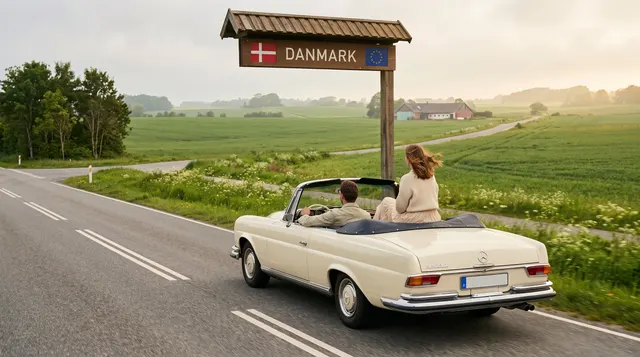
Couples living in Germany often marry in Denmark because getting married in Germany can mean a long bureaucratic process — especially for binational couples or non-EU citizens. Denmark offers a much simpler alternative, and a Danish marriage is recognised under German law.
Why do couples from Germany marry in Denmark?
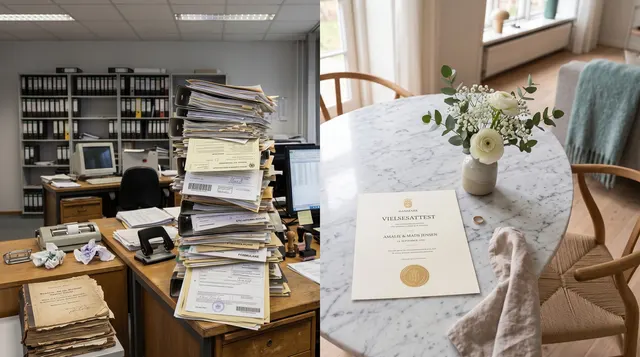
Getting married in Germany typically requires:
- Ehefähigkeitszeugnis (certificate of capacity to marry) for a foreign partner — or an exemption from the Higher Regional Court (OLG) under § 1309 BGB; this can take months
- Birth certificates — foreign ones with apostille or legalisation (depending on the country) and a translation
- Embassy appointments for the foreign partner's documents — often with long waiting times
- Anmeldung (registration of the marriage) at the local Standesamt
- Overall preparation that, with a foreign partner, often takes several weeks to months
In Denmark, you need:
- Valid passports (EU citizens may use their ID card)
- Proof of residence and marital status — for residents of Germany, the Erweiterte Meldebescheinigung (not older than 3 months), which shows the marital status
- Proof of legal entry (non-EU partners)
- If divorced: the final divorce decision (for German divorces with the Rechtskraftvermerk)
- Non-EU partner: depending on the country that issued their own civil-status documents (for example a foreign divorce decree), an apostille or legalisation — never on the passport
For two partners with German documents, that's it. German documents need neither an apostille nor a translation. No Ehefähigkeitszeugnis, no embassy visits, no Anmeldung at a Standesamt. The saving is largest for binational couples; for two German partners without time pressure the local Standesamt is usually cheaper.
Is a Danish marriage recognised in Germany?
Yes. A marriage legally performed in Denmark in Danish form is recognised in Germany (Art. 11 EGBGB). You do not need to remarry or register separately; German citizens can optionally have the marriage entered in the German marriage register (§ 34 PStG). Simply present your Danish marriage certificate to your local Bürgeramt or Standesamt for administrative purposes — within the EU no apostille is required (EU Regulation 2016/1191), although some offices still ask for one. For the full side-by-side analysis on documents, costs, and timelines, see our Denmark vs Germany wedding comparison.
How do you get to Denmark from Germany?
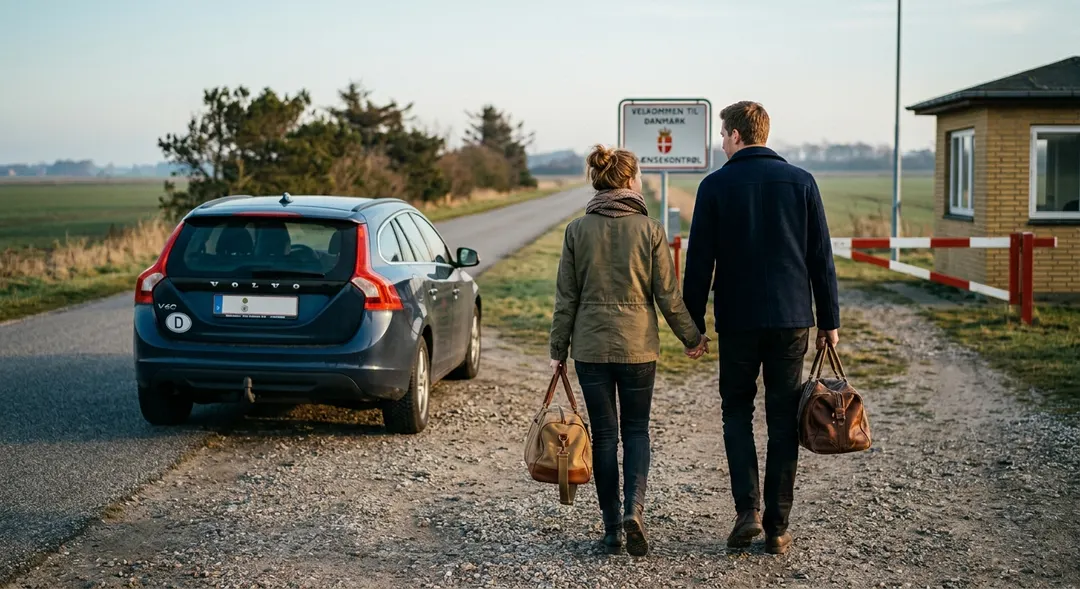
Denmark is easy to reach from Germany:
- By car — Drive to Tønder (about 5 km north of the German border) or Aabenraa (about 25 km north of the border, roughly 20–25 minutes by motorway from the Padborg crossing)
- By train — Hamburg to Copenhagen in roughly 4.5–5 hours via DSB/Deutsche Bahn
- By plane — Budget flights from Berlin, Munich and Frankfurt to Copenhagen
- Flixbus — Budget bus options from major German cities
For couples driving from Northern Germany, getting married in Tønder is a popular choice — the town is only a few minutes from the border.
Where do couples from Germany marry in Denmark?
- Tønder — Popular with couples from Germany. About 5 km from the German border, roughly 10 minutes by car. Drive there and back in a day. Tønder marries couples from abroad on Tuesdays and Thursdays.
- Aabenraa — Calm and well organised; ceremony dates are released 60 days in advance. About 25 km north of the border, roughly 20–25 minutes by motorway.
- Copenhagen — For couples who want a city atmosphere and a romantic weekend. The city says couples may wait up to four months for a date.
Tønder and Aabenraa are the two town halls closest to the German border where DWS books ceremonies; we do not book ceremonies at other town halls such as Sønderborg. Unsure which of the two suits you? Our comparison of Tønder and Aabenraa weighs them up side by side.
| Town hall | Distance from the German border | By car from Hamburg |
|---|---|---|
| Tønder | About 5 km | About 2–2.5 hours |
| Aabenraa | About 25 km | About 2–2.5 hours |
| Copenhagen | — | Much longer; many couples fly or take the train |
Near the border, many couples drive there and back on the wedding day; the ceremony itself takes about 10–15 minutes.
Can the Danish ceremony be conducted in German?
Aabenraa lies in Southern Jutland, home of Denmark's German minority. Aabenraa's registry office marries couples who can communicate in Danish, German or English, so no interpreter is needed for German speakers. Aabenraa also asks couples to bring the same travel documents on the wedding day that were sent to Familieretshuset. Tønder Municipality points out that its registry staff speak very good German and English, and your own witnesses there need only some German or English — so in Tønder, too, you can marry in German or English.
How does the process work with Denmark Wedding Services?
- Step 1: Fill out our free checklist (about 2 minutes).
- Step 2: Receive your personalised document list.
- Step 3: We apply to Familieretshuset on your behalf.
- Step 4: Approval — usually about 5 working days (a target, not a guarantee).
- Step 5: We book your ceremony date with the town hall (it depends on the town hall's free dates), then you drive to Denmark and get married.
- Step 6: Update your marital status at your Bürgeramt; registering the marriage at the Standesamt (§ 34 PStG) is optional.
Driving routes from Hamburg, Berlin, Munich, Frankfurt and Cologne

Most couples from Germany drive, and both border towns are close to the crossing. Here's what each route looks like:
- From Hamburg — about 2–2.5 hours to Tønder or Aabenraa. Take the A7 north; for Aabenraa, stay on the motorway and cross at Flensburg/Padborg. Couples can leave Hamburg in the morning, marry in Aabenraa in the early afternoon, and be back in Hamburg for dinner.
- From Berlin — 5.5–6 hours to Aabenraa via A24 and A7. Many couples from Berlin stay one night near the border (Flensburg or Tønder) before the ceremony, then drive back the next day. Splitting the drive means you arrive rested.
- From Munich — 8–9 hours to Aabenraa, the longest of the major cities. Either fly to Hamburg (1-hour flight + about 2 hours driving) or split the drive across two days with an overnight in Hannover.
- From Frankfurt — 6–6.5 hours via A5 and A7. Many couples fly to Hamburg or Billund instead, which saves around 12 hours of driving there and back.
- From Düsseldorf / Cologne — roughly 5.5–6 hours via A1 and A7 to the Aabenraa exit. Drivable in one day with two stops.
We can suggest the best route when we prepare your application — many couples are surprised that flying to Hamburg and renting a car for the final stretch can be quicker than driving all the way from southern Germany.
What do you need to do in Germany after a Danish wedding?
A Danish marriage is automatically valid in Germany — but "automatic" doesn't mean "effortless." Here's what actually happens after you return:
- Personal status (marital status) — Your marital status in the German population register doesn't update automatically. Visit your Bürgeramt with the Danish certificate; they'll record the change for you.
- Tax class change — Once the Bürgeramt has recorded your marriage, the change is passed on to the tax authorities and both partners are usually placed in Steuerklasse IV automatically. For a different combination (e.g. III/V), apply at your local Finanzamt.
- Health insurance — If one partner is non-working, they may qualify for free family insurance under the working partner's plan (Familienversicherung) — provided the working partner is in statutory health insurance (GKV) and the other partner's income stays below the statutory limit (§ 10 SGB V). Apply at the Krankenkasse with the certificate.
- Surname change — Optional in Germany. If you choose to change names, you do this at the Standesamt with your Danish certificate. Within the EU the Danish certificate needs no apostille (Regulation 2016/1191). Some Standesämter still ask for one, so check with yours before the appointment. If it is required, we can order it for €100.
- Residence permit (for non-EU spouse) — A Danish marriage is a recognised basis for spousal family reunification. For spouses of German citizens living in Germany, German residence law applies (not EU free-movement rules), usually including basic German (A1), with exceptions; for spouses of other EU citizens living in Germany, the EU pathway under Directive 2004/38 applies. The German mission abroad and the Ausländerbehörde are responsible — there is no guarantee.
For the apostille step, see our Danish marriage apostille guide.
When can German paperwork still be needed after a Danish wedding?
A small number of edge cases still require some German bureaucracy even after a Danish wedding:
- Survivor's pensions (Witwenrente / Witwengeld for civil servants) — Some pension bodies may ask for additional proof of the marriage, such as a German marriage certificate after registration under § 34 PStG. Rare but possible.
- Military marriage with US/NATO forces stationed in Germany — SOFA agreements can add extra requirements.
- Religious second ceremony in a German church — The churches ask for their own documents (for example a recent baptismal certificate) for a church wedding, regardless of civil status. This is a separate religious requirement, not legal.
For the vast majority of couples, none of these apply. For most everyday matters (such as updating your marital status and tax class) the Danish certificate is enough.
Combining your wedding with a mini-honeymoon in Denmark
Many couples treat the Denmark trip as a 4–5 day getaway rather than a one-day legal errand. The popular extensions:
- Copenhagen extension — After the ceremony in Tønder or Aabenraa, drive about 3–3.5 hours east to Copenhagen for 2–3 nights. Tivoli Gardens, Nyhavn, world-class restaurants, the design district. See our best places to visit in Copenhagen for the full list.
- Skagen + Aalborg loop — Northern Jutland's beaches and the meeting of two seas at Grenen are roughly a 4-hour drive from Aabenraa. Quieter than Copenhagen, dramatic landscapes for photos.
- South Jutland coastal route — From Tønder, follow the Wadden Sea coast to Ribe (Denmark's oldest town) and the islands of Rømø and Fanø. Ideal for couples who want a quiet, nature-focused mini-honeymoon.
- Cross-border Hamburg-Copenhagen rail trip — Take the train from Hamburg to Copenhagen, which runs through South Jutland near Aabenraa. Marry along the way, sightsee in both cities. About 5 hours total rail time over 4 days.
Many of our couples plan these extensions with the Wedding Guide App included in the Comfort Package.
Many German-based couples are also binational (EU + non-EU partners) — our Denmark binational couples guide addresses the partner-nationality piece, and our Danish wedding documents checklist shows exactly what's needed.
Ready to skip the bureaucracy? Denmark Wedding Services checks your documents, applies to Familieretshuset and books your ceremony date at the town hall.
Related guide: Marrying in Denmark for international couples
FAQs for German Couples
What is the Rechtskraftvermerk and why does Denmark need it?
The Rechtskraftvermerk is the note of finality on a German divorce decision (Scheidungsbeschluss; older decrees: Scheidungsurteil). It confirms that the divorce is final and can no longer be appealed. Familieretshuset only approves a new marriage once any previous marriage has been legally dissolved, and for a German divorce the Rechtskraftvermerk is what shows this. If it is missing, Familieretshuset may ask for it, which delays the case — so DWS checks for it during the document review before submission.
Can we have a religious ceremony in Germany after the Denmark civil wedding?
Yes. Many couples from Germany marry civilly in Denmark and later have a church wedding in their home parish. The church generally does not need the marriage to be registered at a German Standesamt first — the Danish marriage certificate shows the civil marriage — but each church asks for its own documents (for example a recent baptismal certificate), so check with your parish. The two ceremonies can be days or months apart.
How long does it take to marry in Denmark from Germany?
Familieretshuset generally processes a complete application in about 5 working days — a target, not a guarantee. The ceremony date is booked separately after approval: Tønder marries couples from abroad on Tuesdays and Thursdays, Aabenraa releases its dates 60 days in advance, and in Copenhagen the city says the wait can be up to four months. The approval is valid for 4 months.
Do German documents need an apostille or a translation for Denmark?
No. Documents issued in Germany, such as the Erweiterte Meldebescheinigung or a divorce decision with the Rechtskraftvermerk, need no apostille, and Familieretshuset accepts documents in German, English or Danish without translation. Only a non-EU partner's own civil-status documents may need an apostille or legalisation, depending on the country that issued them — passports never do. We check this for you before submission.
Sources
- Your Europe (EU) — marriage and recognition across the EU
- Danish Ministry of Foreign Affairs — legalisation of documents
- Danish Immigration Service — New to Denmark
- Danish Agency of Family Law — international marriages
- EU Regulation 2016/1191 on public documents — EUR-Lex
- Processing time — Familieretshuset
- German Civil Status Act, § 34 PStG — registering a marriage concluded abroad
- Aabenraa Municipality — marriage at the registry office (languages, travel documents on the wedding day, dates released 60 days in advance)
- Tønder Municipality — marrying in Tønder (German; Tuesdays and Thursdays for couples from abroad, staff with very good German and English)
- City of Copenhagen — City Hall wedding (waiting time up to four months)
- Danish Agency of Family Law — documentation requirements (apostille, legalisation, translation)
- § 10 SGB V — family insurance (German)
- § 1309 BGB — Ehefähigkeitszeugnis for persons subject to foreign law (German)
Ready to Start Your Danish Wedding?
Fill out our free checklist in about 2 minutes — we'll send you a personalized document list and guide you through every step.
Start Free Checklist →