Is a Danish Marriage Valid in Switzerland? Registration, Documents and Your Name
Reviewed by Ludmila Bernowski, CEO & Co-Founder of Denmark Wedding Services. Last reviewed: November 2026. Practical, experience-based information, not legal advice — for legal questions, consult a qualified lawyer. Our Google Business Profile and reviews
Short answer: Yes, in principle. A marriage validly concluded in Denmark is recognised in Switzerland (Art. 45 of the Federal Act on Private International Law, PILA/IPRG). It is not registered automatically, though: you report it yourselves, because foreign authorities usually do not inform Switzerland. A shared family name must be declared no later than 6 months after the wedding, and the original documents may be no older than six months.
On this page
- Is a marriage concluded in Denmark valid in Switzerland?
- Do we have to report the Danish marriage in Switzerland?
- Where do we submit the documents?
- Which documents does the Swiss side need?
- What does registration cost, and how long does it take?
- Does the Danish marriage certificate need an apostille?
- Does our surname change through the wedding in Denmark?
- What applies on the Danish side for Swiss citizens?
- Is a same-sex marriage from Denmark recognised too?
- Can my non-EU partner move to Switzerland afterwards?
- How does Denmark Wedding Services help?
- Frequently asked questions about recognition in Switzerland
Who this guide is for: couples with at least one Swiss partner who plan to marry at a Danish town hall, or already have, whether they live in Switzerland, in Denmark or elsewhere. It explains how the marriage gets into the Swiss civil-status register and what to watch for with your surname.
Key points
- The marriage is valid under Danish law; recognition and legal effects abroad depend on the destination country, in Switzerland on Art. 45 PILA.
- The marriage must be reported to your Swiss representation. Danish authorities do not report it for you.
- Originals may be no older than six months; they go to the Swiss civil-status authority and are not returned. Photocopies are not accepted.
- Registration itself is free. If a trusted lawyer has to examine the foreign documents in depth, you pay for that.
- Your name does not change automatically. The declaration of a shared family name is due no later than 6 months after the wedding.
- Switzerland is not in the EU. Ask your civil-status office in advance whether it wants an apostille on the Danish certificate.
Is a marriage concluded in Denmark valid in Switzerland?
In principle, yes. Article 45(1) of the Federal Act on Private International Law (PILA, in German IPRG) says that a marriage validly celebrated abroad is recognised in Switzerland. The Canton of Zurich puts it the same way for its citizens: foreign marriages are recognised if they were validly concluded abroad.
Paragraph 2 sets out one exception: if one partner is Swiss or both live in Switzerland, the marriage is not recognised if it was moved abroad with the manifest intent of circumventing the Swiss rules on annulment of marriage. For an ordinary ceremony at a Danish town hall, after review by the Danish Agency of Family Law (Familieretshuset) and with both partners present, this is normally not an issue. The cantonal civil-status supervisory authority decides on recognition in each case.
Do we have to report the Danish marriage in Switzerland?
Yes. The Swiss Embassy in Denmark states that a marriage abroad must be reported to your Swiss representation so that the Swiss registers can be updated. Foreign authorities generally do not notify the Swiss representation, so you submit the documents yourselves. The Canton of Zurich advises contacting the representation without delay and always stating your place of origin (Heimatort) and current address.
Where do we submit the documents?
That depends on where you live:
- Living in Denmark or another country: your Swiss representation handles it. You can upload copies first through the online counter; the representation checks them and then asks for the originals. The embassy's leaflet for marriages in Denmark (dated 15 June 2022) names the Regional Consular Center Nordic and Baltic Countries in Stockholm as the contact.
- Living in Switzerland: for the name declaration, the Federal Office of Justice names two routes: the Swiss representation abroad or the cantonal civil-status supervisory authority. The Canton of Zurich refers you to the supervisory authority of your home canton if you could not reach the representation. Ask your civil-status office before you travel which route it expects from you.
If at least one spouse is Swiss, the supervisory authority at that spouse's place of origin is responsible for recognition and the name. If both spouses are foreign nationals, it is the authority at their place of residence.
Which documents does the Swiss side need?
The embassy's leaflet for marriages in Denmark lists, among other things:
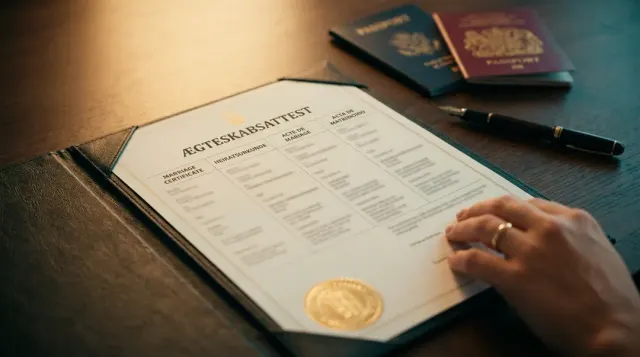
- the original Danish marriage certificate (Vielsesattest),
- the completed "Questionnaire concerning marriage" form,
- for the Swiss partner, a copy of the Swiss passport, a certificate of any name change and, if domiciled in Switzerland, a copy of the Swiss individual civil-status certificate,
- for a Danish partner, among others, a birth certificate, proof of marital status before the wedding and a certificate of residence.
The formal rules matter. All Danish documents must be stamped and signed in original by the issuing authority; documents sent electronically are usually not accepted. The originals may be no older than six months and are not returned. Documents in Danish, English, German, French or Italian are accepted. If any certificates come from a country other than Denmark or Switzerland, contact the representation first, because different rules may apply.
Because the original stays with the Swiss authorities, keep one copy of the marriage certificate for yourselves or order a new one from the kommune. How to do that, and whether you can get a certificate with a stamp and handwritten signature, is explained in the Danish marriage certificate explained.
What does registration cost, and how long does it take?
Entering the marriage in the Swiss civil-status register is free of charge. If a trusted lawyer has to examine foreign certificates in depth, the embassy says that cost is yours.
On timing, the embassy says in general that the procedures can take some time. The leaflet for marriages in Denmark expects at least two months until the marriage is registered. After that, the civil-status office of the place of origin can tell you the status and issue certificates on request, such as a family certificate.
Does the Danish marriage certificate need an apostille?
There is no single clear answer. Switzerland is not in the EU, so EU Regulation 2016/1191, which removes the apostille on marriage certificates between EU countries, does not apply. Neither the embassy page nor the leaflet for Denmark asks for an apostille on the marriage certificate. We have not found an official statement that one is never needed, though.
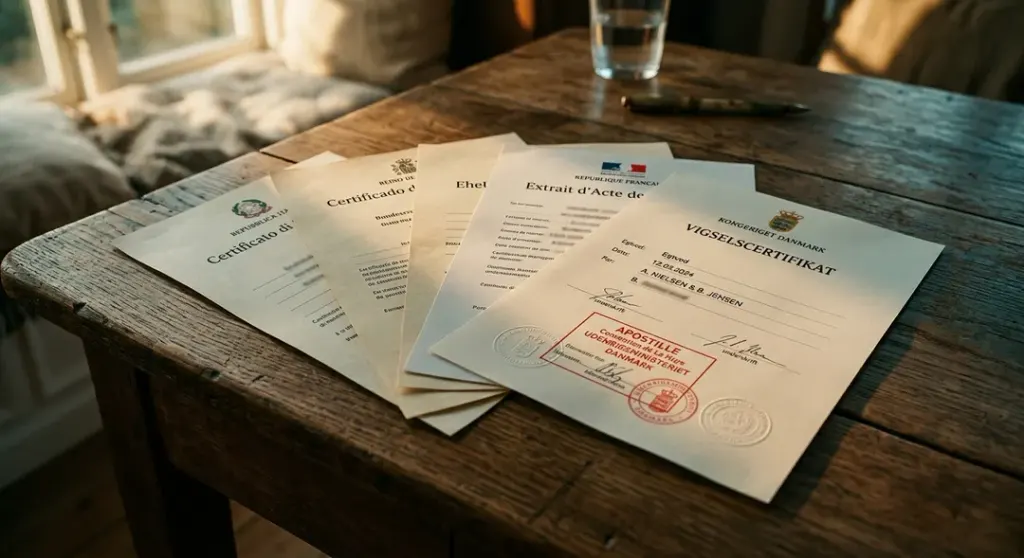
So ask your representation or civil-status office before you submit. If it wants an apostille, DWS can arrange it on the finished Danish marriage certificate through our Apostille Service for €100. More in the Danish marriage certificate and the apostille.
Does our surname change through the wedding in Denmark?
No, not automatically. The Federal Office of Justice is clear: each of you keeps your current name unless you choose a shared one. As a shared family name you can choose the birth surname of either partner.
If the wedding takes place abroad, the name declaration must be made no later than 6 months after the marriage, together with the marriage documents, at the Swiss representation or the cantonal supervisory authority. If you both keep your names, you decide which birth surname your children will bear; if you did not do this at the wedding, you declare it when the first child's birth is registered at the latest. Swiss law does not allow a double surname for children. More in changing your name after a Danish wedding.
Apply for a passport or identity card in the new name only once the marriage and the name change are registered. If you did not change your name, you do not need to do anything, because the identity card does not show civil status.
What applies on the Danish side for Swiss citizens?
Swiss citizens can use either their identity card or their passport for the Familieretshuset application; details in passport and ID requirements. Documents issued in Switzerland need no apostille for Familieretshuset. Documents in German or English are accepted without translation; French or Italian documents must be translated into Danish, English or German by an authorised translator. More in translating documents for a Danish wedding.
Is a same-sex marriage from Denmark recognised too?
Denmark allows same-sex marriage, and Switzerland has had "marriage for all" since 1 July 2022. Since then no new registered partnerships can be formed. According to the Federal Office of Justice, same-sex marriages concluded abroad have been recognised as marriages since that date. You report a same-sex marriage concluded in Denmark the same way as any other marriage.
Can my non-EU partner move to Switzerland afterwards?
A wedding in Denmark gives no automatic right to live in Switzerland. Family reunification is a separate application to the cantonal migration authority. Depending on your partner's residence status in Switzerland, language skills may be required: the Canton of Zurich, for example, asks for a German certificate at level A1 or confirmation of enrolment in a German course in Switzerland when a spouse joins someone with a B or C permit. The cantonal migration authority tells you which requirements apply to you, including when joining a Swiss spouse; neither we nor anyone else can promise the outcome in advance.
How does Denmark Wedding Services help?
We handle the Danish side. With the Comfort Package at €799.00 we check your documents, submit the application to Familieretshuset, reserve the ceremony in a Danish kommune of your choice and provide two witnesses. The official 2,100 DKK fee (2026) is included in our package. You pay only after our team has checked your documents and confirmed that everything is complete.
After the wedding you receive the Danish marriage certificate. You report the marriage to the Swiss representation and make the name declaration yourselves; if your office wants an apostille, we arrange it for €100. What else comes after the ceremony is summed up in married in Denmark: what next?. For neighbouring countries, see recognition in Germany, recognition in Austria and the overview by country. Get your personal document list with the free checklist.
Denmark Wedding Services is not a law firm. We provide practical and administrative support for marrying in Denmark; for individual questions about recognition, your name or residence, please ask the relevant Swiss authority or a qualified legal professional.
Written by Ludmila Bernowski, CEO & Co-Founder of Denmark Wedding Services, state-authorised sworn translator for Russian and German; reviewed by Shenol Reetz, co-founder. Last reviewed: 23 November 2026.
Frequently asked questions about recognition in Switzerland
Is a wedding in Denmark recognised in Switzerland?
In principle, yes. Under Art. 45 PILA, a marriage validly concluded abroad is recognised in Switzerland. The exception is a wedding that was evidently moved abroad to circumvent the Swiss rules on annulment of marriage.
Do we have to report the Danish marriage in Switzerland?
Yes. The marriage must be reported to your Swiss representation, and foreign authorities usually do not do it for you. Registration itself is free.
How old may the documents be?
The originals may be no older than six months. They go to the civil-status authority, are not returned, and photocopies are not accepted.
What is the deadline for declaring a shared family name?
After a wedding abroad, no later than 6 months after the marriage, together with the marriage documents, at the Swiss representation or the cantonal supervisory authority. Without a declaration, each of you keeps your name.
Does the Danish marriage certificate need an apostille for Switzerland?
The embassy and its leaflet for Denmark do not ask for one, but there is no binding statement either way. Ask your representation or civil-status office; if it wants one, DWS arranges it through the Apostille Service for €100.
Sources
- Fedlex: Federal Act on Private International Law (PILA/IPRG, SR 291), Art. 45 (read 2026-11-23)
- Swiss Embassy in Denmark: after a marriage abroad, registration (German) (read 2026-11-23)
- Swiss Embassy: leaflet "After your marriage/partnership performed in Denmark" (dated 15 June 2022) (read 2026-11-23)
- Federal Office of Justice: FAQ on names, first names and citizenship (19 March 2026, German) (read 2026-11-23)
- Canton of Zurich: civil-status events abroad (German) (read 2026-11-23)
- Canton of Zurich: family reunification of third-country nationals (German) (read 2026-11-23)
- Federal Office of Justice: FAQ on marriage and "marriage for all" (19 March 2026, German) (read 2026-11-23)
- Familieretshuset: documentation requirements (read 2026-11-23)
- Your Europe: getting public documents accepted in the EU (read 2026-11-23)
Ready to Start Your Danish Wedding?
Fill out our free checklist in about 2 minutes — we'll send you a personalized document list and guide you through every step.
Start Free Checklist →