Symbolic Ceremony After a Danish Civil Wedding: What Is Legal and How to Plan It
Reviewed by Ludmila Bernowski, CEO & Co-Founder of Denmark Wedding Services. Last reviewed: November 2026. Practical, experience-based information, not legal advice — for legal questions, consult a qualified lawyer. Our Google Business Profile and reviews
Short answer: A symbolic ceremony is allowed, but it does not create a marriage. In Denmark you are legally married only after a wedding before an authority that may marry couples under Danish law, usually the kommune at the town hall. Many couples therefore marry first in a small civil wedding in Denmark and hold their symbolic ceremony later, at home or anywhere else. Your legal wedding date is then the date of the Danish ceremony.
On this page
- Is a symbolic wedding ceremony legally binding?
- Who can legally marry a couple in Denmark?
- Civil wedding in Denmark first, symbolic ceremony later: how does it work?
- Will we have two wedding dates?
- Can the civil wedding and the symbolic ceremony be at the same place?
- Will our home country recognise the Danish marriage?
- Is a symbolic ceremony certificate an official document?
- Symbolic ceremony, church blessing or both?
- What does the legal part in Denmark cost?
- How DWS helps
- Frequently asked questions about symbolic ceremonies after a Danish wedding
Who this guide is for: Couples from anywhere who are planning a celebrant-led or symbolic ceremony – a "freie Trauung" in German-speaking countries – and want to handle the legal part in Denmark first, knowing what counts in law and what stays a celebration.
Key points
- A symbolic ceremony is a celebration without legal effect. It is not forbidden, but it does not replace a civil wedding.
- Under Danish law a wedding is valid only if it took place before an authority that may perform weddings (Marriage Act, § 21). In Germany, for example, a marriage is concluded only before the registrar (§ 1310 BGB).
- An independent celebrant cannot marry you with legal effect in Denmark.
- The usual route: a civil wedding in Denmark, then the symbolic ceremony on a date and at a place of your choice.
- You then have two dates. In law only the date of the Danish wedding counts.
- The marriage is valid under Danish law; recognition and legal effects abroad depend on the destination country.
Is a symbolic wedding ceremony legally binding?
No. Under § 21 of the Danish Marriage Act (Ægteskabsloven), a wedding is valid only if it took place before an authority that may perform weddings under the Act. A symbolic ceremony on a beach, in a garden or in a barn is therefore not a marriage in Denmark. That does not make it unlawful: you may celebrate however and wherever you like – it simply does not make you married.
Many other countries follow the same principle. In Germany, § 1310(1) BGB states that a marriage is concluded only by the couple declaring before the registrar (Standesbeamter) that they wish to marry each other. Some countries do authorise celebrants to conduct legal weddings under their own rules. If you are already married in Denmark, ask your home registry how it treats your Danish marriage before you plan a second ceremony there.
Who can legally marry a couple in Denmark?
In Denmark a marriage is concluded by a church or a civil wedding (Marriage Act, § 15). According to borger.dk, a civil wedding is performed by the mayor or a person the mayor has authorised, and that authorisation may go only to staff of the municipal administration and members of the municipal council. Church weddings are performed by priests of the Danish national church (Folkekirken) and by authorised officiants of recognised faith communities, when one of you is a member.
An independent celebrant belongs to none of these groups. There are no private registrars in Denmark. For the church side, see our guide to church and religious weddings in or after Denmark.
Civil wedding in Denmark first, symbolic ceremony later: how does it work?
Most couples plan the two parts like this:
- Apply to the Danish Agency of Family Law (Familieretshuset). It checks that you may marry; the approval is valid for four months. Our step-by-step guide shows the process.
- Marry at a Danish town hall, for example in Copenhagen, Tønder or Aabenraa. At Copenhagen City Hall the ceremony takes about 10 minutes according to the city, up to 75 guests are allowed, and the city always provides two witnesses.
- Take the Danish marriage certificate home. It is your proof of marriage; the Danish marriage certificate explained shows what it contains.
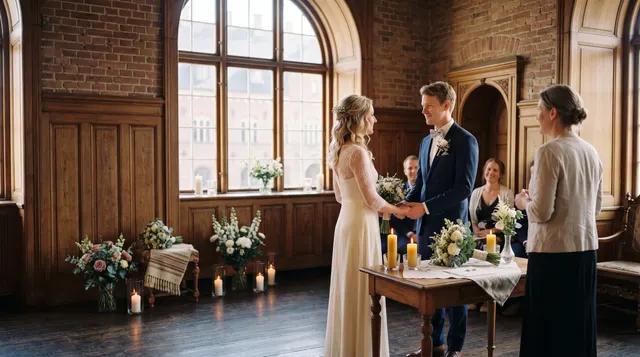
- Hold your symbolic ceremony – days, weeks or months later, at home, abroad or in Denmark.
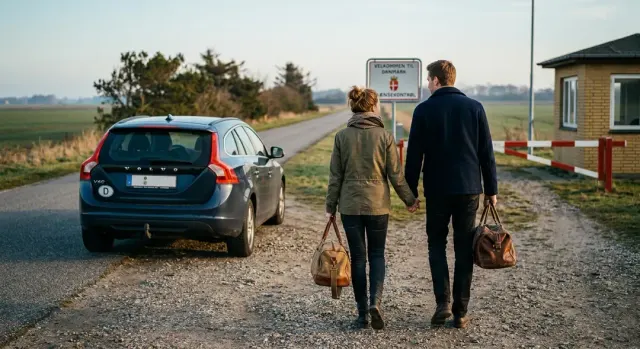
If you keep the Danish wedding deliberately small, just the two of you or a few guests, see our guide to eloping in Denmark. Couples living in Germany find the legal side in getting married in Denmark from Germany.
Will we have two wedding dates?
Usually, yes. The legal date is the day of your wedding in Denmark, and it is printed on the Danish marriage certificate. The symbolic ceremony afterwards does not change it. For authorities, the Danish date is the one that counts. Which day you celebrate as your anniversary is up to you.
Can the civil wedding and the symbolic ceremony be at the same place?
Sometimes. A civil wedding is normally held at the town hall, but the kommune can allow another place in Denmark, such as a forest or a park (Marriage Act, § 18(3); borger.dk). You have no right to this, and for a place outside the town hall the kommune may charge its own costs (§ 21 of the order on the conclusion of marriage) – that is then the kommune's own charge. Which kommunes offer which places is set out in special wedding places in Denmark.
Keeping the two apart is often simpler: the legal wedding at the town hall, then the symbolic ceremony wherever you like. Krusmølle near Aabenraa is our partner venue for the celebration after the wedding. Whether a symbolic ceremony can also be held there is a question for Krusmølle directly.
Will our home country recognise the Danish marriage?
The marriage is valid under Danish law; recognition and legal effects abroad depend on the destination country. Germany, for example, generally recognises it when the Danish form was followed (Art. 11 EGBGB) and each partner met the conditions of their own national law (Art. 13 EGBGB); there is no separate recognition procedure, and registration in the German marriage register under § 34 PStG is voluntary. For other countries, see recognition of a Danish marriage by country; for Germany in detail, Danish marriage recognition in Germany.
Is a symbolic ceremony certificate an official document?
No. A certificate handed to you by your celebrant is a lovely keepsake, but it is not proof of marriage. The only official document is the Danish marriage certificate (vielsesattest) that the kommune issues after the wedding. Always show that one to authorities.
Symbolic ceremony, church blessing or both?
It depends on what matters to you. A symbolic ceremony is non-religious and entirely yours to shape: your own words, your own rituals, your own place. A church blessing after a civil wedding is a church service and follows the church's rules; according to borger.dk, a Folkekirken priest may decline to bless a marriage, and your wedding date stays the date of the civil wedding. Both can follow a wedding in Denmark. For customs you could weave into your celebration, see Danish wedding traditions.
What does the legal part in Denmark cost?
Our Comfort Package costs €799.00, and the Danish authority fee of 2,100 DKK (2026) is included. The kommune itself does not charge for the town hall wedding. Travel, accommodation and your symbolic ceremony at home are planned separately. How couples budget for both is shown in the cost of getting married in Denmark. We do not quote celebrant prices because we have not verified them.
How DWS helps
- Comfort Package for €799.00: the official 2,100 DKK fee (2026) is included in our package. We check your documents, file the application with Familieretshuset, book your civil wedding date and arrange two witnesses – in Copenhagen, Tønder, Aabenraa and every other Danish kommune.
- The legal part, not the celebration: our package covers the civil wedding in Denmark. You arrange your symbolic ceremony, the celebrant and the venue for it yourselves.
- Planning: our free wedding checklist shows which documents you need, and how it works explains the whole route.
The short video on this page shows a small civil wedding for two in Denmark. More about the towns: Copenhagen, Tønder and Aabenraa.
Frequently asked questions about symbolic ceremonies after a Danish wedding
Is a symbolic wedding ceremony legally binding?
No. In Denmark a wedding is valid only if it took place before an authority that may perform weddings under the Marriage Act. A symbolic ceremony is a celebration without legal effect; it is not forbidden.
Can we marry legally in Denmark first and hold the symbolic ceremony later?
Yes. You are legally married from the day of the wedding in Denmark. You can hold the symbolic ceremony afterwards on a date and at a place of your choice; it does not change the legal date.
Will we have two wedding dates?
Usually, yes: the legal date of the wedding in Denmark, printed on the marriage certificate, and the date of your symbolic ceremony. For authorities only the Danish date counts.
Can a celebrant legally marry us in Denmark?
No. Civil weddings in Denmark are performed only by the mayor or municipal staff or council members the mayor has authorised, and church weddings only by Folkekirken priests or authorised officiants of recognised faith communities.
Do we need a second civil wedding at home?
Usually not, but it depends on your country. The marriage is valid under Danish law; recognition and legal effects abroad depend on the destination country. Germany, for example, generally recognises it, and registration there under § 34 PStG is voluntary.
Is a symbolic ceremony certificate an official document?
No. It is a keepsake. The only official document is the Danish marriage certificate that the kommune issues after the wedding.
Does DWS arrange the symbolic ceremony?
Our Comfort Package for €799.00 covers the civil wedding in Denmark, including the authority fee and two witnesses. You arrange your symbolic ceremony, the celebrant and the venue for it yourselves.
Sources
- Ægteskabsloven (Danish Marriage Act), LBK no. 663 of 1 July 2026, §§ 15, 18 and 21 (in Danish) – read 2026-11-23
- Bekendtgørelse om indgåelse af ægteskab (order on the conclusion of marriage), BEK no. 289 of 20 March 2019, § 21 (in Danish) – read 2026-11-23
- borger.dk – Når I vil giftes (in Danish) – read 2026-11-23
- City of Copenhagen – City Hall wedding – read 2026-11-23
- § 1310 BGB, German Civil Code (in German) – read 2026-11-23
- § 34 PStG, German Civil Status Act (in German) – read 2026-11-23
- EGBGB, Art. 11 and 13 (in German) – read 2026-11-23
Written by Ludmila Bernowski, co-founder of Denmark Wedding Services; reviewed by Shenol Reetz, co-founder. Denmark Wedding Services is not a law firm; this guide is general information, not legal advice. Last reviewed: 2026-11-23.
Watch Our Video
Follow us on YouTube, Instagram & TikTok for more wedding tips
Ready to Start Your Danish Wedding?
Fill out our free checklist in about 2 minutes — we'll send you a personalized document list and guide you through every step.
Start Free Checklist →