Long-Distance Couples: Marrying in Denmark While Living Apart
Reviewed by Ludmila Bernowski, CEO & Co-Founder of Denmark Wedding Services. Last reviewed: November 2026. Practical, experience-based information, not legal advice — for legal questions, consult a qualified lawyer. Our Google Business Profile and reviews
Short answer: Yes. Couples who live in two different countries can marry in Denmark. Neither of you has to live there, and you do not even need to have entered Denmark when you apply. Both of you must meet the conditions of the Danish Marriage Act, be able to stay in Denmark lawfully and appear together before the registrar on the wedding day. Almost everything before that, from documents to signatures, can be done at a distance.
On this page
- Can we marry in Denmark if we live in different countries?
- Can each of us apply from our own country?
- Do we need a residence certificate if we do not live together?
- Do we both have to sign on the same sheet of paper?
- Will living apart look like a sham marriage?
- What proof of our relationship should we prepare?
- Do we have to travel to Denmark together?
- How long do we need to stay in Denmark?
- Do we need to bring witnesses?
- Where can we live after the wedding?
- Will our marriage be recognised in both our countries?
- A sample plan for a couple living in two countries
- How DWS helps
- Frequently asked questions for long-distance couples
Who this guide is for: Couples in a long-distance relationship who live in different countries, often one partner in the EU and the other outside it, and want to know how to organise the application, the signatures, the proof of relationship and the journeys without living in the same place.
Key points
- Denmark has no residency requirement for marriage, and Life in Denmark states that you do not need to have entered Denmark at the time you apply.
- The Danish Agency of Family Law (Familieretshuset) never approves just one partner: both of you must meet the Marriage Act conditions, even if one or both of you live outside Denmark.
- A residence certificate is only needed if you live together outside Denmark. Couples who live apart do not add one.
- Signatures are handwritten unless you both apply with MitID, and the official forms put both signature lines on one page.
- Living apart is not in itself a reason to refuse. Where Familieretshuset checks the relationship, it asks how long you have known each other, where you met and whether you live or have lived together.
- You may travel separately, but you must stand before the registrar at the same time; two witnesses are required, and with us they are included.
- The marriage is valid under Danish law; recognition and legal effects abroad depend on the destination country, which for long-distance couples often means two countries.
Can we marry in Denmark if we live in different countries?
Yes. Familieretshuset writes that to obtain a Certificate of Marital Status, the approval you need before the ceremony, both of you must meet the requirements of the Danish Marriage Act, "even if one or both of you reside outside of Denmark". The basic conditions are the same for everyone: you are both at least 18, free to marry, and able to enter and stay in Denmark lawfully.
Because the approval covers you as a couple, it cannot be issued to just one of you. That is the one thing distance never changes: the application is joint, even if you prepare it from two countries.
Can each of us apply from our own country?
Yes. The application is online, and Life in Denmark confirms that neither of you needs to be in Denmark when you apply. How it works at a distance depends on who submits it:
- If you apply yourselves: each partner completes their own part of the application. Familieretshuset's application guide says both applicants must register with their own e-mail address and phone number, and the e-mail addresses must not be identical. Familieretshuset closes the case if it has not received both parts within 14 days, and you would then apply and pay again. Across time zones, agree on the date you start and who finishes when.
- If someone applies for you (an agency such as us, or a relative): you both sign a power of attorney, and Familieretshuset requires it with both of your original signatures. Your representative then submits the whole application, so the 14-day coordination between the two of you falls away.
Either way, every document can be photographed and uploaded from wherever each of you lives.
Do we need a residence certificate if we do not live together?
No. Familieretshuset asks for a residence certificate or similar documentation only "if you live together outside of Denmark". If you live in different countries, you do not add one. In our document list, a registration certificate showing a shared address is only needed for couples who have had the same address for at least 6 months.
Do we both have to sign on the same sheet of paper?
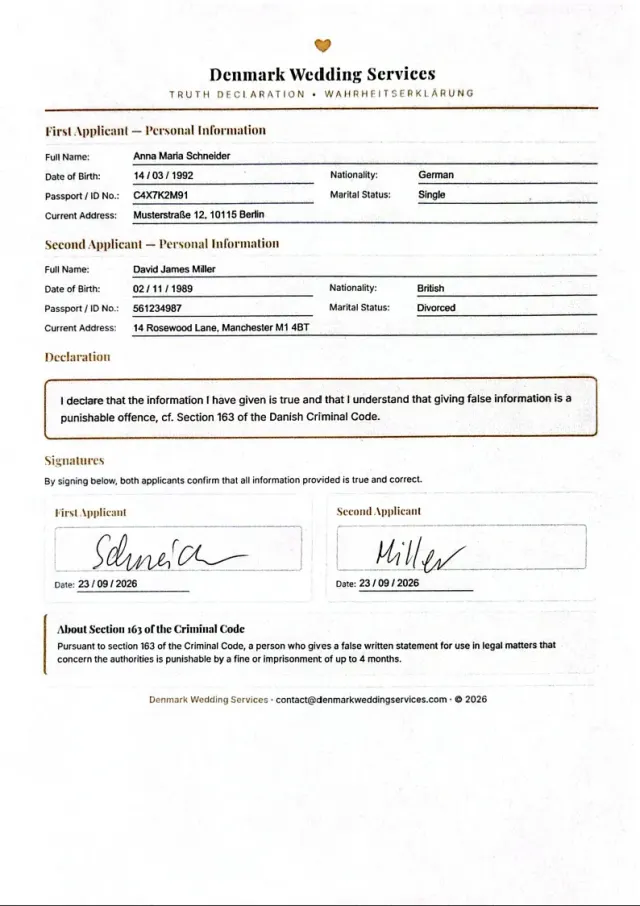
The official templates, the declaration of truth and the power of attorney, put both partners' signature lines on one page, and Familieretshuset requires both of your original, handwritten signatures. Life in Denmark adds that digital signatures are not accepted unless you both apply with MitID.
The guidance we read does not say whether two separately signed copies are accepted. The safe way is therefore one sheet signed by both of you, for example during a visit, or by one partner signing and posting the printed sheet to the other, who signs it and photographs it. If neither is possible for you, talk to us before you sign, and we will look at your case. Our guide to the declaration of truth and the power of attorney explains what each form says.
Will living apart look like a sham marriage?
Not by itself. Denmark bans marriages whose decisive purpose is a right of residence, so when one partner is a non-EU citizen without a permanent right to live in Denmark, Familieretshuset may ask about your relationship: how long you have known each other, where you met, whether you have children together, and whether you live together or have lived together before. If your relationship is insufficiently documented, it may ask for unedited photos of you both, and it may invite you to an interview.
Not living together is one question among several, not a verdict. What helps is a clear and consistent picture of a real relationship. The full rules are in our guide to proof of relationship for marriage in Denmark.
What proof of our relationship should we prepare?
Photos are not required with the application. To avoid delays if Familieretshuset asks, we ask couples with a non-EU partner to prepare three kinds of proof in advance:
- Photos of the two of you together from different moments of the relationship, going back up to about three years, unedited, with the original dates visible.
- Messages from your first contact until today, as a selection that shows the timeline.
- Travel tickets or boarding passes from your visits to each other.
For long-distance couples the tickets often tell the story best: they show when and where you met in person. This list is our practice, not an official requirement, and Familieretshuset decides what is enough.
Do we have to travel to Denmark together?
No. Nothing in the official rules we read requires you to arrive together, and each of you can fly in from your own country. Each non-EU partner documents their own lawful stay. For entries and exits after 10 April 2026, Familieretshuset lists:
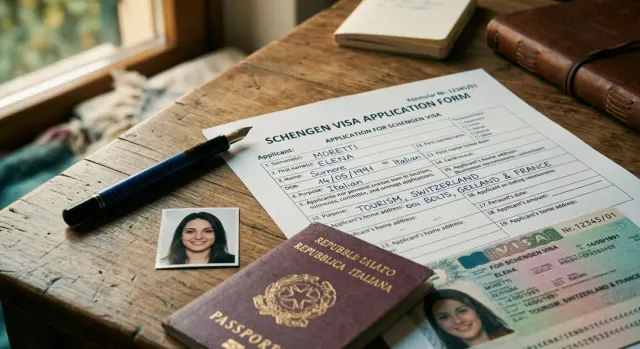
- Visa-required citizens: the visa sticker in the passport, a printout of the data and result pages of the EES calculator, and plane tickets or boarding passes.
- Visa-exempt citizens: the EES calculator printout and plane tickets or boarding passes.
- Holders of a residence permit for a Schengen country: the permit itself.
So keep your own tickets and boarding passes for each journey. Visa questions are covered in our guide to visa requirements for marrying in Denmark and the EES printout in proof of legal stay after EES. For the practical side of the trip, see travelling to Denmark for your wedding.
On the day itself, you do have to be there together. Under § 20 of the Danish Marriage Act, both partners declare at the same time, in answer to the registrar's question, that they want to marry each other. There is no marriage by proxy or video call.
How long do we need to stay in Denmark?
Usually not long. Most of our couples are in Denmark for under 72 hours: arrive, marry, leave. Plan the journeys around two separate steps:
- The approval: Familieretshuset aims to decide within about 5 working days once the application is complete; that is a target, not a guarantee. Where it has asked for more information, it is currently processing applications received in October 2026 (read 23 November 2026). The approval is normally valid for 4 months, and the wedding must take place within that period.
- The ceremony date: a separate step with its own wait, depending on the dates your town hall has free. See waiting times for a town hall wedding and booking a town hall wedding date.
Book flexible tickets where you can, and only once you know your date.
Do we need to bring witnesses?
No. A Danish wedding needs at least two witnesses, and with our package two witnesses are included, so nobody else has to travel. More in our guide to witnesses at a Danish wedding.
Where can we live after the wedding?
The wedding does not settle that. A Danish marriage does not by itself give either of you a right to live in Denmark or in your partner's country. Where you can live together is decided by the immigration rules of the country you move to, in a separate application. See family reunification after a Danish wedding.
Will our marriage be recognised in both our countries?
Your marriage is valid under Danish law. Recognition and legal effects abroad depend on the destination country, and a long-distance couple often has two: each of your home countries, or the country you move to. Some countries ask for an apostille on the Danish certificate; our guide married in Denmark: what next lists the steps.
A sample plan for a couple living in two countries
This is a typical sequence, not a story of a real couple:
| Step | Partner A (at home) | Partner B (abroad) |
|---|---|---|
| 1. Free checklist | Answers the questions for both of you | Sends passport details and earlier marriages, if any |
| 2. Documents | Photographs own passport and documents | Photographs own passport and documents; gets an apostille or legalisation where the issuing country needs one |
| 3. Forms | Signs the printed forms by hand | Signs the same sheets, then photographs them |
| 4. Approval | Waits for Familieretshuset | Prepares the visa or EES printout, if needed |
| 5. Wedding date | Books own flight once the date is fixed | Books own flight and keeps the boarding passes |
| 6. Wedding day | Meets partner B in Denmark | Meets partner A in Denmark |
How DWS helps
- Comfort Package, €799.00: the official 2,100 DKK fee (2026) is included in our package. We fill in the forms, check every document before you pay anything, submit the application to Familieretshuset as your representative, and answer its questions, including any request for photos.
- Built for two places: documents are uploaded one by one, in any order, and saved the moment they are added, so each of you can photograph your documents where you live. We check that your proof of relationship matches what the application says.
- One date for two journeys: we book the ceremony in the Danish kommune you choose, always with two witnesses provided by us. If a kommune charges its own fee for the ceremony, that is the town's charge, and we show it to you before you choose.
We cannot promise approval or a particular date: Familieretshuset decides on the application, and the town hall sets its own dates. Start with the free wedding checklist, see how the process works, or read our guide for binational couples.
Denmark Wedding Services is not a law firm. This guide is general information, not legal advice; questions about residence or family reunification in an individual case should go to the relevant authority or a qualified legal professional.
Written by Ludmila Bernowski, co-founder of Denmark Wedding Services; reviewed by Shenol Reetz, co-founder. Last checked: 23 November 2026.
Frequently asked questions for long-distance couples
Can we marry in Denmark if we live in different countries?
Yes. Denmark has no residency requirement for marriage, and you do not need to have entered Denmark when you apply. Both of you must meet the conditions of the Danish Marriage Act and be able to stay in Denmark lawfully on the wedding day.
Do we need a residence certificate if we do not live together?
No. Familieretshuset asks for a residence certificate or similar documentation only if you live together outside Denmark.
Can we sign the forms separately in our two countries?
The official templates put both signature lines on one page, and the guidance we read does not say whether two separately signed copies are accepted. The safe way is one sheet signed by both of you by hand; if that is not possible, talk to us before you sign.
Do we have to arrive in Denmark together?
No. Each of you can travel from your own country, and each non-EU partner documents their own lawful stay, so keep your own tickets and boarding passes. On the wedding day you must both be present at the same time.
Does marrying in Denmark let us live together?
Not by itself. Where you can live together is decided by the immigration rules of the country you move to, in a separate application.
Sources
- Familieretshuset – Apply for a Certificate of Marital Status – read 23 November 2026
- Familieretshuset – Processing time for certificates of marital status – read 23 November 2026
- Familieretshuset – Application for a Certificate of marital status, guide (PDF) – read 23 November 2026
- Familieretshuset – Documentation of legal stay in Schengen for non-EU citizens – read 23 November 2026
- Familieretshuset – Banning sham marriages – read 23 November 2026
- Familieretshuset – Power of Attorney (official template, PDF) – read 23 November 2026
- Familieretshuset – Truth declaration (official template, PDF) – read 23 November 2026
- Life in Denmark – If you wish to get married in Denmark – read 23 November 2026
- Retsinformation – Danish Marriage Act, LBK no. 663 of 1 July 2026, § 20 (Danish) – read 23 November 2026
- New to Denmark – Family reunification – read 23 November 2026
Watch Our Video
Follow us on YouTube, Instagram & TikTok for more wedding tips
Ready to Start Your Danish Wedding?
Fill out our free checklist in about 2 minutes — we'll send you a personalized document list and guide you through every step.
Start Free Checklist →