Gay & Same-Sex Marriage in Denmark: Legal Since 2012
Reviewed by Ludmila Bernowski, CEO & Co-Founder of Denmark Wedding Services. Last reviewed: October 2026. Practical, experience-based information, not legal advice — for legal questions, consult a qualified lawyer. Our Google Business Profile and reviews
Short answer: Yes. Same-sex marriage has been legal in Denmark since 15 June 2012, and same-sex couples marry through exactly the same civil process, with the same documents and approval time, as any other couple. You do not need to live in Denmark. Whether the marriage is recognised at home depends on your country's law; the UK and the US recognise it.
On this page
- Why do same-sex couples choose Denmark?
- How does the marriage process work for same-sex couples?
- Which documents do same-sex couples need?
- How much does a same-sex wedding in Denmark cost?
- Where is a Danish same-sex marriage recognised?
- Is Denmark a safe destination for LGBTQ+ couples?
- What if one partner's home country does not recognise the marriage?
- What should same-sex couples know about eloping in Denmark?
- Where can same-sex couples marry and celebrate in Denmark?
- How does the process work for transgender partners?
- How many countries allow same-sex marriage, and how does Denmark compare?
- FAQs About Same-Sex Marriage in Denmark
Who this guide is for: Gay, lesbian, queer and trans couples — including binational couples — from the UK, the US, Canada, Australia and elsewhere who want to marry in Denmark.
Key points
- Denmark introduced the world's first registered partnership law in 1989 and opened marriage to same-sex couples on 15 June 2012.
- The application, the documents and the review by Familieretshuset are identical for all couples — there is no separate procedure and no extra paperwork.
- A same-sex marriage concluded in Denmark is recognised in England and Wales and by US immigration authorities.
- Within the EU, a member state must recognise the same-sex marriage of two EU citizens concluded in another member state where they exercised their freedom to move and reside (Court of Justice of the EU, 25 November 2025, C-713/23).
- If one partner comes from a country that does not recognise same-sex marriage, check the consequences there before you travel or deal with its authorities.
Denmark holds a special place in LGBTQ+ history. On 1 October 1989 the world's first law on registered partnerships for same-sex couples came into force there. Since 15 June 2012 same-sex couples in Denmark can marry, with exactly the same rights and duties as opposite-sex couples, and no new registered partnerships have been entered into since then. Today the Danish Marriage Act simply states that it applies to marriages between two people of different sex and between two people of the same sex (Ægteskabsloven § 1).
In practice, a same-sex marriage in Denmark is simply a marriage: Familieretshuset, the Danish Agency of Family Law, reviews your application under the same rules, and the town hall marries you in the same ceremony. How the process works for every couple is explained in our guide to marrying in Denmark as an international couple.
Why do same-sex couples choose Denmark?
Many same-sex couples could also marry at home. They choose Denmark for the same reasons as other international couples — and for binational couples these reasons often weigh even more:
- Full legal equality: Danish marriage law is gender-neutral; you have the same rights and duties as any other married couple.
- Lean paperwork: Denmark asks for neither birth certificates nor a certificate of capacity to marry, and it does not ask UK citizens for a Certificate of No Impediment. For couples whose documents come from several countries, that is a real relief.
- Discretion: The wedding is a private, dignified civil ceremony without public banns. If you want to celebrate in the smallest circle first, you can.
- Short review time: Familieretshuset generally approves complete applications in about 5 working days — a general target, not a guarantee.
- No residency requirement: You do not need to live in Denmark, but you must enter lawfully and stay lawfully for the ceremony.
- Three town halls to choose from: Copenhagen, Aabenraa and Tønder.
Why so many international couples choose Denmark in the first place is covered in our overview of why to get married in Denmark.
How does the marriage process work for same-sex couples?
The process for same-sex marriage in Denmark is identical to any other marriage. With Denmark Wedding Services it works like this (as of September 2026):
- Free checklist: You receive your personal document list by email.
- Application details: You answer the questions about both partners online.
- Sign the forms: We send you the service contract, power of attorney and declaration of truth already filled in; you both sign them by hand and upload the scans.
- Upload your documents: Phone photos or scans are enough — the upload page can also scan documents with your phone camera.
- Application to Familieretshuset: We check everything and submit the application. The approval (Prøvelsesattest) generally arrives after about 5 working days and is valid for 4 months, or less if a passport, visa or residence permit expires earlier.
- Date and wedding: We book your date in Copenhagen, Aabenraa or Tønder, depending on each town hall's free dates: Copenhagen City Hall says the wait for a date can be up to four months, Aabenraa releases its dates 60 days in advance, and Tønder marries couples from abroad on Tuesdays and Thursdays. You marry with two witnesses and receive your Danish marriage certificate.
You can also apply to Familieretshuset yourselves; a representative is optional. Couples who book the Comfort Package get our wedding planning app with a countdown to the ceremony and a wedding-day checklist. Every step in detail: our step-by-step guide to getting married in Denmark.
Which documents do same-sex couples need?
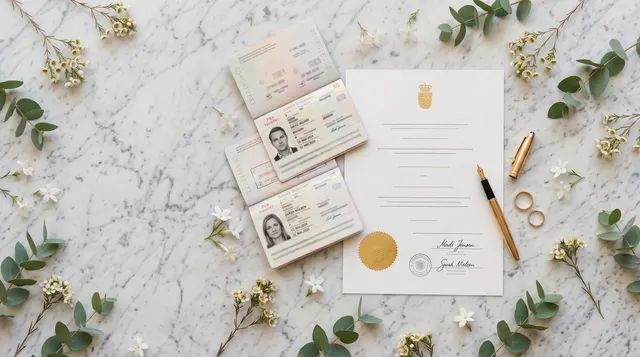
The same as every other couple. For each partner, usually:
- Passport, or for EU/EEA citizens a national ID card (front and back).
- Proof of residence and civil status, not older than 3 months (DWS asks for this; Familieretshuset publishes no fixed limit).
- If divorced: the final divorce decree — in England and Wales the Final Order, called Decree Absolute before April 2022. If widowed: the death certificate of the former spouse.
- Partners from outside the EU, in addition: proof of lawful entry and stay — a Schengen visa or a residence permit, or, if you enter visa-free (for example with a US, UK, Canadian or Australian passport), your passport plus travel proof such as a boarding pass, because passports are no longer stamped since the EU Entry/Exit System (EES) started on 10 April 2026 — and, if you have no children together, proof of your relationship (e.g. photos together from different times, travel tickets, chat excerpts).
Whether a document needs an apostille or legalisation depends on the country that issued it: documents from the US, the UK, Canada or Australia typically need none, documents from countries such as Russia, Ukraine or India do, and a passport never does. We check this for each of your documents. Documents in Danish, English or German are accepted without translation. No birth certificates and no certificate of capacity to marry (the German Ehefähigkeitszeugnis) are needed. If you are in a registered or civil partnership, tell us before you start — we clarify which proof is needed in your case.
The full list by life situation is in our guide to documents for a Danish wedding; your personal list comes with the free wedding checklist.
How much does a same-sex wedding in Denmark cost?
Exactly the same as any other wedding in Denmark — there are no surcharges.
| Item | Price (as of September 2026) |
|---|---|
| Comfort Package: document check, application to Familieretshuset incl. the Danish authority fee, ceremony booking, two legal witnesses, 24/7 AI assistant | €799.00 |
| Apostille Service (optional, for using the certificate outside the EU) | €100 |
| Certified translation German ⇄ Russian (optional) | €50 per document |
| Travel, accommodation, rings, photographer, celebration | individual, not included |
You pay only at the end of the document upload. How travel and accommodation add up is shown in our detailed breakdown of the wedding cost in Denmark.
Where is a Danish same-sex marriage recognised?
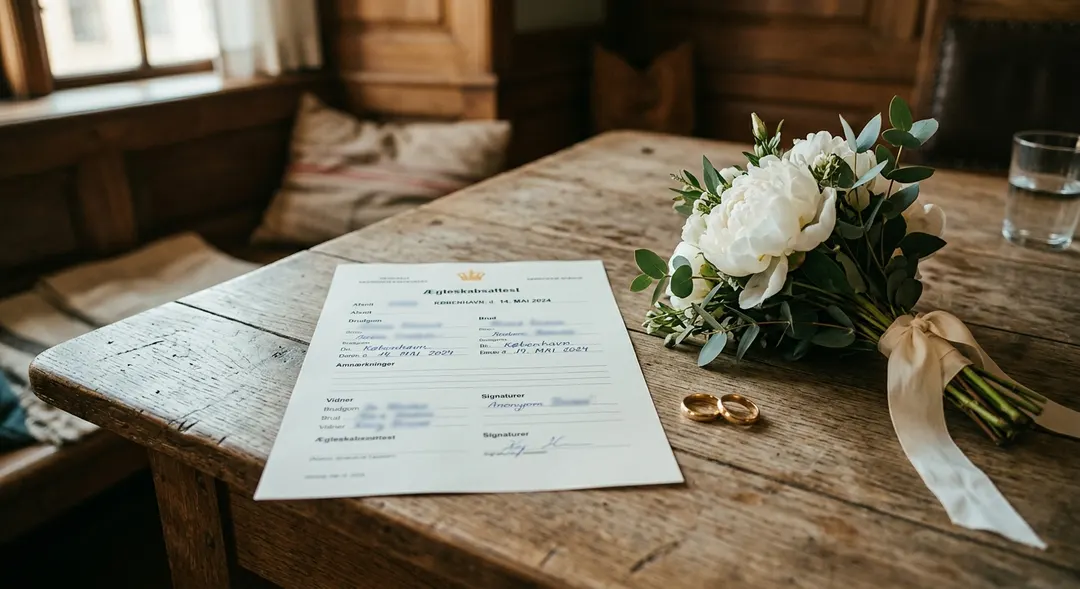
Under Danish law your marriage is valid in any case. Whether another country recognises it depends on that country's law. The picture in September 2026:
- United Kingdom: A same-sex marriage concluded abroad is recognised in England and Wales (Marriage (Same Sex Couples) Act 2013, section 10).
- United States: US immigration authorities judge a same-sex marriage by the law of the place where it was performed, so a marriage valid in Denmark is treated like any other marriage (USCIS Policy Manual).
- EU member states: Since the judgment of the Court of Justice of the EU of 25 November 2025 (C-713/23), a member state must recognise the same-sex marriage of two EU citizens that was lawfully concluded in another member state where they exercised their freedom to move and reside and created or strengthened their family life — even if its own law does not allow same-sex marriage. States do not have to introduce same-sex marriage themselves. The judgment concerned a couple who had lived in the other member state; a trip to Denmark only for the wedding may not be enough, so couples from EU countries without same-sex marriage should check how their country applies it.
- Other countries that allow same-sex marriage — for example Canada, Australia, New Zealand, Switzerland, Norway, Iceland, Brazil, Argentina, Mexico, South Africa and Taiwan — generally recognise a same-sex marriage concluded abroad; confirm with the local authority before you rely on it.
- No recognition: for example Russia, Turkey, Saudi Arabia, the UAE, Egypt, India, China and many countries in the Middle East and Africa. The marriage stays valid in Denmark but usually brings no spousal rights there.
For official use outside the EU, authorities usually ask for an apostille on the Danish marriage certificate; our optional Apostille Service (€100) takes care of it. Inside the EU, civil-status documents need no apostille under EU Regulation 2016/1191, although some offices still ask for one — check with your registry office. The certificate is issued in five languages (Danish, English, German, French and Spanish). An apostille authenticates the certificate; it does not by itself make a country recognise the marriage. More in our guide to the apostille for a Danish marriage certificate.
Is Denmark a safe destination for LGBTQ+ couples?
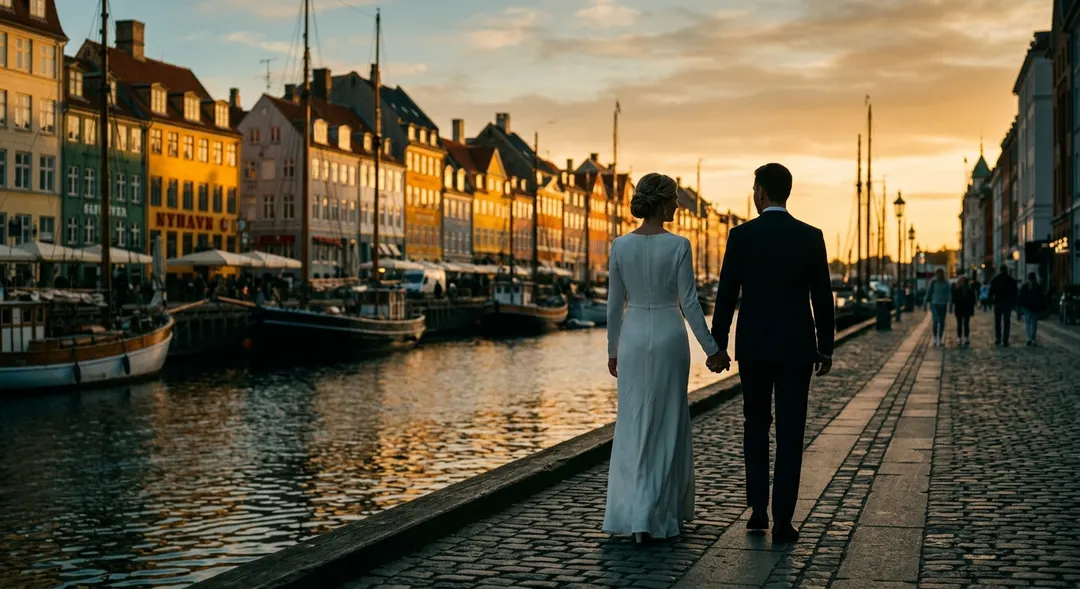
Denmark is one of the most LGBTQ+-friendly countries in Europe: in ILGA-Europe's Rainbow Map 2026 it scores 85% and ranks 5th. Copenhagen has a visible queer community, and holding hands in the street is everyday life there, not a statement.
In practice you book your hotel, restaurant and photographer like any other couple. You can marry at three town halls: getting married in Copenhagen, getting married in Aabenraa near the German border, or getting married in Tønder. For ideas in the capital, see the best places to visit in Copenhagen as a couple and, for the photo shoot afterwards, our romantic photo spots in Copenhagen.
What if one partner's home country does not recognise the marriage?
The Danish marriage certificate is the easy part. It gets harder when one partner is a citizen of a country that does not recognise same-sex marriage. Honestly summarised (as of September 2026):
- Within the EU: the CJEU judgment described above applies to EU citizens who exercised their freedom of movement; it does not oblige any state to introduce same-sex marriage.
- Outside the EU: only that country's law decides. In some countries the marriage has no legal effect, and in some, disclosing a same-sex marriage can even carry legal risks. Before travelling there or dealing with its authorities, get advice from a specialised LGBTQ+ or human-rights organisation.
- Moving to a country that recognises the marriage: a Danish marriage can be the basis for a spouse or partner visa in the UK, the US, an EU country or elsewhere, if one partner has the right to live there. The immigration authority still checks its usual requirements, such as income or language, and there is no guarantee.
- EU citizens moving within the EU: if an EU citizen moves to another EU state with a spouse from outside the EU, EU free-movement law (Directive 2004/38/EC) applies, and the Court of Justice confirmed in Coman (C-673/16, 2018) that a same-sex spouse counts as a spouse for this right of residence.
How binational couples put together the documents for the non-EU partner is explained in our guide for binational couples in Denmark; entry rules are covered in our guide to the visa requirements for a wedding in Denmark.
What should same-sex couples know about eloping in Denmark?
Many same-sex couples choose a wedding without guests — sometimes to avoid family pressure, sometimes because they want to celebrate later. Practical notes:
- Witnesses: Two legal witnesses are included in the Comfort Package, so you do not need to involve family or friends.
- Discretion: Danish authorities do not announce ceremonies publicly. Only the people you tell know when and where you marry.
- Photography: Ask photographers for work with same-sex couples — a portfolio quickly shows whether their style suits you.
- Accommodation: Hotels and restaurants in Denmark are generally welcoming; no special preparation is needed.
The wider framework for this kind of wedding is in our elopement in Denmark guide.
Where can same-sex couples marry and celebrate in Denmark?
Because there is no separate procedure in Denmark, there are no separate venues either:
- Ceremony venues: The town halls in Copenhagen, Aabenraa and Tønder marry same-sex couples in the same ceremony and through the same booking process as everyone else. Depending on the town hall, the ceremony is held in Danish, English or German.
- Photographers: Especially in Copenhagen, many wedding photographers regularly work with queer couples. Choose someone you feel comfortable with — it shows in the pictures.
- Celebration: Whether a dinner for two or a small party with friends, restaurants and venues in Denmark treat you like any other wedding couple.
- Pride: Copenhagen Pride usually takes place in August. If you want to combine your wedding with Pride week, book accommodation and your ceremony date early, because the city is full.
Which month suits you best is covered in our guide on when to get married in Denmark.
How does the process work for transgender partners?
For couples where one or both partners are trans or non-binary, the process is the same. Familieretshuset works with your current official documents:
- Passport or ID card with your current name and gender marker.
- Divorce decree or death certificate if you were married before — possibly still in your former name.
- Proof of the name or gender change, if earlier documents are in another name, so the authority can match them to you.
Denmark has allowed legal gender change on application since 2014, and Danish marriage law is gender-neutral. If the names in your documents differ, contact us before uploading — we check which proof should be added, and we answer in English, German and Russian.
How many countries allow same-sex marriage, and how does Denmark compare?
According to Our World in Data, same-sex marriage was legal in 39 countries in 2025 (data as of June 2025), including 16 of the 27 EU member states. Denmark was the first country in the world to introduce registered partnerships (1 October 1989) and opened marriage to same-sex couples on 15 June 2012. In Denmark, same-sex couples marry at the same town halls, with the same documents and the same Familieretshuset approval as everyone else.
- 39 countries allowed same-sex marriage in 2025 (Our World in Data, as of June 2025)
- 16 of 27 EU states perform same-sex marriage themselves
- Denmark: registered partnership since 1989, marriage since 15 June 2012
- Recognition abroad: see the section "Where is a Danish same-sex marriage recognised?" above
FAQs About Same-Sex Marriage in Denmark
Is gay marriage legal in Denmark?
Yes. Same-sex marriage has been legal in Denmark since 15 June 2012, and the Danish Marriage Act applies equally to couples of different sex and of the same sex (Ægteskabsloven § 1). Denmark was also the first country to introduce registered partnerships, in 1989. International same-sex couples can marry in Denmark without living there, with the same documents and the same process as any other couple.
Do same-sex couples face any extra scrutiny at Familieretshuset?
No. Danish marriage law has applied equally to same-sex and opposite-sex couples since 15 June 2012 (Ægteskabsloven § 1): same-sex couples file the same application, submit the same documents and go through the same review. Complete applications are generally approved in about 5 working days — a general target, not a guarantee. Follow-up questions arise for the same reasons for all couples, usually a missing apostille, an outdated certificate or an incomplete document.
Is a Danish same-sex marriage valid in the UK and the US?
Yes, in general. In England and Wales a same-sex marriage concluded abroad is recognised under section 10 of the Marriage (Same Sex Couples) Act 2013. In the US, immigration authorities judge a same-sex marriage by the law of the place where it was performed, so a marriage valid in Denmark is treated like any other marriage (USCIS Policy Manual). For official use outside the EU, authorities usually ask for an apostille on the Danish marriage certificate.
What if one partner's home country doesn't recognise same-sex marriage?
The marriage stays valid under Danish law. Within the EU, since the judgment of the Court of Justice of the EU of 25 November 2025 (C-713/23), a member state must recognise the same-sex marriage of two EU citizens concluded in another member state where they exercised their freedom to move and reside; it does not have to introduce same-sex marriage itself. Outside the EU, each country's law decides: in some the marriage has no effect, and in some disclosing it can carry legal risks. Check the consequences before travelling there or dealing with its authorities.
Can a non-EU spouse join me after the wedding?
That depends on the country where you want to live, not on Denmark. In countries that recognise the marriage, a same-sex spouse applies under the same spouse or partner rules as any other spouse; the authority still checks the usual requirements, such as income or language, and there is no guarantee. If an EU citizen moves to another EU state with a non-EU spouse, EU free-movement law (Directive 2004/38/EC) applies, and the Court of Justice confirmed in Coman (C-673/16, 2018) that a same-sex spouse counts as a spouse.
Sources
- Familieretshuset — international marriages — official information from the Danish Agency of Family Law on the application and requirements
- Life in Denmark — getting married in Denmark — official Danish citizen portal
- Retsinformation — Ægteskabsloven (LBK nr. 663 of 1 July 2026), § 1 — Danish Marriage Act: applies to couples of different sex and of the same sex
- EU Agency for Fundamental Rights — CJEU case C-713/23 — judgment of 25 November 2025 on recognising same-sex marriages concluded in another member state
- EU Agency for Fundamental Rights — CJEU case C-673/16 (Coman) — same-sex spouses and the EU right of residence
- Marriage (Same Sex Couples) Act 2013, section 10 — legislation.gov.uk — recognition of overseas same-sex marriages in England and Wales
- USCIS Policy Manual — marriage and marital union — US place-of-celebration rule for same-sex marriages
- EU Regulation 2016/1191 on public documents — EUR-Lex — no apostille for civil-status documents between EU states
- EU Entry/Exit System (EES) — official EU information on the new border checks
- ILGA-Europe — Rainbow Map 2026 — annual ranking of LGBTI equality in Europe
- Our World in Data — countries with same-sex marriage — number of countries where same-sex marriage is legal
- City of Copenhagen — City Hall wedding — the wait for a wedding date can be up to four months
- Aabenraa Municipality — marriage registry office — dates are released 60 days in advance
- Tønder Municipality — getting married in Tønder — ceremony days for couples from abroad (in German)
Ready to Start Your Danish Wedding?
Fill out our free checklist in about 2 minutes — we'll send you a personalized document list and guide you through every step.
Start Free Checklist →