Denmark vs Germany: Where Is It Easier to Marry?
Reviewed by Ludmila Bernowski, CEO & Co-Founder of Denmark Wedding Services. Last reviewed: October 2026. Practical, experience-based information, not legal advice — for legal questions, consult a qualified lawyer. Our Google Business Profile and reviews
Short answer: For international couples, Denmark is usually faster and simpler than a German Standesamt: no Ehefähigkeitszeugnis, far less paperwork, and complete applications are generally processed in about 5 working days (a target, not a guarantee). With a foreign partner, German preparation often takes several weeks to months. A Danish marriage is legally valid in Germany.
On this page
- Which documents do you need in Germany and in Denmark?
- How long does it take to marry in Germany vs Denmark?
- Is it cheaper to marry in Denmark or in Germany?
- Is a Danish marriage valid in Germany?
- Which languages can the wedding ceremony be in?
- Where is it easier for binational couples to marry?
- Denmark vs Germany at a glance
- What are the downsides of marrying in Denmark?
- When is a German Standesamt the better choice?
- Decision guide: Standesamt in Germany or town hall in Denmark?
- What admin follows the wedding in Germany?
- FAQs About Denmark vs Germany
Who this guide is for: Couples in or near Germany deciding between a Danish wedding and the local Standesamt.
Key points
- Timeline: about 5 working days (Denmark, complete application; then the wait for a ceremony date at the town hall) vs often several weeks to months (Germany, with a foreign partner).
- Denmark needs far fewer documents and no Ehefähigkeitszeugnis.
- Both marriages carry the same legal weight; a marriage concluded in Danish form is formally valid in Germany (Art. 11 EGBGB).
- The 5-working-day figure is a general target, not a guarantee.
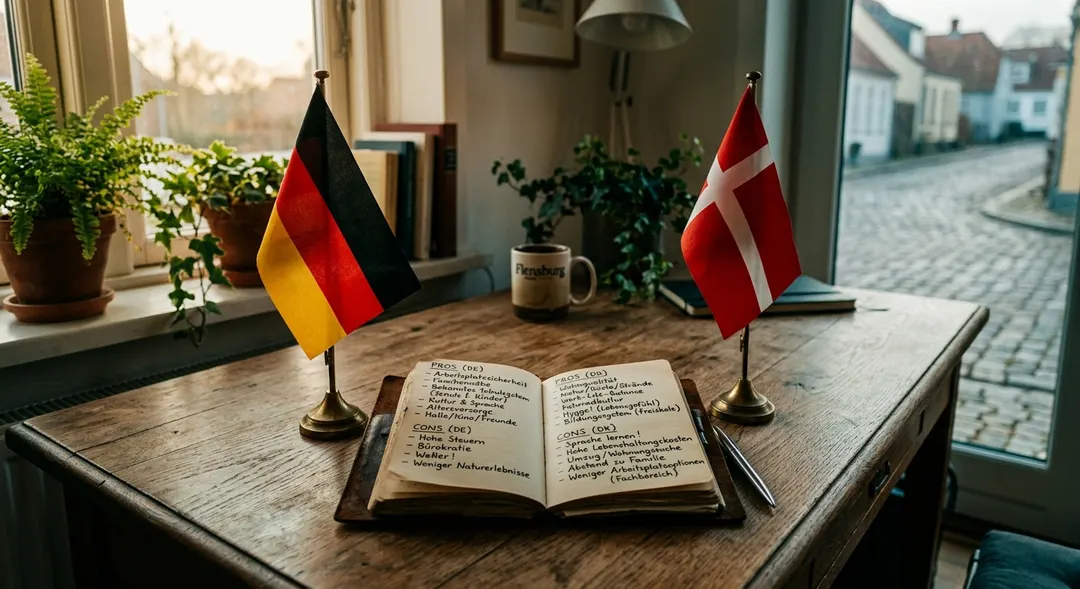
If you're a couple living in or near Germany and wondering whether to get married in Germany or Denmark, this honest comparison will help you decide. We compare every aspect — documents, costs, processing time, and legal recognition — so you can make an informed choice.
Which documents do you need in Germany and in Denmark?
Documents for a German Standesamt wedding
- Personalausweis or passport
- Geburtsurkunde — a certified extract from the German birth register (foreign birth certificates with apostille or legalisation, depending on the country, and translated)
- For a foreign partner: Ehefähigkeitszeugnis (certificate of capacity to marry) from their home country — or an exemption from the Higher Regional Court (OLG) under § 1309 BGB
- Erweiterte Meldebescheinigung / Aufenthaltsbescheinigung (proof of residence and marital status)
- Divorce decree or death certificate (if applicable)
- Various forms and declarations
Documents for a Danish wedding
- Valid passports (EU citizens may use their ID card)
- Proof of residence and marital status — for residents of Germany, the Erweiterte Meldebescheinigung (not older than 3 months)
- Divorce decree (if applicable): for German divorces the Scheidungsbeschluss (older decisions: Scheidungsurteil) with the Rechtskraftvermerk
- Non-EU partners additionally: proof of legal stay, and — depending on the country that issued their own civil-status documents — an apostille or legalisation (never on the passport)
Documents in German, English or Danish need no translation, and documents from Germany need no apostille. Familieretshuset may also ask a couple with a non-EU partner how they met and for photos of the two of them together.
Winner: Denmark — above all because the Ehefähigkeitszeugnis and the birth certificates are not needed.
How long does it take to marry in Germany vs Denmark?
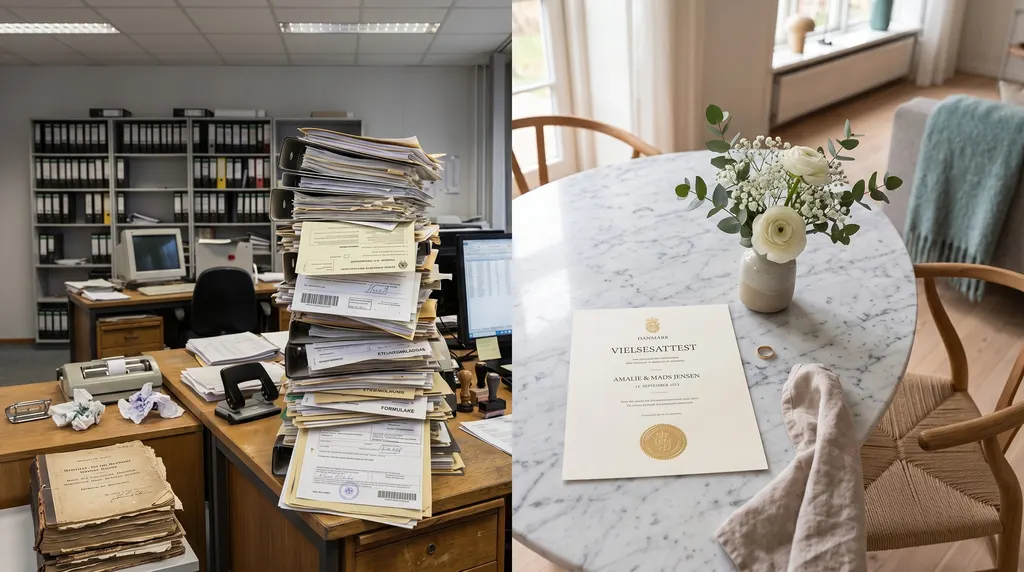
Germany: How long the Standesamt takes depends mainly on how quickly you obtain your documents and a date. With a foreign partner it takes longer: the Ehefähigkeitszeugnis or an OLG exemption under § 1309 BGB, plus legalised and translated documents, often mean several weeks to months. In Berlin, for example, the Kammergericht says you should expect at least three weeks for the exemption from the Ehefähigkeitszeugnis alone — longer if documents have to be requested again. Once the Standesamt has confirmed that you may marry, the wedding must take place within six months; otherwise you have to register again (§ 13 (4) PStG).
Denmark: Familieretshuset generally processes complete applications in about 5 working days (a target, not a guarantee). The ceremony date is then booked separately and depends on the town hall's free dates. After approval, Tønder marries couples from abroad on Tuesdays and Thursdays, Aabenraa releases its dates 60 days in advance, and the City of Copenhagen says the wait can be up to four months. The approval (Prøvelsesattest) is valid for 4 months.
Winner: Denmark — especially for binational couples; for two German partners the time advantage is smaller.
Is it cheaper to marry in Denmark or in Germany?
Only the costs of the legal part can be compared fairly. The celebration, clothes, rings and photographer cost as much as you choose to spend in either country.
| Item (as of September 2026) | German Standesamt (Berlin example) | Denmark with DWS |
|---|---|---|
| Registration or application | €45.00 | included in the Comfort Package (€799.00), incl. the Danish authority fee |
| Surcharge for foreign law | €45.00 per partner concerned | none |
| Exemption from the Ehefähigkeitszeugnis | €15 to €305 at the Higher Regional Court, depending on income (at least three weeks) | none |
| Translations | sworn translation of all foreign-language documents | only for documents not in German, English or Danish (including the apostille itself): DWS translates Russian ⇄ German for €50 per document, other languages an authorised translator |
| Apostille or legalisation | depends on the foreign partner's country | depends on the issuing country (e.g. Russia, Ukraine, India yes; USA, UK, Turkey typically no) |
| Ceremony outside the official rooms | €75.00 to €150.00 | not offered — the ceremony is at the town hall, date booking included in the package |
| Travel and accommodation | usually none | your own costs, depending on distance |
Verdict: For two German partners, the local Standesamt is usually cheaper. For binational couples, the documents, translations, exemption procedure and waiting time that Denmark avoids often outweigh the package price and travel — work out your own case. See our transparent 2026 cost breakdown for the full line-by-line picture, including travel and add-ons.
Is a Danish marriage valid in Germany?
Both German and Danish marriages are equally valid in Germany. A marriage legally performed in Denmark in Danish form is formally valid in Germany (Art. 11 EGBGB). Whether each partner was free to marry (age, not already married) is judged in Germany under that partner's own national law (Art. 13 EGBGB). In Denmark, the certificate of marital status (Prøvelsesattest) from Familieretshuset confirms before the wedding that you meet the conditions of the Danish Marriage Act. German authorities accept Danish marriage certificates without any additional registration requirement; German citizens can optionally have the marriage entered in the German marriage register (§ 34 PStG). Within the EU the certificate needs no apostille (EU Regulation 2016/1191), although some offices still ask for one — check with your Standesamt.
Result: Tie — both are equally recognised.
Which languages can the wedding ceremony be in?
Germany: Ceremonies are typically in German only; if one of you doesn't speak German well enough, a sworn interpreter is needed. Denmark: Ceremonies available in English, German, or Danish, depending on the town hall.
Winner: Denmark — More language options for international couples. See our full guide for international couples marrying in Denmark for the country-by-country document table.
Where is it easier for binational couples to marry?
If one partner is non-EU, Germany requires an Ehefähigkeitszeugnis from the partner's home country or an OLG exemption under § 1309 BGB, translated documents and often embassy involvement — a process that can take months. Denmark requires no Ehefähigkeitszeugnis: the non-EU partner needs a passport, proof of residence and marital status, proof of legal stay (see the list below) and, depending on the country, an apostille or legalisation on their own civil-status documents (passports never need an apostille). The partner must be able to enter Denmark legally.
Proof of legal stay that Familieretshuset accepts for entries since 10 April 2026:
- a residence permit from a Schengen country
- with a visa: the visa plus a printout of the data and result pages of the EES calculator and, once you have entered, your plane tickets or boarding passes
- visa-free: a printout of the data and result pages of the EES calculator and, once you have entered, your plane tickets or boarding passes
For the document side specifically, our Danish wedding document checklist shows exactly what's required. What changes after the wedding — whose law applies at home and where you can live together — is covered in our guide to marrying a non-EU partner in Denmark.
Important limit: a Duldung or Aufenthaltsgestattung generally does not allow visa-free travel to other Schengen countries (Auswärtiges Amt), so a partner with only such a paper usually cannot travel to Denmark to marry — then the German Standesamt is usually the route.
Winner: Denmark — The difference is dramatic for binational couples, as long as the partner can enter Denmark legally.
In short: which route suits an international couple?
For international and binational couples, Denmark is usually much simpler than Germany. In Germany you give notice of your intended marriage at the Standesamt (Anmeldung der Eheschließung); a foreign partner needs an Ehefähigkeitszeugnis or an exemption from the Higher Regional Court (OLG) under § 1309 BGB, plus foreign documents with apostille or legalisation depending on the country and certified German translations — with a foreign partner this often takes several weeks to months. Denmark requires no Ehefähigkeitszeugnis, no OLG exemption and no Anmeldung, and a complete application is generally processed in about 5 working days (a target, not a guarantee). Documents in German, English or Danish need no translation. Whether a non-EU partner's own civil-status documents need an apostille or legalisation depends on the country that issued them (e.g. Russia, Ukraine, India: yes; USA, UK, Turkey: typically no); documents from Germany never do. Sources: Familieretshuset — documentation requirements and EU Regulation 2016/1191 on public documents (EUR-Lex)
- Denmark: about 5 working days processing, no Anmeldung, no apostille for documents from Germany or the EU; for other countries it depends on the issuing country
- Germany: often several weeks to months with a foreign partner; Anmeldung der Eheschließung required; Ehefähigkeitszeugnis or OLG exemption for a foreign partner
- Cost: Denmark €799.00 all-in Comfort Package plus your own travel; Germany varies by municipality plus translations and any OLG fee
- Language: Denmark accepts DE/EN/DA directly; Germany requires DE translations
Denmark vs Germany at a glance
| Aspect | Germany | Denmark |
|---|---|---|
| Documents | ID, birth-register extract; for a foreign partner Ehefähigkeitszeugnis or OLG exemption | Passport, Erweiterte Meldebescheinigung; extra documents for non-EU partners |
| Processing | Often several weeks to months with a foreign partner | About 5 working days for a complete application (not a guarantee) |
| Cost | From €45.00 (Berlin) plus foreign-law surcharges, translations and any OLG fee (€15–305) | €799.00 Comfort Package incl. authority fee, plus travel |
| Valid in Germany | Yes | Yes (form: Art. 11 EGBGB) |
| Languages | German (interpreter if needed) | EN/DE/DA, depending on the town hall |
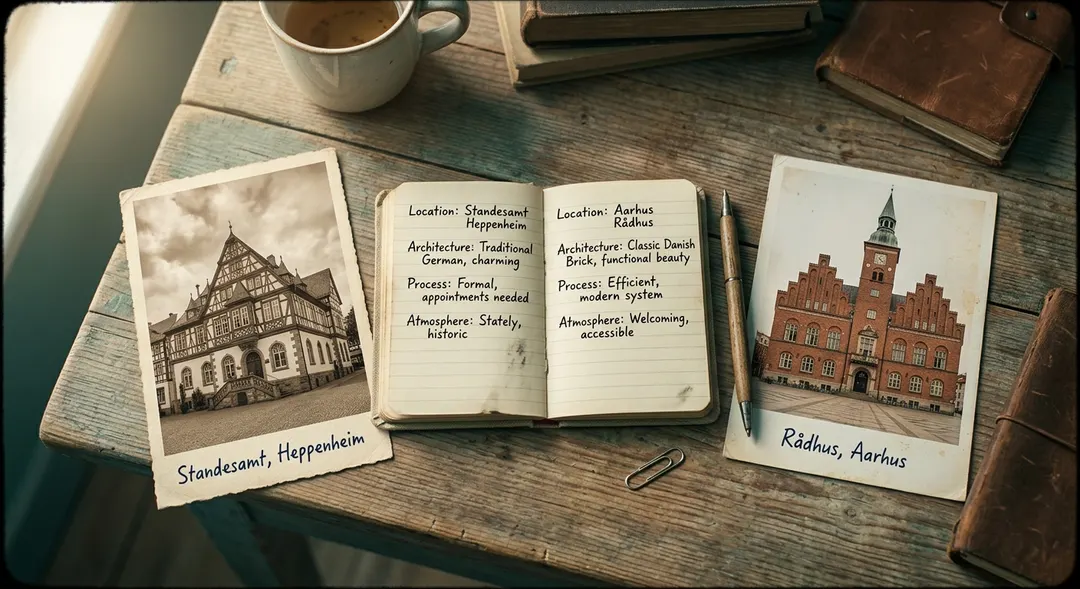
For most binational, international, or time-conscious couples, Denmark is the simpler route; for two German partners without time pressure, the advantage is smaller.
What are the downsides of marrying in Denmark?
- Travel: both partners must appear in person at the town hall. From southern Germany that usually means at least one night away.
- Civil ceremony only: we arrange the civil ceremony at the Danish town hall. A church wedding is a separate step and can follow later in your home parish — ask there which documents it needs.
- Dates: the ceremony date is booked only after approval and depends on the town hall's free dates; a specific day cannot be guaranteed.
- Married name: a joint married name is optional and is not chosen at the Danish ceremony. If you want a joint married name, you declare it afterwards at the German Standesamt; a later declaration must be publicly certified (§ 1355 BGB). Since 1 May 2025, German law also allows a double name formed from both surnames as the married name.
When is a German Standesamt the better choice?
We try to be honest, not just promotional. There are situations where marrying in Germany makes more sense than Denmark:
- You want a religious ceremony — At home, the civil ceremony and a Catholic or Protestant church wedding are easier to coordinate, often in the same week. Denmark only handles civil ceremonies; a church wedding is a separate step and can follow later in your home parish.
- You are both German with no time pressure — The paperwork in Germany is then manageable and usually cheaper.
- One partner only has a Duldung or Aufenthaltsgestattung, or an asylum procedure is ongoing — These papers generally do not allow visa-free travel to other Schengen countries, and marriage can interact with asylum status; consult an immigration lawyer.
- You want a large family-and-friends celebration on the wedding day itself — German Standesamt ceremonies often integrate naturally with reception venues; a Denmark trip is more focused on the legal core.
- You're already deep into the German Standesamt process — If you've already paid for translations and apostilles and have a date booked, switching is wasted money.
For many couples, none of these apply. But honesty is part of how we work.
Decision guide: Standesamt in Germany or town hall in Denmark?
- Are you a binational couple with a non-EU partner? → Usually Denmark, as long as the partner can enter Denmark legally. The Ehefähigkeitszeugnis or OLG-exemption paperwork in Germany is the primary friction Denmark eliminates.
- Are you on a time-sensitive deadline (visa expiry, work relocation, family event)? → Denmark is easier to plan: approval generally comes in about 5 working days, although no one can guarantee a specific ceremony date. With a tight deadline the border towns often suit better than Copenhagen, where the wait can be up to four months.
- Do you want a focused civil ceremony (no large celebration on the day)? → Either works; Denmark is usually faster.
- Are you both German citizens with no complicating factors and want a German-language ceremony with extended family? → Germany may suit you better — and for two German partners it is usually cheaper.
- Are you flexible about the day of the week? → Denmark can work: getting married in Tønder means a Tuesday or Thursday, because Tønder marries couples from abroad on those days, and getting married in Aabenraa depends on dates the town hall releases 60 days in advance. We book the first date that suits you after approval, but no one can guarantee a specific day.
How the two procedures differ in practice
For many international couples the Danish town hall (Rådhus) route is easier than the German Standesamt. At the Standesamt you give notice of your intended marriage in person with original documents and the marriage requirements are checked; with a foreign partner, further appointments and possibly the OLG exemption procedure come on top. For the Danish route you upload your documents as scans or photos, DWS applies to Familieretshuset, and you appear in person only on the wedding day. Denmark has no residence requirement; ceremony dates depend on the town hall's availability.
- Standesamt: Anmeldung der Eheschließung with original documents
- Rådhus: no residence in Denmark needed
- Standesamt: often several appointments with a foreign partner
- Rådhus: in person only on the wedding day
What admin follows the wedding in Germany?
After a Danish wedding you show the Danish marriage certificate at your Bürgeramt yourself so that your marital status is updated; a name declaration and registration in the German marriage register (§ 34 PStG) are optional. Tax class, health insurance, residence rights and the apostille question are explained step by step in after the wedding: steps in Germany and in our Danish marriage apostille guide.
If you're based in Germany, our getting married in Denmark from Germany guide also covers the journey and the cross-border logistics. And if you want the full timeline, our step-by-step guide to getting married in Denmark walks every stage. Still comparing destinations? See Denmark vs Cyprus for your wedding.
Ready to take the simple route? Start with Denmark Wedding Services today.
FAQs About Denmark vs Germany
Will my Danish marriage be recognised in Germany?
Yes. A marriage concluded in Denmark before a Danish authority in Danish form is formally valid in Germany (Art. 11 EGBGB), and under EU Regulation 2016/1191 the Danish marriage certificate needs no apostille in Germany — some offices still ask for one, so check with your Standesamt. Registering the marriage in the German marriage register (Nachbeurkundung, § 34 PStG) is optional for German citizens; the fee is set by each city.
What about tax and immigration recognition in Germany?
Legally it is treated like a German marriage. Once your marital status has been updated at the Bürgeramt, you are usually placed in tax class IV automatically (§ 39e EStG). For family reunification of a non-EU partner, the Danish marriage is a recognised basis, but the German embassy or consulate and the Ausländerbehörde still check the other conditions, usually including basic German (§ 28 and § 30 AufenthG). There is no guarantee.
Do we have to register a Danish marriage in Germany?
No, registration is voluntary. German citizens can have the marriage entered in the German marriage register under § 34 PStG and then receive a German marriage certificate, which can be practical for later dealings with authorities; each city sets its own fee. Independently of that, you update your marital status in the population register at the Bürgeramt with the Danish marriage certificate.
What are the downsides of marrying in Denmark compared with Germany?
You both have to travel and appear in person at the town hall, there is only a civil ceremony, and the date depends on the town hall's free dates — no one can guarantee a specific day. If you want a joint married name, you declare it afterwards at the German Standesamt; a later declaration must be publicly certified (§ 1355 BGB). For two German partners with all their documents at hand, the local Standesamt is usually cheaper.
Is marrying in Denmark cheaper than in Germany?
It depends on your case. For two German partners the Standesamt is usually cheaper: in Berlin, giving notice of the marriage (Anmeldung) costs €45.00 (as of September 2026). For binational couples, Germany adds surcharges, translations, further legalisations and possibly €15 to €305 for the OLG exemption. The Danish route with DWS costs €799.00 including the Danish authority fee, plus travel and accommodation.
Sources
- Your Europe (EU) — marriage and recognition across the EU
- Danish Ministry of Foreign Affairs — legalisation of documents
- EU Regulation 2016/1191 on public documents (EUR-Lex)
- Danish Agency of Family Law — international marriages
- Familieretshuset — documentation requirements (apostille, legalisation, translation)
- Art. 13 EGBGB — conditions of marriage under each partner's national law (German)
- § 27 AufenthG — when family reunification is refused (German)
- § 30 AufenthG — spousal reunification, including basic German; applies to spouses of Germans via § 28 (German)
- Processing time — Familieretshuset
- Getting married in Denmark — lifeindenmark.borger.dk
- Service Berlin — giving notice of a marriage with foreign involvement (German): documents and fees of a German Standesamt (Berlin example)
- Service Berlin — giving notice of a marriage without foreign involvement (German): €45.00 fee, €75.00 to €150.00 for a ceremony outside the official rooms
- Kammergericht Berlin — exemption from the Ehefähigkeitszeugnis (German): fee and processing time
- Auswärtiges Amt — travelling to other Schengen countries with a German residence document (German): Duldung and Aufenthaltsgestattung
- § 39e EStG — automatic tax class on marriage (German)
- § 13 PStG — registering a marriage, six-month deadline (German)
- § 1355 BGB — married name, including double names (German)
- Familieretshuset — documentation of legal stay in Schengen for non-EU citizens
- Familieretshuset — preventing sham marriages (questions about the relationship)
- Aabenraa Municipality — marriage at the registry office (dates released 60 days in advance)
- Tønder Municipality — marrying in Tønder (German; Tuesdays and Thursdays for couples from abroad)
- City of Copenhagen — City Hall wedding (waiting time up to four months)
Ready to Start Your Danish Wedding?
Fill out our free checklist in about 2 minutes — we'll send you a personalized document list and guide you through every step.
Start Free Checklist →