Marry in Denmark Without a Birth Certificate: What Counts Instead
Reviewed by Ludmila Bernowski, CEO & Co-Founder of Denmark Wedding Services. Last reviewed: November 2026. Practical, experience-based information, not legal advice — for legal questions, consult a qualified lawyer. Our Google Business Profile and reviews
Short answer: No, you do not need a birth certificate to apply to marry in Denmark. If you are not registered in Denmark, your passport proves your name and date of birth (photos of every page); EU and EEA citizens can also use their national ID card. The Danish Agency of Family Law (Familieretshuset) asks for birth certificates only for children you have together. A birth certificate can come up later, for example if you register the marriage in Germany.
On this page
- Do you need a birth certificate to get married in Denmark?
- How do you prove your name and date of birth instead?
- What if your name differs between documents?
- When does a birth certificate still come up?
- What if you cannot get any documents from your home country?
- Why does a German registry office ask for a birth certificate when Denmark does not?
- How DWS helps
- Questions about marrying in Denmark without a birth certificate
Who this guide is for: Couples where one partner has no birth certificate or can only get one with a lot of effort: because records in the home country were lost, because the issuing country requires an apostille or legalisation and then a translation, or because a registry office back home asks for a recent birth-register extract for a wedding there.
Key points
- Your own birth certificates are not on Familieretshuset's document list. Birth certificates are required only for children you have together.
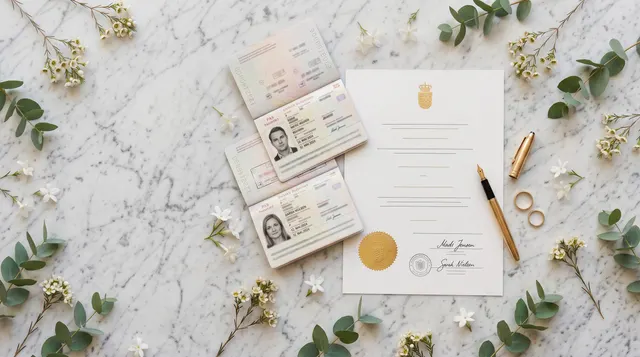
- Your passport proves your name and date of birth: photos of every page, including the blank pages and the front and back covers. EU and EEA citizens can submit their ID card instead (front and back).
- If your name differs between documents, prove the change, for example with an earlier marriage certificate or a name-change certificate.
- If you cannot obtain a document that is asked for, say so on the application form and explain why. Familieretshuset decides case by case.
- Registering the Danish marriage in Germany later (§ 34 PStG) is voluntary. The German registry office may ask for its own documents for that, including birth certificates.
- Our Comfort Package costs €799.00, with the Danish authority fee included.
Do you need a birth certificate to get married in Denmark?
No. Familieretshuset lists these documents for the application: your passport or EU ID card with photos, proof of your right to enter and stay in Denmark, a residence certificate if you live together outside Denmark, birth certificates of any children you have together and, if either of you was married before, proof that the marriage ended by divorce, death or annulment. Your own birth certificates are not on the list.
This even applies to people who live in Denmark. According to the official guidance on marriage cases (VEJ no. 10410, point 1.4), their name and date of birth come from the Danish civil registry (CPR), so they do not have to show birth, name or baptism certificates. For the full document list by situation, see our guide to documents for a Danish wedding.
How do you prove your name and date of birth instead?
With your identity document. If you are not registered in Denmark, your name and date of birth are documented "in another way", for example with a copy of your passport (VEJ, point 1.4). In practice that means:
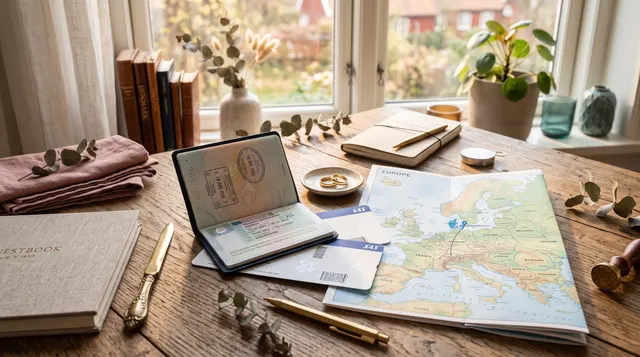
- Passport: colour photos of every page in very good quality, including the front and back covers and every blank page. Missing pages are one of the most common mistakes in applications.
- National ID card: EU and EEA citizens can submit their ID card instead of a passport, with one photo of the front and one of the back.
- Non-EU passport: it must be valid for at least 3 months after the date you expect to leave Denmark, have at least 2 blank pages and have been issued within the past 10 years.
The approval (prøvelsesattest) is valid for 4 months. If your passport, visa or residence permit expires sooner, the approval is shortened to match. Bring the same passport to the ceremony: the municipality receives a copy of your ID with the approval and checks before the ceremony that you are the people the approval was issued for. For entry, visa and lawful-stay rules, see our guide to visa requirements for a Danish wedding.
What if your name differs between documents?
Then you need a document that explains the difference. Under VEJ (point 1.4), a name that differs from the registry or from your certificates must be documented in another way, for example by a marriage certificate, a registered partnership certificate or a name-change certificate.
A typical case: you are divorced and use your birth name again, but the divorce decree still shows your married name. Add the earlier marriage certificate or the name-change certificate. A birth certificate is not required for this.
When does a birth certificate still come up?
There are three situations in which a birth certificate may still be needed.
You have children together
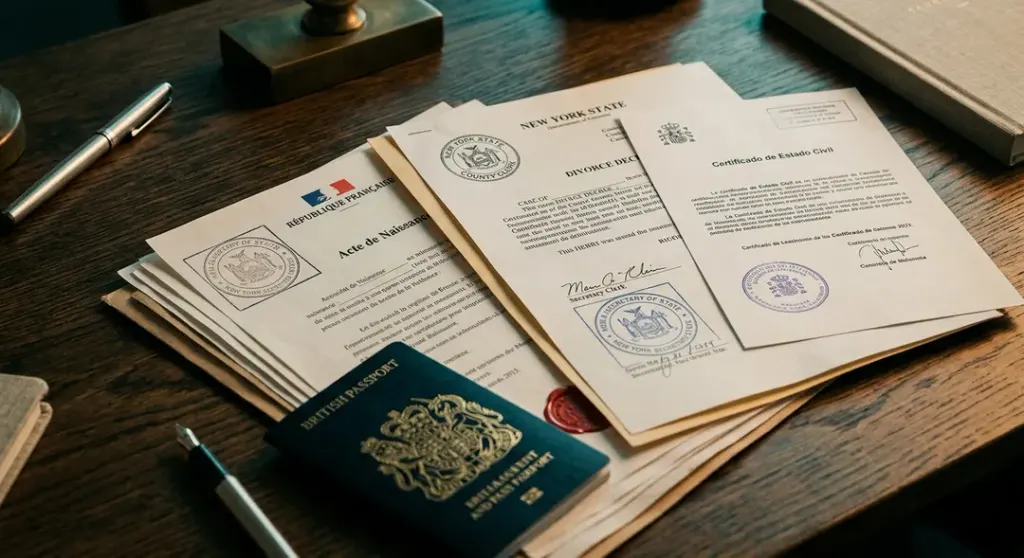
Submit the birth certificate of each child you have together. Familieretshuset needs it in the original language and, if the certificate is not in Danish, English or German, a translation into one of those languages by an authorised translator. Whether it needs an apostille or legalisation depends on the country that issued it; see our overview of apostille and legalisation by issuing country. If one partner is not an EU or EEA citizen, the birth certificates of shared children usually also count as proof of your relationship. Familieretshuset makes that call, so prepare the proof of relationship anyway.
Familieretshuset has doubts
The agency can ask for more in an individual case. Under VEJ (point 1.4) it may ask to see photo ID if it doubts your identity, and ask for the underlying certificates if it doubts the registry details. So a birth certificate is not ruled out; it is just not part of the standard application.
Later in Germany: registering the marriage
Germans who married abroad can apply to have the marriage entered in the German marriage register (§ 34 PStG, "Nachbeurkundung"). This is voluntary: your Danish marriage is valid under Danish law without it; recognition and legal effects abroad depend on the destination country. For this registration the German registry office may ask for its own documents, and these can include birth certificates. Ask your registry office what it needs. More in our guide to recognition of a Danish marriage in Germany.
What if you cannot get any documents from your home country?
That does not automatically rule out a wedding in Denmark. If you cannot enclose a document that is asked for, state this on the application form and explain why (Life in Denmark). Familieretshuset decides case by case.
The official guidance has clear rules for this, mainly for proof of marital status:
- Familieretshuset cannot require refugees or asylum seekers to provide a civil status certificate from the country they fled, and as a rule no other documents from that country either (VEJ, points 2.5.1.2 and 2.5.2.3.1). There are exceptions, for example if the person has travelled back to that country several times after being granted refugee status.
- The same applies where obtaining the certificate is impossible or very burdensome. You must document this, for example with a statement from the authorities or an embassy.
- If no proof at all is possible, you declare that you are unmarried by signing the marriage declaration, under penalty of law (VEJ, point 2.5.1).
One condition stays in place in every case: a partner who is not an EU or EEA citizen must be lawfully in Denmark. Life in Denmark states that procedural residence, for example while an asylum or residence application is pending, is not lawful residence under the Danish Marriage Act; exceptions are possible only in special circumstances.
Why does a German registry office ask for a birth certificate when Denmark does not?
Because the two countries check different things. In Germany, couples must back up their details with public documents when they give notice of marriage (§ 12 PStG). In practice this usually includes a birth certificate or an extract from the birth register.
The same goes for the German certificate of no impediment (Ehefähigkeitszeugnis), which some countries require before a German citizen can marry there. To issue it, the Berlin registry office, for example, asks for a certified extract from the birth register that is no more than 6 months old on the day you apply. Denmark does not require a certificate of no impediment; what Familieretshuset checks instead is explained in our guide to marrying in Denmark without a certificate of no impediment. You also do not need a civil status certificate or a certificate of residence for the application, although Familieretshuset may request them in an individual case (VEJ, point 2.5.1.1).
How DWS helps
- Comfort Package for €799.00: the official 2,100 DKK fee (2026) is included in our package. We check your documents before you pay: whether every passport page is photographed, whether your passport or visa is valid long enough, and whether names differ between documents.
- Missing documents: if you cannot obtain a document, we write the explanation for the application with you. We also take on difficult cases, such as refugees without documents from their home country, and check your documents first.
- Application, date and witnesses: we submit the application to Familieretshuset, book your ceremony date and arrange two witnesses in every Danish municipality.
Familieretshuset generally processes complete applications in about 5 working days; this is a target, not a guarantee. Where it has asked for more information, it is currently working on applications received in October 2026.
The video on this page shows how our process works. See the step-by-step route on how it works, get your personal list with the free wedding checklist and find more answers in the FAQ.
Questions about marrying in Denmark without a birth certificate
Do we need our birth certificates to marry in Denmark?
No. Familieretshuset asks for birth certificates only for children you have together. Your own birth certificates are not part of the application.
How do I prove my name and date of birth then?
With your passport, photographed on every page including the blank pages and the covers. EU and EEA citizens can submit their national ID card instead, with photos of the front and back.
My passport name differs from my divorce papers. What now?
Add the document that shows the name change, for example the earlier marriage certificate or a name-change certificate. That is what the Danish guidance on marriage cases (VEJ, point 1.4) provides for.
I cannot get any documents from my home country. Is a wedding impossible?
Not automatically. State on the application which document is missing and explain why. Familieretshuset cannot, as a rule, require refugees or asylum seekers to provide documents from the country they fled. The agency decides case by case, and lawful stay in Denmark is still required.
Will a German registry office ask for a birth certificate afterwards?
Not for the Danish marriage to be valid. If you choose to register the marriage in Germany under § 34 PStG, the registry office may ask for its own documents, which can include birth certificates. Ask your registry office what it needs.
Sources
- Life in Denmark – If you wish to get married in Denmark – read 2026-11-23
- Familieretshuset – Apply for a Certificate of Marital Status – read 2026-11-23
- Familieretshuset – Documentation requirements – read 2026-11-23
- Familieretshuset – Processing time for certificates of marital status – read 2026-11-23
- Vejledning om behandling af ægteskabssager, VEJ no. 10410 of 19 Dec 2022, points 1.4, 2.5.1 and 2.5.2.3.1 (in Danish) – read 2026-11-23
- § 34 PStG – marriages abroad (in German, gesetze-im-internet.de) – read 2026-11-23
- § 12 PStG – notice of marriage (in German, gesetze-im-internet.de) – read 2026-11-23
- Service Berlin – Ehefähigkeitszeugnis beantragen (in German) – read 2026-11-23
Written by Ludmila Bernowski, co-founder of Denmark Wedding Services; reviewed by Shenol Reetz, co-founder. Denmark Wedding Services is not a law firm; this guide is general information, not legal advice. Last reviewed: 23 November 2026.
Watch Our Video
Follow us on YouTube, Instagram & TikTok for more wedding tips
Ready to Start Your Danish Wedding?
Fill out our free checklist in about 2 minutes — we'll send you a personalized document list and guide you through every step.
Start Free Checklist →