Why Get Married in Denmark? 6 Benefits for Couples
Reviewed by Ludmila Bernowski, CEO & Co-Founder of Denmark Wedding Services. Last reviewed: October 2026. Practical, experience-based information, not legal advice — for legal questions, consult a qualified lawyer. Our Google Business Profile and reviews
Short answer: International couples choose Denmark for minimal paperwork, civil ceremonies in English, German or Danish and a relatively fast process: complete applications are generally processed in about 5 working days (a target, not a guarantee). The marriage is valid under Danish law and in principle recognised in the other EU countries; elsewhere, recognition depends on the destination country.
On this page
- Benefit 1: very few documents
- Benefit 2: fast approval, about 5 working days as a target
- Benefit 3: ceremonies in English, German or Danish
- Benefit 4: no apostille inside the EU and a certificate in five languages
- Benefit 5: do you need to live in Denmark to marry? No
- Benefit 6: three town halls near Germany and in the capital
- How does Denmark compare to other wedding destinations?
- Common myths about marrying in Denmark — debunked
- What couples value about marrying in Denmark
- FAQs About Choosing Denmark
Who this guide is for: International and binational couples weighing Denmark against marrying at home or in other destinations.
Key points
- Very few documents in standard cases — usually passports, proof of legal entry or residence and a current proof of civil status.
- Ceremonies in English, German or Danish; certificate issued in five languages.
- No residency requirement, but you must be able to enter and stay in Denmark lawfully.
- Complete applications: about 5 working days as a general target, not a guarantee.
- Inside the EU: in principle recognised in the other member states (not fully for same-sex marriages), and the certificate needs no apostille (Regulation 2016/1191); elsewhere, recognition depends on your destination country’s laws.
The main benefits of getting married in Denmark are the short document list, the multilingual ceremonies and a relatively fast approval — which is why many international couples marry here rather than at home. The process is quick — but quick does not mean casual. Danish weddings are elegant and legally binding, and the marriage is in principle recognised in the other EU countries (recognition further afield depends on the destination country). This article covers the benefits; the full requirements for marrying in Denmark as a foreigner are in our main guide for international couples.
Benefit 1: very few documents
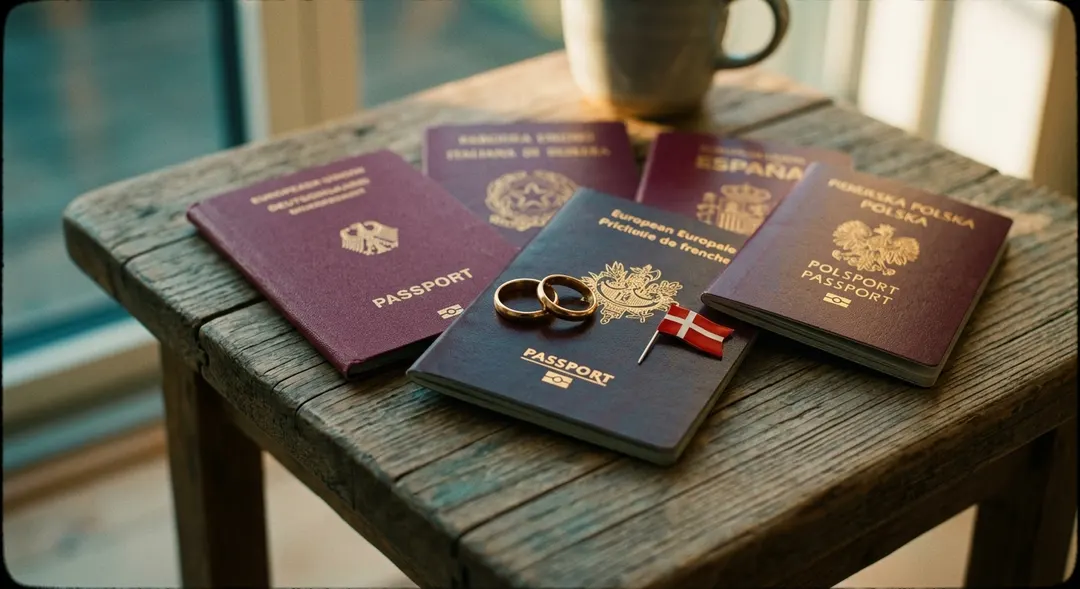
Unlike many European countries, Denmark asks for very few documents: usually valid passports, proof of legal entry or residence and a current proof of civil status (plus a divorce decree or death certificate if you were married before). You typically need no birth certificates and no embassy appointments — the paperwork that makes getting married abroad so difficult in countries like Germany, France or Italy. For the paper-by-paper list, country by country — including whether your documents need an apostille, which depends on the country that issued them — see our Danish wedding documents guide.
Benefit 2: fast approval, about 5 working days as a target
The Danish Agency of Family Law (Familieretshuset) generally processes complete marriage applications with no missing information in about 5 working days; cases needing more information take longer — this is a general target, not a guarantee (Familieretshuset processing time); what the agency checks is explained in our guide to Familieretshuset. After approval, the ceremony date is booked separately and depends on the town hall's free slots: the City of Copenhagen states that the wait can be up to four months (City of Copenhagen — City Hall wedding). The approval (Prøvelsesattest) is valid for up to 4 months; its validity is shortened if a passport expires soon after it is issued (Life in Denmark); the wedding must take place within that period. Compared with the weeks or months that the document checks alone take in many other countries, the process is still short. For couples who need to get married quickly — whether for visa reasons, personal preference, or simply because they don't want to wait — Denmark offers an established and relatively fast process, as long as the ceremony date is planned early. Our full Denmark vs Germany wedding comparison breaks down the timeline difference (about 5 working days vs often several weeks in Germany) across documents, cost, and recognition.

Benefit 3: ceremonies in English, German or Danish
Wedding ceremonies at Danish municipality offices can typically be conducted in English, German, or Danish — the languages on offer depend on the municipality. At Copenhagen City Hall, for example, the ceremony can be held in any of the three (City of Copenhagen — City Hall wedding). No interpreter needed if you speak any of these languages. This suits, for example, British, German-Russian and other international couples.
Benefit 4: no apostille inside the EU and a certificate in five languages
A Danish marriage certificate is valid under Danish law. Once apostilled, it can be authenticated for use in the member states of the Hague Apostille Convention — but authentication is not automatic recognition of every legal effect, and recognition abroad depends on the laws of your destination country. The certificate is issued in five languages (Danish, English, German, French and Spanish), which often removes the need for separate translations.
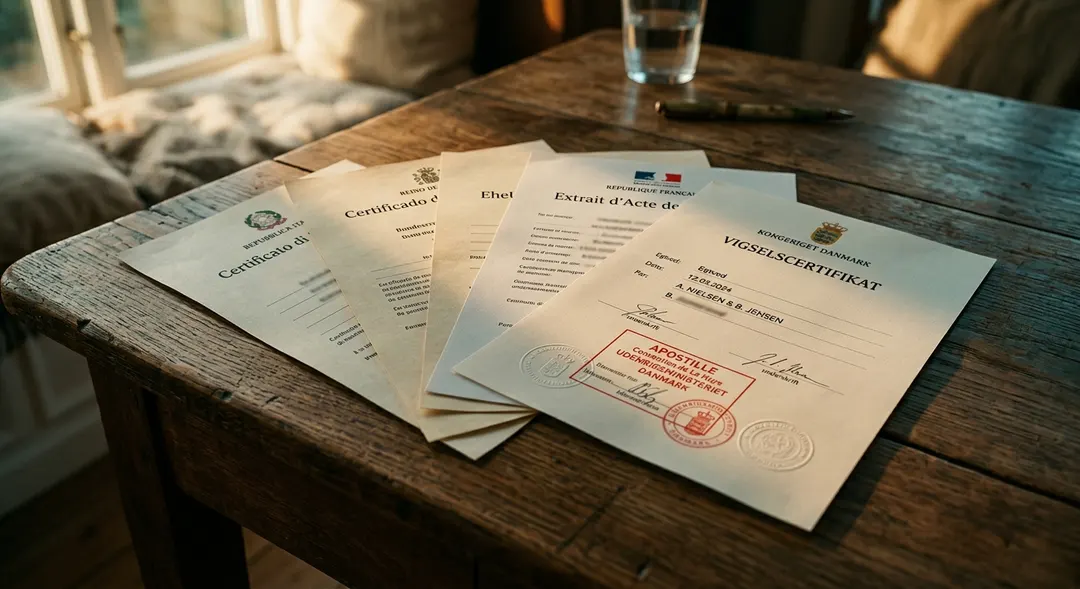
Inside the EU: Regulation 2016/1191
Within the EU, Regulation 2016/1191 lets public documents such as a marriage certificate circulate between member states without an apostille (some authorities still ask for one — check with the receiving authority). Recognition of the marriage itself is a separate question: a marriage concluded in one EU country is in principle recognised in the other EU countries, although this does not fully apply to same-sex marriages (Your Europe — marriage). Source for the apostille rule: Danish Ministry of Foreign Affairs — EU Regulation 2016/1191.
- EU use — Regulation 2016/1191: no apostille needed for civil-status documents between EU states
- Outside the EU — the Danish marriage certificate usually needs an apostille (countries outside the Hague Apostille Convention ask for legalisation instead); DWS offers the apostille as an optional service for €100
Benefit 5: do you need to live in Denmark to marry? No
No. Denmark has no residency requirement and no minimum stay: both partners only need to be at least 18, unmarried, able to enter and stay in Denmark lawfully, and present in person at the ceremony. Who may marry and which papers you need is set out in our guide to the requirements for marrying in Denmark as a foreigner and in our guide to visa and entry requirements for a Danish wedding; same-sex couples follow exactly the same process (same-sex marriage in Denmark), and our free wedding checklist shows the documents for your situation.
Benefit 6: three town halls near Germany and in the capital
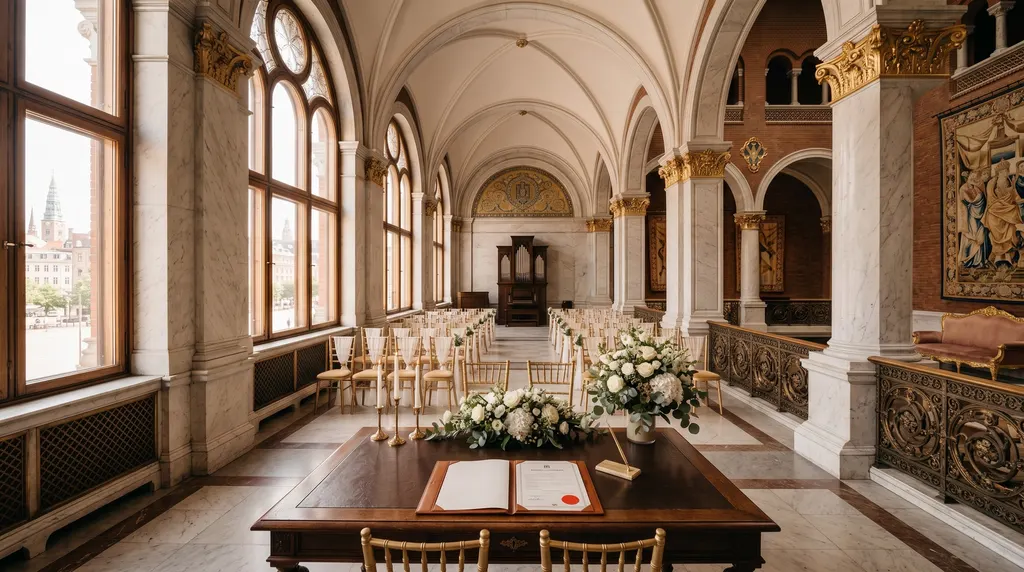
Beyond the practical advantages, Denmark offers beautiful settings for your ceremony. With DWS you marry at one of three town halls: getting married in Copenhagen at the historic City Hall, getting married in Aabenraa about 25 km from the German border, or getting married in Tønder about 5 km from it. Each has its own atmosphere, from the capital's grand hall to small-town calm in southern Denmark.
How does Denmark compare to other wedding destinations?
Couples often weigh Denmark against other simple-marriage countries. The honest comparison:
- Cyprus — Long known as a Mediterranean marriage option. Pros: English-speaking, relatively quick. Cons: couples usually need to be on the island in person before the ceremony to submit their documents, and requirements and lead times vary by municipality. Our Denmark vs Cyprus wedding comparison covers the details.
- Gibraltar — Short lead times are possible. Pros: fast. Cons: Gibraltar is small (limited venues), and couples must usually appear in person at the registry before the ceremony.
- Las Vegas / USA — Non-Americans need US entry permission (visa or ESTA). Marriage certificates are issued at county level (for Las Vegas weddings, by the Clark County Clerk) and usually need an apostille for use in Europe. Travel costs are typically much higher for European couples.
- Italy / France / Spain — Beautiful but bureaucratic. Italy requires foreign partners to present a Nulla Osta, a declaration from their own country's authority that there is no impediment to the marriage (Art. 116 of the Italian Civil Code). France requires a link to the commune — typically at least one month's continuous residence of one partner (or a parent) — and banns published for at least 10 days.
- Germany / UK / Netherlands — Local-resident-friendly but heavy paperwork for international couples. Preparing a German Standesamt wedding with foreign documents can take several weeks.
Denmark sits in the sweet spot: no residency requirement, minimal paperwork, multilingual ceremonies, a certificate that needs no apostille inside the EU, and processing in about 5 working days for complete applications (a target, not a guarantee). The closest competitor is Cyprus, but Denmark wins on multilingual flexibility and proximity to most of the EU.
Common myths about marrying in Denmark — debunked
Five things we hear repeatedly that aren't true:
- Myth: "Denmark only does fast civil weddings, no real ceremony." — False. Copenhagen City Hall ceremonies are conducted in elegant historic rooms. Aabenraa and Tønder have intimate, atmospheric venues. The ceremonies are real, full civil weddings — just without weeks of bureaucratic preparation.
- Myth: "A Danish marriage isn't valid anywhere outside Denmark." — A Danish marriage is valid under Danish law, and once apostilled the certificate can be authenticated for use in the member states of the Hague Apostille Convention. Whether your home country recognises the marriage and the rights it grants depends on that country's own laws; for non-Hague countries (such as the UAE, Qatar or Iran) a separate legalisation step is needed — see our apostille guide for the path in those cases.
- Myth: "You have to live in Denmark for X weeks before you can marry." — False. There is no residency requirement: once your approval and ceremony date are confirmed, you can fly in on the morning of your ceremony.
- Myth: "It must be cheaper because it's lower quality." — The legal weight of a Danish marriage is identical to a German, French, or Italian one. The price difference comes from cutting bureaucracy, not corners. Our transparent cost breakdown shows where the savings come from.
- Myth: "It's just for elopements; you can't have guests or a real wedding." — False. Many couples bring 2–20 family/friends. Restaurants and hotels accommodate full reception celebrations after the ceremony. Some couples even book Refshaleøen venues for full-scale parties post-ceremony.
What couples value about marrying in Denmark
Our founders Ludmila and Shenol married in Denmark themselves in 2018, after German wedding bureaucracy nearly derailed their plans — that experience is why DWS exists (see our story). In conversations with the couples we support, three themes come up again and again:
- It feels like a real wedding, not a formality. Couples who expect a sterile civil office are often moved by the warm town hall staff, the beautiful rooms and how personal the day feels.
- It is faster than they feared. Many international couples have been through long document checks elsewhere, so the Familieretshuset target of about 5 working days for complete applications is often a pleasant surprise.
- The time goes to the marriage, not the paperwork. Instead of months spent collecting documents, couples upload a few papers and spend the weeks before the wedding looking forward to it.
Our step-by-step guide to getting married in Denmark maps every stage. Denmark Wedding Services handles the entire process for you — from document preparation to ceremony booking. Start your journey today.
FAQs About Choosing Denmark
Why is Denmark often cheaper for international couples?
Because several costly steps fall away. Denmark asks for no certificate of no impediment, no birth certificates and no residence period, and documents in Danish, English or German need no translation. Familieretshuset aims to process complete applications in about 5 working days (a target, not a guarantee). In Germany, a foreign partner may need a certificate of no impediment or a court exemption; Italy requires a Nulla Osta plus translations. With DWS the Comfort Package costs €799.00, including the Danish authority fee and two witnesses, plus your travel and accommodation. For two partners with local documents, marrying at home is often cheaper — the savings are largest for international and binational couples.
Do we have to live in Denmark to marry there?
No. Denmark has no residency requirement and no minimum stay before the wedding. Both partners must be at least 18, unmarried, able to enter and stay in Denmark lawfully, and present in person at the ceremony. Once Familieretshuset has approved your application and the date is booked, you can arrive on the wedding day itself.
Is Denmark only for elopement, or can we have a full celebration?
Both are possible. Denmark is well known for elopements (a short ceremony, two legal witnesses provided by DWS with the Comfort Package, often only a day or two in Denmark), but it also suits larger celebrations. Copenhagen has plenty of restaurants and reception venues for 30–100 guests. At Copenhagen City Hall you can bring up to 75 guests (children and photographer included) and the ceremony takes about 10 minutes; in the other town halls the room decides how many guests fit. Many international couples come for the elopement experience; others add a small celebration. The choice depends on your style, not on Danish rules.
Sources
- Your Europe (EU) — marriage and recognition across the EU
- Danish Agency of Family Law — international marriages
- Processing time — Familieretshuset
- Legal residence for marriage in Denmark — Familieretshuset
- Getting married in Denmark — lifeindenmark.borger.dk
- City of Copenhagen — City Hall wedding (ceremony languages, up to 75 guests, about 10 minutes)
- Danish Ministry of Foreign Affairs — EU Regulation 2016/1191
- Clark County Clerk — proof of marriage: certified marriage certificates for weddings in Las Vegas
- Service-Public.fr — where you can marry in France (French): residence of at least one month, banns for 10 days
- Italian Ministry of Justice — marriage of couples of different nationalities (Italian): Nulla Osta under Art. 116 of the Civil Code
Ready to Start Your Danish Wedding?
Fill out our free checklist in about 2 minutes — we'll send you a personalized document list and guide you through every step.
Start Free Checklist →