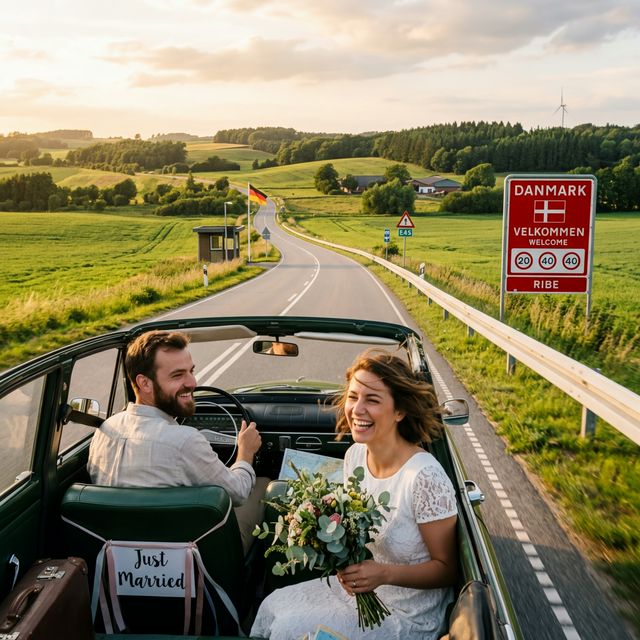
How to Get Married in Denmark: Step-by-Step Guide 2026
Getting married in Denmark as an international couple takes about 7 working days end-to-end: 5 working days for Familieretshuset (the Danish Agency of Family Law) to review the application, plus a short window for travel and ceremony. The seven steps are: (1) confirm eligibility — both partners 18+, legally single, with valid passports and Schengen entry; (2) gather documents (passport + divorce decree if previously married); Denmark does NOT require birth certificates, Ehefähigkeitszeugnis, or embassy appointments; (3) submit the application via Denmark Wedding Services on your behalf; (4) receive the Prøvelsesattest (certificate of no impediment to marriage), valid for 4 months; (5) book a ceremony date in Copenhagen, Aabenraa, or Tønder; (6) travel to Denmark and marry in a 15–20 minute civil ceremony; (7) receive the marriage certificate immediately, issued in five languages and recognised in 100+ countries. The Comfort Package is €800 fixed-price all-inclusive. If timing is your main constraint, see how fast you can legally marry in Denmark — under the right conditions the whole process takes 3–5 days.
Getting married in Denmark is one of the simplest and fastest ways to have a legally binding wedding in Europe. Whether you're a binational couple, an international couple living abroad, or simply looking for a stress-free wedding — this step-by-step guide for 2026 covers everything.
Step 1: Check Your Eligibility
Denmark welcomes all nationalities and has no residency requirement. To get married in Denmark, you need:
- Both partners must be at least 18 years old
- Both partners must be legally single (not currently married)
- Both partners must be able to legally enter Denmark (valid passport + Schengen visa if required)
That's it. No citizenship, residency, or language requirements.
Step 2: Gather Your Documents
The Danish Family Court (Familieretshuset) requires:
- Valid passports for both partners
- Proof of legal entry (Schengen visa, EU residence permit, or visa-free entry stamp)
- Divorce decree (if previously married) — must be final and legally binding
- Death certificate (if widowed)
Important: Denmark does NOT require birth certificates, embassy appointments, or a certificate of capacity to marry (Ehefähigkeitszeugnis). Our complete document checklist for a Danish wedding breaks down every variation — divorce, widowhood, non-EU partners — in detail.
Step 3: Submit Your Application
With Denmark Wedding Services, you don't need to navigate Danish bureaucracy alone. Here's how it works:
- Fill out our online checklist with your personal details
- We review your answers and send you a personalized document list
- You sign the service contract and power of attorney
- We prepare and submit your complete application to Familieretshuset
Step 4: Wait for Approval (5 Working Days)
Familieretshuset processes applications within 5 working days. Once approved, you receive a Prøvelsesattest (certificate of no impediment to marriage). This certificate is valid for 4 months.
Step 5: Book Your Ceremony Date
After approval, you choose your preferred ceremony date and location:
- Copenhagen — Denmark's iconic capital with historic City Hall
- Aabenraa — Calm Southern Denmark, excellent date availability
- Tønder — Near the German border, ideal for driving couples
Ceremonies are conducted in English, German, or Danish.
Step 6: Travel to Denmark and Get Married
On ceremony day:
- Arrive at the municipality with your passports
- Our two legal witnesses will be present (included in Comfort Package)
- The ceremony takes approximately 15–20 minutes
- You receive your marriage certificate immediately — issued in five languages
Step 7: After the Wedding
Your Danish marriage certificate is recognized in over 100 countries. For additional international authentication, our Apostille Service (€100) provides full Hague Convention certification — read our Danish marriage apostille guide for which countries need it and how the process works.
Total Timeline
- Document preparation: 1–2 weeks
- Familieretshuset approval: 5 working days
- Ceremony booking: Flexible dates available
- Total: As fast as 2–3 weeks from start to wedding day
Day-by-Day Timeline — The Final Week Before Your Ceremony
The last seven days of preparation matter more than people think. Here's what we recommend:
- 7 days before — Confirm flight times and hotel booking. Check both passport expiry dates (must be valid for at least 3 months past travel).
- 5 days before — Print three things: your Prøvelsesattest, your hotel confirmation, your return ticket. Even in 2026, Danish town halls occasionally need physical copies.
- 3 days before — Pack your wedding outfit with backup. Copenhagen weather can shift from 22°C and sun to rain in an hour.
- 1 day before — Travel to your ceremony city. Most couples arrive in Aabenraa or Tønder by car the evening before; Copenhagen guests fly in same-day or the night before.
- Ceremony day — Arrive 15 minutes early. The ceremony is 15–20 minutes. You leave with a signed marriage certificate and head to dinner, photos, or the airport.
Common Stumbles by Step — And How to Avoid Them
Across 500+ weddings, the same six issues come up most:
1. Step 2 (documents): renewing a passport mid-process. AFL flags any passport number change between application and ceremony. Don't renew until after the wedding. 2. Step 3 (application): typos in transliterated names. Russian, Chinese, and Arabic names need consistent transliteration across passport, divorce decree, and application. We catch these. 3. Step 4 (approval): Schengen visa expiring 1–2 days after ceremony. Build a 5-day buffer. Visa-free travelers don't need to worry, but visa holders absolutely do. 4. Step 5 (booking): assuming Saturdays are always available. Copenhagen Saturdays book 4–6 weeks ahead during peak season (May–September). Aabenraa and Tønder have weekday flexibility year-round. 5. Step 6 (ceremony day): forgetting witnesses' ID. Our two free witnesses solve this; if you bring your own, they need physical photo ID. 6. Step 7 (post-wedding): not requesting Apostille right away. The Danish Ministry takes 1–3 weeks. Order it the same week as the ceremony — see our Danish marriage apostille guide for the full process.
Express Track — When You Need to Marry Within 7–10 Days
Couples with tight deadlines (visa expiring, work relocation, family event) can compress the timeline to a week:
- Day 1 — Submit checklist + service contract.
- Day 2 — We send personalized document list; you gather and scan documents.
- Day 3–4 — We submit application to Familieretshuset.
- Day 5–7 — AFL approves (express track, fastest 3–5 working days).
- Day 8–10 — You travel to Denmark and marry.
The ceiling is set by AFL's processing speed, not us. Aabenraa and Tønder handle express bookings best because of their flexible scheduling.
The Week of Your Ceremony — A Mental Checklist
- Travel insurance covering Schengen → check.
- Both partners' passports → check, and packed in carry-on.
- Wedding attire → backup outfit for rain.
- Phones charged → for photos and our app.
- Witnesses confirmed (yours or ours) → confirmed.
- Cash or card for taxi from station/airport → 200–400 DKK is sufficient.
- A celebratory plan for after the ceremony → restaurant booking helps if you're staying overnight.
Frequently Asked Questions
Q: Can we do the entire process remotely without visiting Denmark twice? A: Yes. Most of our couples make exactly one trip — for the ceremony itself. Documents are submitted digitally; we manage everything until you fly in for the day.
Q: What happens if Familieretshuset asks for additional documents mid-process? A: Common, not concerning. We respond on your behalf within 24 hours. Adds 3–5 days to the total timeline.
Q: We have very different cultural backgrounds — does that affect approval? A: Only if combined with other red flags (large age gap, no shared language, recent first meeting). Our team coaches you on what AFL looks for. Our Denmark binational couples guide covers this in depth.
Q: Can we change the ceremony date once it's booked? A: Yes — €200 fee for date changes (subject to availability). Most date changes happen because of flight reschedules; plan with a buffer to avoid this.
Q: Do you handle the trip itself — flights, hotels, transport? A: We don't book travel for you, but our free wedding planning app has recommended hotels and transport options near each ceremony location.
For a complete cost picture before you commit, see our transparent 2026 wedding cost breakdown. Many of our couples track every step of this guide on their phone via our free wedding planning app.
Ready to begin? Start your free checklist with Denmark Wedding Services today.
Related guide: How to get married in Denmark fast — complete 7-day timeline
Ready to Start Your Danish Wedding?
Fill out our free checklist in just 10 minutes — we'll send you a personalized document list and guide you through every step.
Helpful Resources
Related Articles
Getting Married in Denmark from Germany: The Easy Way
You live in Germany and want to get married without the Standesamt bureaucracy? Denmark is just across the border — fast, simple, and fully recognized in Germany. Here is your guide.

Getting Married in Denmark as a Binational Couple
EU + non-EU partner? Different nationalities? Different religions? Denmark is the easiest country in Europe for binational and international couples to get legally married — here's everything you need to know.
How Much Does a Wedding in Denmark Cost?
A transparent breakdown of all costs involved in getting married in Denmark in 2026 — from service fees and travel to accommodation and extras. No hidden charges, no surprises.
Step-by-Step Guide to Getting Married in Denmark
What is the step-by-step process to marry in Denmark?
There are 5 sequential steps to marry in Denmark — gather documents (1-2 weeks), submit Familieretshuset application (1 day), wait for Prøvelsesattest approval (5 working days), attend ceremony at chosen town hall (15-20 minutes), and process apostille for international use (3-5 working days). Total realistic timeline: 2-6 weeks end-to-end.
- Step 1: Documents — gather + verify with DWS (1-2 weeks)
- Step 2: Application — submit via Familieretshuset portal (1 day)
- Step 3: Wait for approval — 5 working days for clean cases
- Step 4: Ceremony — at Copenhagen, Aabenraa, or Tønder
- Step 5: Apostille — for non-EU recognition (3-5 days)

Which step typically takes longest?
For most couples, Step 1 (document gathering) takes longest — typically 1-2 weeks for EU couples (no apostille needed) and 2-4 weeks for non-EU couples requiring apostille from home-country authorities. After documents are ready, Steps 2-5 run on fixed timelines (1 day + 5 working days + same-week ceremony + 3-5 days apostille). The variable is purely Step 1.
- Step 1 — variable: 1-4 weeks depending on apostille needs
- Step 2 — fixed: 1 day with DWS support
- Step 3 — fixed: 5 working days at Familieretshuset
- Step 4 — fast: same-week (Aabenraa/Tønder) to 2 weeks (Copenhagen)
- Step 5 — fixed: 3-5 working days at Udenrigsministeriet

FAQs About the Step-by-Step Denmark Process
Can steps 1 and 2 overlap to save time?
Yes — and DWS routinely runs them in parallel. While you are gathering apostilled documents (Step 1), we are filling out the Familieretshuset application form, drafting the marriage notice, and preparing the witness coordination. The moment your final document arrives, we submit the complete application within the same day. This parallelisation typically saves 3-5 days compared to a strictly sequential approach.
What happens if Step 3 reveals a document problem?
Familieretshuset flags the specific issue (typically a clarification request, not a full rejection — 12% of applications get flagged). The 5-day clock pauses while waiting for the additional document, then resumes from where it stopped (does not restart from zero). Typical delay: 3-5 days. DWS responds to flag requests within 24 hours on your behalf, so the back-and-forth is fast. Pre-submission document review (included in Comfort Package) eliminates most flag triggers in advance.