Do You Need to Live in Denmark to Get Married There?
It's the question we get more than any other. Some version of: *"Don't we need to live in Denmark for X weeks to get married there?"* The answer is the same in every email, every WhatsApp, every consultation: no, neither partner needs to live in Denmark, ever, in any form. Not before the ceremony, not on the day, not afterwards. This guide explains what the actual rules look like, where the myth comes from, and the few country-specific entry rules that genuinely matter.
The Short Version
Denmark imposes zero residency requirement for getting married. The legal text governing civil marriage in Denmark (the Ægteskabsloven, Marriage Act, §11a) requires only that:
- Both partners are at least 18 years old.
- Neither is currently married to someone else.
- Both can prove legal entry into Denmark for the wedding day itself.
That third item — "legal entry" — is the only travel-related requirement. It does not mean residency. It means you can fly into Copenhagen the morning of the wedding, present your passport, marry, and fly out that evening. We've handled hundreds of weddings exactly that way.
Why the Myth Persists
The "you need to live there" assumption comes from how marriage works in many other countries:
- Germany — The German Standesamt requires you to be registered at a German address (Anmeldung), and many cases require a 6-week residency period before the wedding.
- France — Marriage in France requires at least 30 days of continuous residence in the commune (municipality) before the ceremony.
- Italy — Similar 4-week residency for civil marriage in many regions.
- United Kingdom — Notice of marriage must be given in person 28 days in advance, at a register office in your district.
- United States (Las Vegas exception aside) — Most states require some form of state-residency documentation for marriage licences.
Denmark is the European outlier. There is no Anmeldung. No 30-day rule. No "give notice in person." Submission happens online, the Family Court reviews, and the ceremony happens whenever a town hall slot is available.
What "Legal Entry" Actually Means
Legal entry to Denmark on your wedding day depends on your nationality. Most couples fall into one of these categories:
- EU citizens — Just bring your national ID card or passport. No paperwork beyond that.
- Schengen-area citizens (non-EU but Schengen, like Switzerland, Norway, Iceland, Liechtenstein) — Same as EU: ID card or passport.
- Visa-free travellers (USA, UK post-Brexit, Canada, Australia, Japan, South Korea, Brazil, Mexico, Argentina, etc.) — Passport with at least 6 months remaining validity. ETIAS authorisation when it launches in 2026 (€7, 3-year validity, online, 10-minute application).
- Schengen visa holders — Standard short-stay Schengen visa (Type C). The visa must be valid on your wedding day.
- EU residence permit holders (non-EU citizens with German Aufenthaltstitel, French titre de séjour, etc.) — Your residence permit acts as proof of legal entry.
- Couples currently in Denmark on student or work visas — Your existing residence permit covers it; nothing extra needed.
For the country-by-country breakdown including the trickier scenarios (asylum-seekers, biometric passport rules for Ukrainians, dual citizenship complications), see our Denmark wedding visa requirements guide.
Common Edge Cases We Handle
A few situations where the residency question gets nuanced — but never to the point of requiring you to live in Denmark:
- One partner already lives in Denmark — No advantage, no disadvantage. The same documents and process apply as for two non-residents. Their Danish CPR (civil-registry number) actually does *not* speed anything up.
- One partner has been refused a Schengen visa in the past — As long as the current visa is valid, the past refusal doesn't block the marriage. We've handled this several times.
- Asylum seekers in Denmark — Yes, you can marry. Legal entry is established by your asylum-application paperwork. The process takes slightly longer (3 weeks instead of 1) due to additional Family Court verification.
- Stateless persons — Legally complex but possible. We refer these cases to a partner immigration lawyer for the entry-status portion; the wedding itself is straightforward once entry is documented.
Why This Matters for Planning
The zero-residency rule is what makes Denmark uniquely flexible for international couples:
- You can plan around your work calendar — fly in Friday, marry Saturday, fly out Sunday.
- You can plan around your home country's commitments — no need to take 6 weeks off work.
- You can plan around a partner's visa cycle — marry on the visa you have rather than waiting for a new one.
- You can plan a destination wedding without becoming a destination resident — Copenhagen, Aabenraa, or Tønder for the day, home in your own bed by the next.
For a sense of how this works in practice over a 24-hour Copenhagen visit, see our best places to visit in Copenhagen day-of itinerary.
A Real Couple Who Married Without Either Partner Being a Danish Resident
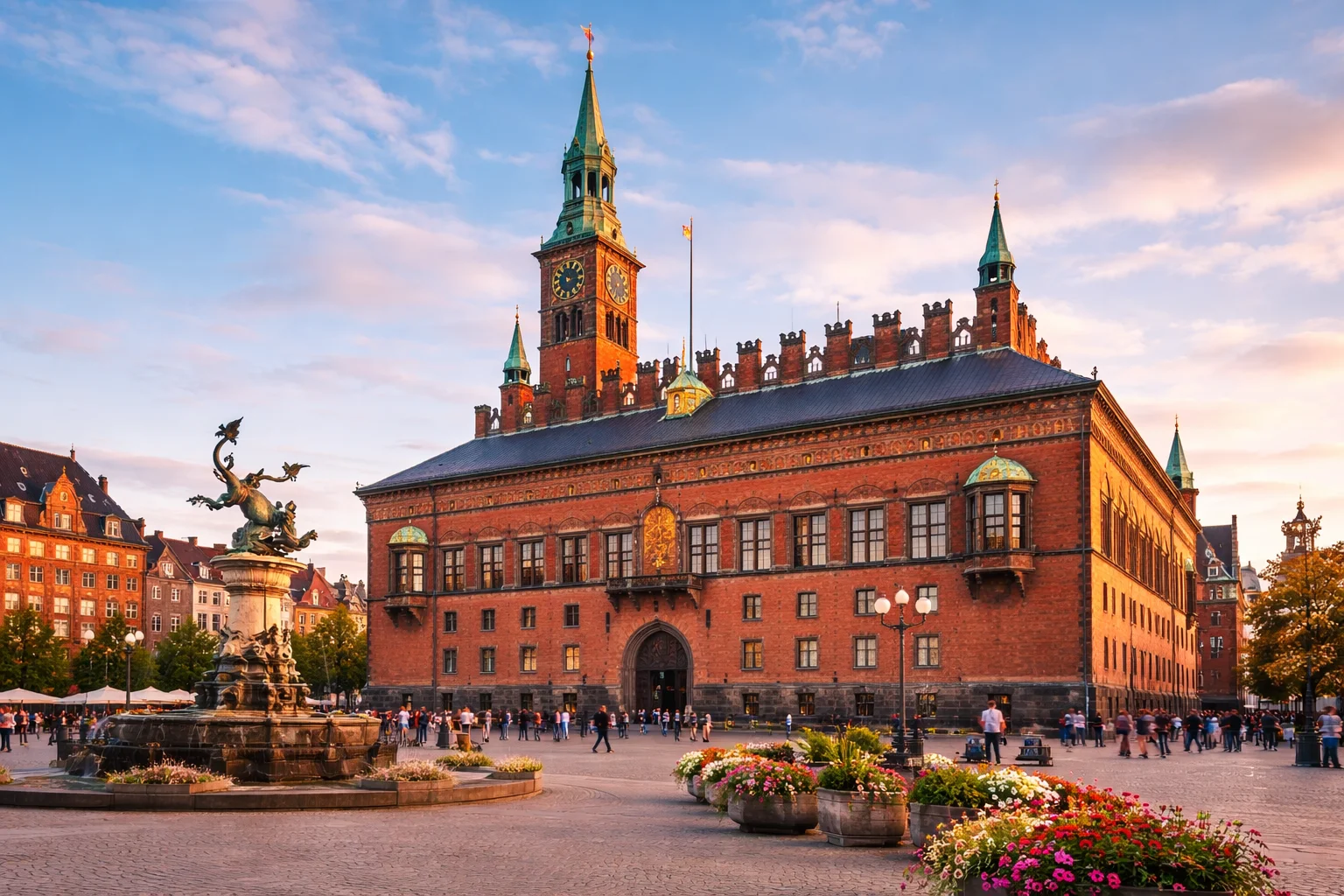
J & O (May 2025) — Brazilian (J) and British (O) couple. J lives in São Paulo, O lives in London. They had not been to Denmark before in their lives. Total Danish presence: J flew in from São Paulo via Munich on Friday morning, O flew in from London on Friday afternoon. Saturday: ceremony at 11:00 in Copenhagen City Hall, lunch at Restaurant Geist, photos around Nyhavn from 14:00–16:30, dinner at Restaurant 108. Sunday: brunch, J flew home via Frankfurt, O flew home via Heathrow. Total time on Danish soil: 51 hours each. Marriage certificate apostilled and couriered to São Paulo (J) and London (O) within 3 weeks.
Neither spent a single night as a Danish resident. Neither needed to.
What's Required Instead of Residency
Since you don't need residency, what do you need? The list is shorter than most couples expect:
- Valid passport (or EU national ID)
- Proof of legal entry (visa or visa-free status)
- Final divorce decree if previously married
- Death certificate of former spouse if widowed
- Power-of-attorney to Denmark Wedding Services (so we can submit on your behalf — this is the only "local representation" Denmark requires)
The full breakdown is in our Danish wedding documents checklist. For the AFL-approval side specifically, our Familieretshuset guide explains how the Danish Family Court handles non-resident applications.
The Honest Caveats
A few situations where the absence-of-residency rule has subtleties:
- Tax residency — Marrying in Denmark does not make you a Danish tax resident. Tax residency is a separate question governed by your country and how many days you spend in Denmark per year.
- Healthcare — A Danish marriage certificate does not entitle you to use the Danish state healthcare system. Continued home-country health insurance is essential.
- Voting rights — Marriage in Denmark does not give Danish voting rights to non-citizens.
- Future immigration — Marrying in Denmark does not by itself give either partner the right to immigrate to Denmark. EU partners have separate freedom-of-movement rules; non-EU partners would need to apply for a residence permit through standard channels.
In other words: the wedding is fully Danish legally, but it doesn't change anything about *where you live*. That's a feature, not a bug — couples who marry in Denmark are choosing it for the simplicity, not for relocation.
The Compared-To-Germany Picture
In Germany, you'd need to:
1. Register at a German address (Anmeldung) — €0 but requires a German tenancy. 2. Wait for Standesamt notice period (typically 4–8 weeks). 3. Provide certified translations of every foreign document. 4. Provide an Ehefähigkeitszeugnis (certificate of marriageability) from your home country, often involving consulate visits.
In Denmark, you skip all four. Our full Denmark vs Germany wedding comparison shows the timeline (5 days vs 4–12 weeks), document count, and cost differences across the two routes.
The single most useful sentence in this entire guide: you do not need to live in Denmark to get married there. Everything else is just paperwork — and our free wedding planning app helps you track that part too.
Ready to Start Your Danish Wedding?
Fill out our free checklist in just 10 minutes — we'll send you a personalized document list and guide you through every step.
Helpful Resources
Related Articles

Visa Requirements for Marrying in Denmark 2026
Can you marry in Denmark on a tourist visa? What if your partner is non-EU? This guide covers every visa scenario for getting married in Denmark in 2026.

Getting Married in Denmark as a Binational Couple
EU + non-EU partner? Different nationalities? Different religions? Denmark is the easiest country in Europe for binational and international couples to get legally married — here's everything you need to know.

How to Get Married in Denmark: Step-by-Step Guide 2026
The definitive step-by-step guide to getting married in Denmark in 2026. From documents and approval to ceremony day — everything you need to know in one place.